

Plantscaping is defined as the professional integration of living plants into indoor and outdoor environments to support mental and physical wellness through stress reduction, improved air quality, and enhanced emotional well-being. Understanding how plantscaping supports wellness goals starts with a clear fact: plants do not just decorate a space. They change how your body and mind respond to it. Research published in 2026 confirms that indoor plants reduce stress, filter air pollutants, and activate the body's natural relaxation response. For office managers, wellness advocates, and health-oriented business owners, this science translates into a measurable return on a relatively simple investment.
How does plantscaping support wellness goals?
Plantscaping supports wellness goals by triggering measurable physiological changes, not just creating a pleasant atmosphere. Indoor plants reduce stress by up to 12% and lower heart rates when placed within a person's primary field of view. That number matters because it means the benefit is passive. You do not have to interact with the plants. Simply seeing them works.
The mechanism behind this is the parasympathetic nervous system. Plantscaping activates this system, which governs the body's "rest and digest" state, helping people decompress rather than stay locked in a stress response. Biophilic design, the practice of embedding natural elements into built environments, formalizes this principle. It draws on decades of research showing that human beings are neurologically wired to respond positively to nature.
"The primary wellness goal of plantscaping is to activate the parasympathetic nervous system, helping individuals decompress rather than directly fixing stress sources. The plants do not remove the stressor. They change how your body holds it."
Mood and cognition also improve with plant exposure. Studies show reduced anxiety, better focus, and faster cognitive restoration in plant-rich environments. These effects compound over time, making plantscaping a long-term wellness strategy rather than a one-time aesthetic upgrade.
Pro Tip: Place plants at seated eye level in workstations and conference rooms. Visibility from your primary resting gaze, not just the room perimeter, is what drives the physiological response.

How do plants improve indoor air quality for wellness?
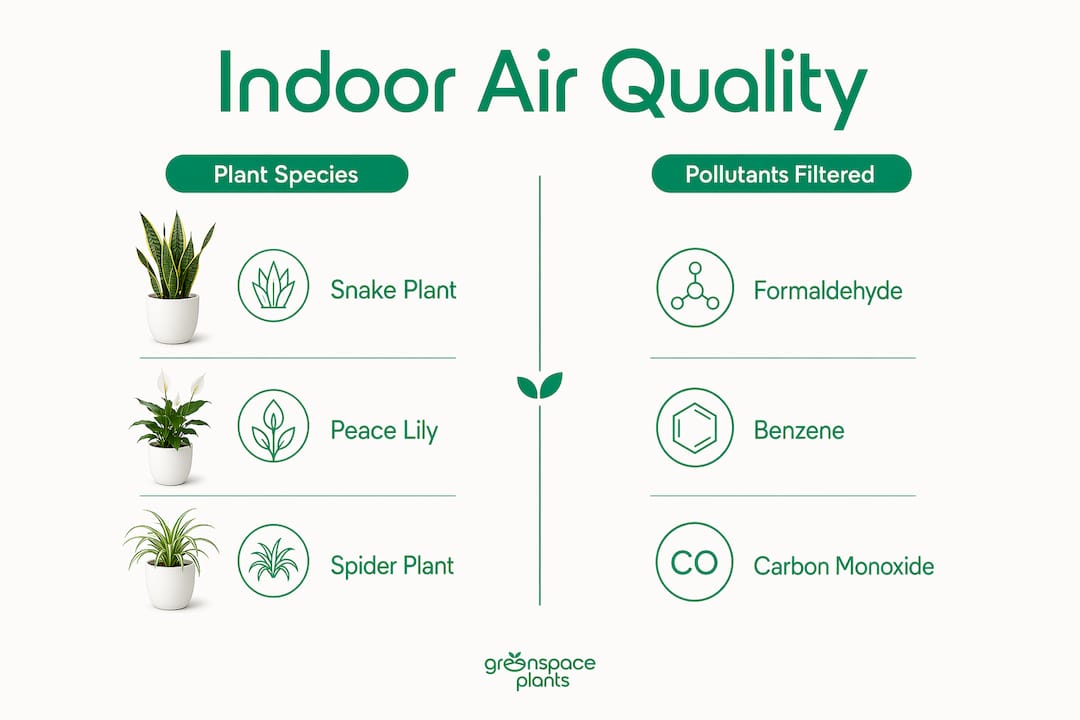
Plants filter indoor air pollutants continuously, and this matters most in sealed commercial buildings where fresh air circulation is limited. Peace lilies and snake plants are among the most studied species for removing formaldehyde, benzene, trichloroethylene, and ammonia from indoor air. These are not rare chemicals. They off-gas from furniture, carpets, cleaning products, and printers in virtually every office.
The biological process is straightforward. Plants absorb toxins through their leaves and root systems, convert carbon dioxide to oxygen, and release moisture that stabilizes indoor humidity. In sealed buildings, this continuous filtration supports cognitive function and reduces the dry-air complaints that are common in heavily air-conditioned spaces.
Here is a quick reference for high-performing air-purifying plants:
| Plant | Key pollutants filtered | Light requirement |
|---|---|---|
| Snake plant (Sansevieria) | Formaldehyde, benzene | Low to bright indirect |
| Peace lily (Spathiphyllum) | Ammonia, benzene, formaldehyde | Low to medium |
| Pothos (Epipremnum aureum) | Formaldehyde, xylene | Low to medium |
| Spider plant (Chlorophytum) | Carbon monoxide, formaldehyde | Bright indirect |
The subjective experience of cleaner air also matters. Workers in plant-rich offices consistently report that air feels fresher, even when mechanical ventilation stays constant. That perception reduces fatigue and supports the kind of sustained focus that wellness-oriented organizations want to cultivate.
Key air quality benefits of plantscaping include:
- Reduction of volatile organic compounds (VOCs) from office furniture and equipment
- Stabilized indoor humidity, which reduces dry eyes and respiratory irritation
- Increased oxygen levels, supporting alertness during long work sessions
- Improved subjective air freshness, which correlates with lower reported fatigue
What design choices maximize plantscaping's wellness impact?
Plant placement and design structure determine whether a plantscape calms or overwhelms. Careful plant placement within the primary field of view, and avoiding cluttered greenery, maximizes restorative impact by reducing cognitive load. More plants do not automatically mean more benefit.
Medium levels of species richness produce stronger stress recovery effects than overly dense plantings. A curated selection of three to five species in a well-organized layout outperforms a crowded mix of a dozen varieties. Think of it like a well-edited room: restraint creates calm, excess creates noise.
Green wall design follows the same logic. Curvilinear green wall morphology reduces fatigue more effectively than linear layouts. Walls with organic, flowing shapes engage the eye without demanding active attention, which is exactly the restorative effect you want in a break room or reception area. Linear, grid-style walls can feel more formal and are better suited to structured workspaces.
Pro Tip: For offices, prioritize plant placement near conference rooms, break areas, and reception zones. These are the spaces where people transition mentally, and plants there deliver the greatest psychological benefit.
Real living plants outperform artificial plants in physiological stress reduction, including measurable heart rate lowering. Artificial plants offer no air filtration and no parasympathetic activation. They are a visual shortcut with none of the biological payoff.
Upkeep is not optional. Neglected plants with dusty leaves and dying foliage cause visual fatigue and actively undermine wellness benefits. A wilting plant in a reception area sends the wrong signal and reverses the calming effect you invested in. Professional maintenance is the difference between a plantscape that heals and one that stresses.
How can you practically integrate plantscaping for wellness?
Integrating plants into your environment for wellness does not require a full redesign. It requires a deliberate plan. Here is a structured approach that works for offices, wellness centers, and commercial spaces of any size.
- Audit your space first. Identify the rooms where people spend the most time and where stress is highest. Conference rooms, open-plan desks, and waiting areas are the highest-priority zones.
- Match plants to your light conditions. Snake plants and pothos thrive in low light. Peace lilies handle medium light well. Choosing the wrong species for your light conditions leads to plant decline, which defeats the purpose.
- Start with a curated selection. Three to five species in well-chosen planters create more impact than a large, random collection. Use indoor plant selection guidance to match species to your specific environment.
- Establish a maintenance routine. Weekly checks for soil moisture, dust on leaves, and early signs of pests keep plants healthy and visually appealing. Healthy plants are the only plants that deliver wellness benefits.
- Consider structured programs for deeper impact. Horticultural therapy programs with weekly 90-minute plant-related sessions show measurable improvements in psychological recovery markers over 10 weeks. For wellness centers or employee wellness programs, this structured approach produces documented results.
For organizations that want results without managing the details, professional plantscaping services handle design, installation, and ongoing care. Greenspace Plants, for example, offers its Greenspace+ program across Toronto, Vancouver, and Calgary. Clients receive plant design, installation, regular maintenance, and replacements for a fixed monthly fee, with no upfront costs.
Wellness advocates working in personal spaces can apply the same principles at a smaller scale. A snake plant on a desk, a peace lily near a reading chair, and a pothos in a bathroom create a layered, multi-room effect that builds the parasympathetic response throughout the day.
Emerging research also points to smart biophilic environments that integrate plants with smart lighting and irrigation systems tuned to occupants' circadian rhythms. These systems are becoming more accessible for commercial spaces and represent the next step in evidence-based wellness design.
Key Takeaways
Plantscaping supports wellness goals by combining physiological stress reduction, air quality improvement, and restorative design into a single, evidence-backed environmental strategy.
| Point | Details |
|---|---|
| Stress reduction is passive | Plants lower stress by up to 12% simply by being visible, requiring no active engagement from people. |
| Air filtration is ongoing | Species like snake plants and peace lilies continuously remove VOCs, supporting cognitive function and comfort. |
| Design restraint matters | Medium species richness and curvilinear layouts outperform dense or grid-style plantscapes for restorative effect. |
| Real plants are non-negotiable | Living plants outperform artificial ones in every physiological measure, including heart rate reduction. |
| Upkeep drives results | Neglected plants cause visual fatigue and reverse wellness benefits, making professional maintenance a core part of any plantscaping strategy. |
Why I think most organizations are still getting plantscaping wrong
After working with commercial spaces across Canada, the pattern I see most often is this: organizations buy plants, place them wherever there is floor space, and then wonder why the effect feels flat. The problem is almost never the plants. It is the placement and the follow-through.
A dying ficus in a corner does not calm anyone. It signals neglect. And neglect, even in a plant, registers subconsciously as a stressor. The organizations that get the most out of their plantscapes treat them like any other wellness infrastructure. They maintain them, they position them deliberately, and they revisit the design as the space evolves.
The other misconception I encounter is that more plants equal more benefit. The research says otherwise. A curated, well-maintained selection of five species in the right locations outperforms a crowded greenhouse aesthetic every time. Restraint is a design skill, and it is the one most often skipped.
The most exciting development I am watching is the integration of living plant systems with smart building technology. Lighting tuned to circadian rhythms, irrigation systems that respond to plant health data, and air quality sensors that inform plant placement. These are not distant concepts. They are being deployed in forward-thinking commercial spaces right now. Organizations that invest in this direction will have a measurable wellness advantage over those that treat plants as decoration.
— Nicole
Greenspace Plants brings professional plantscaping to your space
If you are ready to move from the idea of a greener workspace to the reality of one, Greenspace Plants makes that transition straightforward. We design, install, and maintain interior plant services for commercial spaces across Toronto, Vancouver, and Calgary. Our Greenspace+ program covers everything under a fixed monthly fee, including plant replacements, so your plantscape stays healthy and effective without adding to your team's workload.
Healthy plants require consistent, expert care to deliver the wellness benefits this article describes. Our plant clinicians visit regularly, handle every maintenance task, and replace any plant that is not thriving. You get the results. We handle the details. Browse our plant design portfolio to see what a professionally maintained plantscape looks like in real commercial environments, then reach out to start a conversation about your space.
FAQ
What is plantscaping and how does it support wellness?
Plantscaping is the professional integration of living plants into indoor environments to improve mental and physical well-being. It supports wellness by reducing stress hormones, filtering air pollutants, and activating the parasympathetic nervous system.
Which plants are most effective for indoor air quality?
Snake plants, peace lilies, pothos, and spider plants are among the most studied species for removing formaldehyde, benzene, and ammonia from indoor air. All four perform well in typical office light conditions.
How many plants does an office need to see wellness benefits?
A curated selection of three to five species placed within primary sight lines delivers stronger restorative effects than a large, dense collection. Medium species richness outperforms quantity in stress recovery research.
Do artificial plants provide the same wellness benefits as real ones?
Real living plants outperform artificial plants in every physiological measure, including heart rate reduction and air filtration. Artificial plants offer no biological benefit and should not be used as a substitute in wellness-focused environments.
How often do plantscaped environments need professional maintenance?
Weekly maintenance checks are the standard for commercial plantscapes. Neglected plants with dusty leaves or dying foliage cause visual fatigue and actively undermine the wellness benefits that healthy plants provide.