
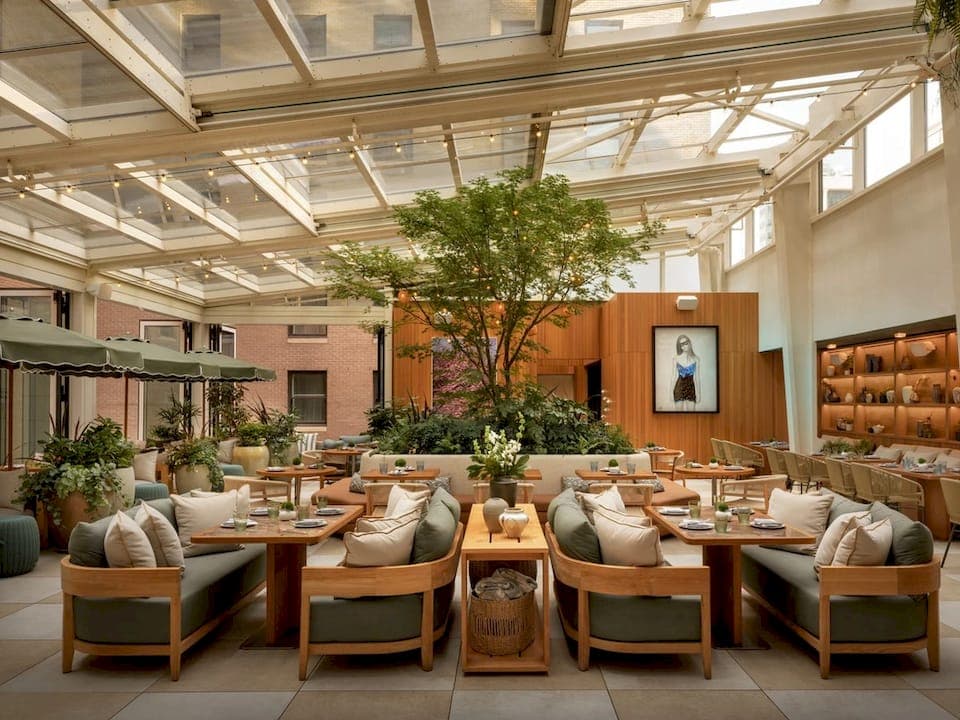

Indoor plant care in a restaurant setting is the practice of selecting, maintaining, and managing indoor greenery specifically adapted to dynamic hospitality environments to enhance ambiance, improve air quality, and elevate the customer experience. Restaurants face conditions that most plants were never designed for: kitchen heat, chemical cleaning agents, inconsistent lighting, and heavy foot traffic. These stressors make generic plant care advice nearly useless. What works in a home or office fails quickly behind a host stand or near a prep kitchen. This guide covers the plant species, maintenance routines, and professional service models that actually hold up in real dining environments, drawing on 2026 industry best practices and Greenspaceplants' experience across commercial spaces in Toronto, Vancouver, and Calgary.
What does indoor plant care in a restaurant setting actually involve?
Indoor plant care in a restaurant setting is more than watering on a schedule. It is a structured system of plant selection, placement, inspection, and ongoing stewardship designed around the specific pressures of a hospitality environment. Restaurants create micro-climates that shift throughout the day: morning prep generates heat and steam, evening service brings crowds and noise, and overnight cleaning introduces chemical exposure. Plants placed without accounting for these variables decline fast.
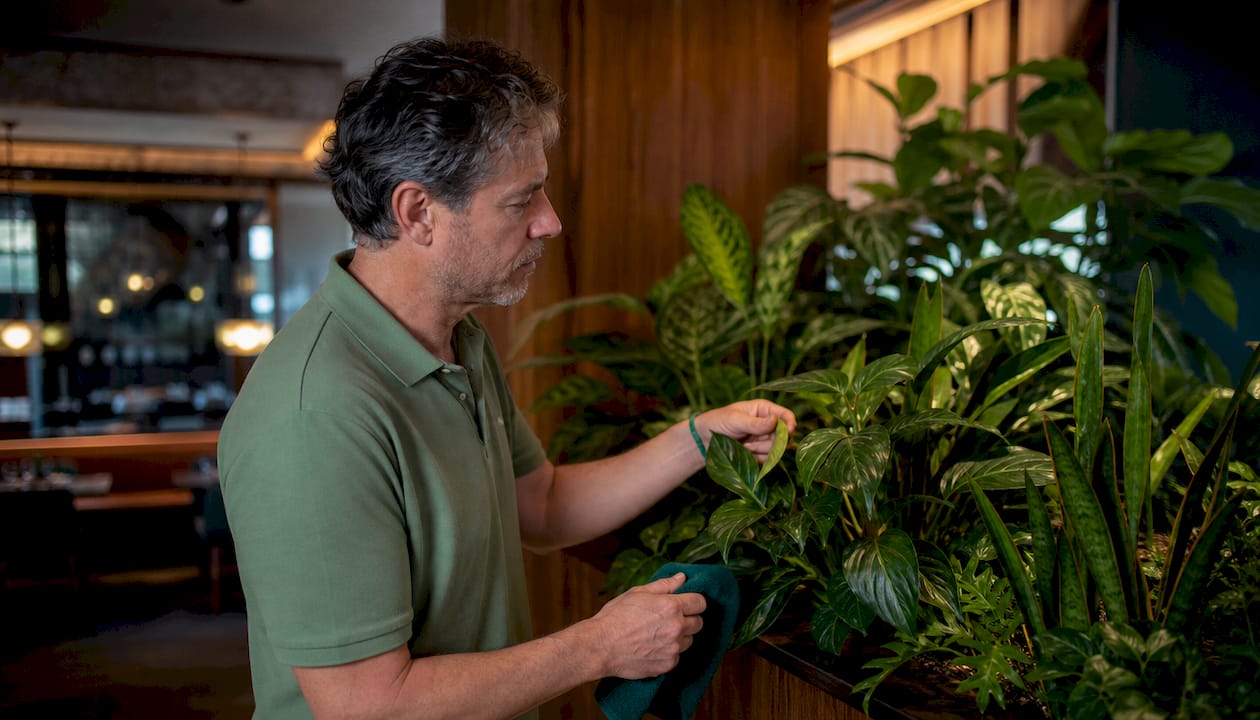
The industry term for this practice is interior plantscaping, which refers to the professional design and maintenance of plants within built commercial environments. Plantscaping in restaurants carries additional complexity compared to offices or retail spaces because the environment is less stable and the aesthetic stakes are higher. A wilting plant near the entrance sends a message to guests before they even sit down.
The core goals of restaurant plant care are threefold: maintain plant health, preserve visual appeal, and support the dining experience. Indoor plants improve ambiance, air quality, and reduce fatigue by increasing humidity and acting as acoustic buffers in busy spaces. That last point surprises most restaurant owners. Live plants genuinely soften sound in a crowded dining room, which directly affects how comfortable guests feel during their meal.
Which indoor plants thrive best in restaurant environments?
The best plants for restaurants share three traits: tolerance to irregular watering, adaptability to artificial or low light, and non-toxicity to humans. Not every beautiful plant qualifies. Selecting the wrong species means repeated replacements, which costs more than getting the selection right from the start.
These species consistently perform well in restaurant conditions:
- Snake plant (Sansevieria trifasciata): Tolerates 50–1,000 foot-candles of artificial light and only needs watering every 3–6 weeks. It handles drafts and temperature swings without complaint.
- ZZ plant (Zamioculcas zamiifolia): Survives up to 8–12 weeks without water, making it ideal for high-volume operations where watering schedules slip during busy service weeks.
- Spider plant (Chlorophytum comosum): A non-toxic species that filters airborne pollutants and thrives under fluorescent lighting. Its trailing form works well in elevated planters near host stands.
- Parlor palm (Chamaedorea elegans): A non-toxic, low-light palm that adds visual height without requiring direct sunlight. It tolerates the humidity near kitchen pass-throughs better than most palms.
- Pothos (Epipremnum aureum): Extremely forgiving, fast-growing, and effective in hanging or trailing arrangements. Note that pothos is mildly toxic if ingested, so placement away from food surfaces is required.
Placement matters as much as species selection. Plants near kitchen openings face heat and grease exposure. Non-toxic varieties are the industry standard in food service environments, specifically because accidental contact with plant debris or dropped garnishes happens regularly in busy dining rooms. Prioritize non-toxic species regardless of where you plan to place them.
Pro Tip: Favor species with waxy or thick leaves near kitchen areas. They resist grease buildup and are easier to wipe clean during routine maintenance.
What are the essential steps in restaurant plant maintenance?
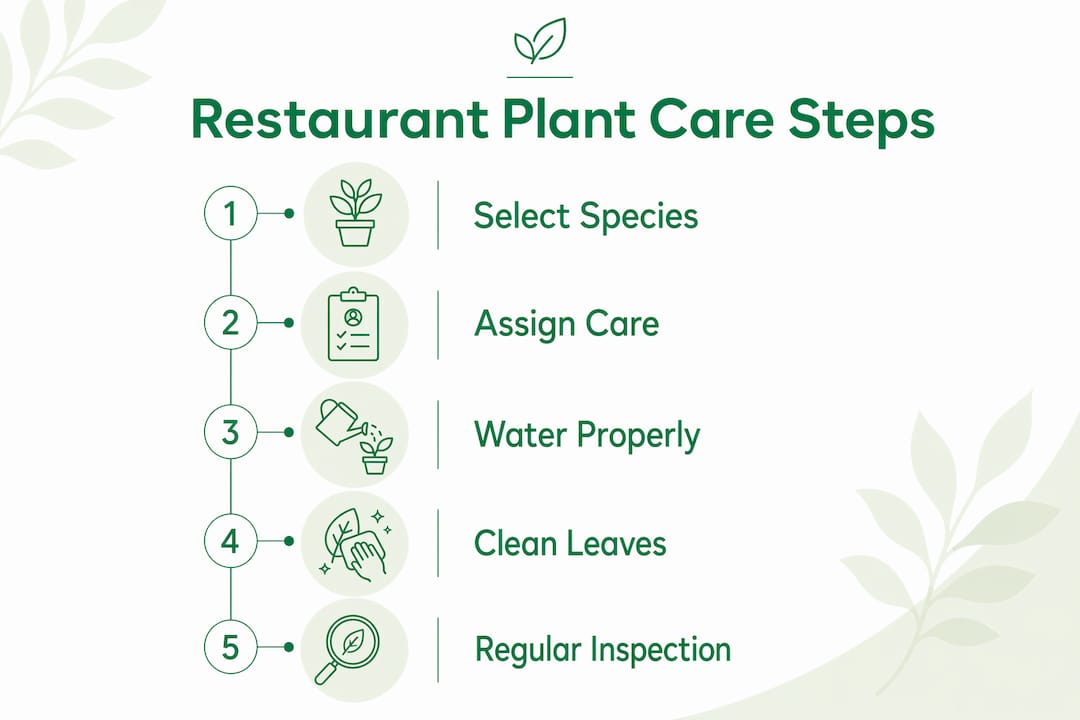
A reliable maintenance routine prevents the slow decline that makes restaurant plants look neglected. The key is building care into existing operational rhythms rather than treating it as a separate task. A practical maintenance workflow includes daily inspections, weekly moisture checks, and monthly fertilization during the active growth season.
Here is the step-by-step routine we recommend for restaurant environments:
-
Daily 5-minute visual inspection. Scan each plant for yellowing leaves, wilting, pest activity, or soil that has pulled away from the pot edge. Daily pest inspections are critical in hospitality settings because spider mites and fungus gnats spread rapidly in the humidity near kitchen areas. Catching an infestation on day one costs nothing. Catching it on day fourteen costs you the plant.
-
Weekly soil moisture check. Use a soil moisture meter rather than guessing by touch. Insert the probe to mid-root depth and water only when the reading drops into the dry zone for that species. Weekly care for a collection of 10–20 plants typically takes 1–2 hours. That is a manageable task for a designated staff member or a visiting technician.
-
Leaf cleaning every two weeks. Dust accumulates on broad leaves and blocks photosynthesis. Wipe leaves with a damp cloth or use a gentle foliar spray. Clean leaves also look better under restaurant lighting, which is the whole point.
-
Monthly fertilization from march through september. The active growth season in the Northern Hemisphere runs march through september. Apply a balanced liquid fertilizer at half the recommended dose during this window. Skip fertilization in winter months when plants are resting, since overfeeding dormant plants causes root burn.
-
Quarterly pruning and rotation. Remove dead or yellowing foliage with clean, sterilized pruning shears. Rotating pots by one-quarter turn each quarter corrects phototropic lean and keeps plants growing evenly. A lopsided plant in a dining room looks like a plant that nobody cares about.
Pro Tip: Assign plant care to one staff member per shift rather than leaving it to "whoever has time." Shared responsibility usually means no responsibility.
How do professional plant maintenance services support restaurant plant care?
Professional plant maintenance services handle the full cycle of care so your team does not have to. For most restaurant operators, this is the most practical path to consistently healthy indoor greenery for dining spaces. Restaurant staff are trained to serve guests, not to diagnose chlorosis or manage Integrated Pest Management protocols.
The professional service workflow typically follows this structure:
- Site assessment. A technician walks the space to evaluate light levels, HVAC placement, traffic patterns, and kitchen proximity. This determines which species will thrive where, and which locations need artificial alternatives.
- Design and installation. Professional installations are scheduled during early morning or late-night windows to avoid disrupting service. Planters, soil, and plants arrive ready to place.
- Ongoing maintenance visits. Technicians act as plant clinicians, performing the full inspection and care routine on a scheduled basis. They bring the right tools, including soil meters, pruning equipment, and pest management products.
- Guaranteed plant replacement. Reputable service contracts include guaranteed replacement of any plant that declines beyond recovery. This removes the financial risk of plant loss from your operating budget.
Early detection of plant issues like yellowing leaves or dry soil during regular maintenance visits prevents costly replacements and keeps restaurants looking guest-ready year-round. That is the core value of professional care: proactive stewardship rather than reactive replacement.
Pro Tip: Ask any prospective plant service provider whether their contract includes plant replacement at no additional charge. If it does not, the real cost of the service is higher than the quoted price.
How do plants function as design elements in a restaurant?
Plants serve functional roles in restaurant design that go well beyond decoration. Used deliberately, they shape how guests feel, how loud the room sounds, and how the space flows from entrance to table.
Here are four ways to integrate indoor greenery as a functional design element:
-
Create a psychological transition at the entrance. Plants positioned near entryways or host stands signal a shift from the street into a curated environment. This transition lowers guest stress before they are seated. A tall Parlor palm or a cluster of Snake plants near the door achieves this without blocking sightlines.
-
Use plants as acoustic buffers. Live plants absorb and scatter sound waves, reducing the hard echo that makes busy dining rooms feel chaotic. Position large-leafed plants or plant walls along hard surfaces like exposed brick or glass partitions for the most noticeable effect.
-
Place plants for passive air filtration. High-traffic areas accumulate more airborne particulates. Positioning air-purifying species like Spider plants or Snake plants near the host stand or bar area puts their filtration capacity where it matters most.
-
Use high-quality artificial plants in harsh micro-climates. Kitchen heat, drafts, and cleaning chemicals cause typical plants to struggle in certain restaurant locations. In those spots, a well-chosen artificial plant is a more honest choice than a live plant that will decline within weeks. The goal is a vibrant-looking space, not a commitment to live plants at all costs.
One safety note: never place any plant, live or artificial, directly over food preparation surfaces. Even non-toxic species shed debris, and no plant belongs in a position where it can contaminate food.
Key Takeaways
Effective restaurant plant care requires species selection, structured routines, and professional support working together to maintain a consistently vibrant dining environment.
| Point | Details |
|---|---|
| Select the right species | Snake plants, ZZ plants, Spider plants, and Parlor palms tolerate restaurant conditions best. |
| Prioritize non-toxic varieties | Non-toxic species are the industry standard in food service to protect guests and staff. |
| Follow a structured routine | Daily inspections, weekly moisture checks, and monthly fertilization prevent most plant loss. |
| Rotate plants quarterly | A one-quarter turn each quarter corrects uneven growth and maintains visual appeal. |
| Consider professional services | Contracted plant care removes operational burden and includes guaranteed plant replacement. |
Why I think most restaurants get plant care backwards
Most restaurant owners I speak with treat plants as decor they buy once and maintain occasionally. That mindset produces the sad, yellowing ficus in the corner that guests politely ignore. The restaurants with genuinely impressive indoor greenery treat plant care the way they treat their kitchen equipment: as something that requires a schedule, a responsible person, and a budget.
The restaurant environment is genuinely harder on plants than any office or home. The temperature swings from a cold open to a full dinner service, the cleaning chemicals used overnight, the grease that settles on leaves near the pass. These are real stressors that most plant care guides written for homeowners never address. Selecting a species that looks beautiful in a garden center but cannot handle a commercial kitchen's ambient heat is a predictable failure.
My honest recommendation is to outsource plant care before you think you need to. The cost of a professional maintenance contract is almost always lower than the cumulative cost of replacing plants that declined because nobody had time to water them during a busy Saturday service. Greenspaceplants' Greenspace+ model, which covers design, installation, maintenance, and replacement for a fixed monthly fee, is exactly the kind of structure that removes this problem from your plate entirely.
The other thing I would push back on: do not feel obligated to use live plants everywhere. A well-placed, high-quality artificial plant in a spot with zero natural light and chemical exposure is a better choice than a struggling live plant. Guests notice when plants look unhealthy. They rarely notice that a plant in a dark corner is artificial.
— Nicole
Greenspaceplants' plant services for restaurants
Running a restaurant means your attention is on your guests, your team, and your kitchen. Plant care should not compete for that attention.
Greenspaceplants offers indoor plant rental programs and full-service maintenance across Toronto, Vancouver, and Calgary, with installations scheduled outside operating hours so your service never skips a beat. The Greenspace+ program covers design, installation, ongoing care, and plant replacement under one fixed monthly fee, with no upfront costs and no long-term commitment required. If a plant declines, we replace it. You can also browse real installation examples to see how other hospitality spaces have used indoor greenery to build a stronger dining atmosphere. Reach out to Greenspaceplants to request a site consultation and get a design proposal built around your specific space.
FAQ
What are the best plants for a restaurant setting?
Snake plants, ZZ plants, Spider plants, and Parlor palms are the top choices for restaurants. They tolerate artificial light, irregular watering, and the temperature swings common in hospitality environments.
How often should restaurant plants be watered?
Watering frequency depends on the species. Snake plants need water every 3–6 weeks, while ZZ plants can go 8–12 weeks without water. Always use a soil moisture meter rather than a fixed schedule to avoid overwatering.
What is the difference between indoor plant rental and buying plants outright?
Indoor plant rental services for restaurants include design, installation, maintenance, and plant replacement under one recurring fee. Buying plants outright means your team absorbs all care and replacement costs, which adds up quickly in a demanding restaurant environment.
How do professional plant services handle pest control in restaurants?
Professional technicians use Integrated Pest Management protocols, which prioritize early detection and targeted treatment over broad chemical application. Daily visual inspections catch pest activity like spider mites or fungus gnats before infestations spread.
Can plants actually improve acoustics in a dining room?
Yes. Live plants absorb and scatter sound waves, which reduces echo in hard-surfaced dining rooms. Positioning large-leafed plants or plant walls along glass or brick surfaces produces the most noticeable acoustic improvement.