
Preserved moss walls in Canada typically run $100–$175 per square foot installed, according to buyer-facing pricing research, though the range widens considerably once you factor in design complexity, site conditions, and whether you're buying a framed art piece or a full commercial feature wall. Here's a quick orientation before we get into the details:
- Small framed pieces (under 10 sq ft): Retail and supply-only pricing often starts around $100/sq ft, with ready-to-hang pieces like a 48×28 preserved moss art panel listed at CA$453.02 on the Canadian market.
- Mid-size feature panels (8–50 sq ft): Expect $100–$130/sq ft supply-only, or $110–$150/sq ft for a professionally installed panel. A Calgary-based installer lists a starting price of approximately $110/sq ft plus tax.
- Full commercial walls (100–300+ sq ft): Installed costs typically land in the $125–$175/sq ft range, with high-end custom work (logos, 3D relief, specialty moss mixes) pushing higher.
The single most useful next step: request an on-site quote from a commercial provider like Greenspace Plants, who can measure your space, assess site conditions, and give you a line-item breakdown rather than a ballpark.
Key Takeaways
Preserved moss walls in Canada typically cost $100–$175 per square foot installed, with design complexity, moss type, and site conditions being the primary factors that move the price within that range.
| Point | Details |
|---|---|
| Installed price range | Most Canadian commercial projects land between $100–$175/sq ft installed, depending on design and site. |
| Biggest cost drivers | Moss type (bun vs. woodland), 3D relief design, logo work, and site complexity move the price most. |
| Maintenance reality | Preserved moss needs only periodic dusting and humidity monitoring, with no irrigation or horticultural visits required. |
| Lifespan expectation | In typical commercial interiors, preserved moss lasts 8–12 years before visible degradation. |
| Greenspace Plants | Serves Toronto, Vancouver, and Calgary with on-site quotes, professional installation, and optional Greenspace+ ongoing care. |
Table of Contents
- How is moss wall cost actually calculated?
- What does a typical commercial installation quote include?
- Why does moss wall pricing swing so much?
- What does the installation process look like, and how long does it take?
- How long does preserved moss last, and what maintenance does it need?
- When does DIY make sense, and when should you hire a professional?
- Sample Canadian quotes: what three real scenarios look like
- How Greenspace Plants approaches preserved moss wall projects
- Why most businesses choose preserved moss over living walls
- Greenspace Plants can quote your moss wall project
- Sources
How is moss wall cost actually calculated?
Suppliers price preserved moss walls two ways: per square foot for larger installations and per piece for framed art panels. Understanding which model a vendor uses is the first thing to clarify when comparing bids, because a per-piece price can look cheaper until you calculate the implied square-foot rate.
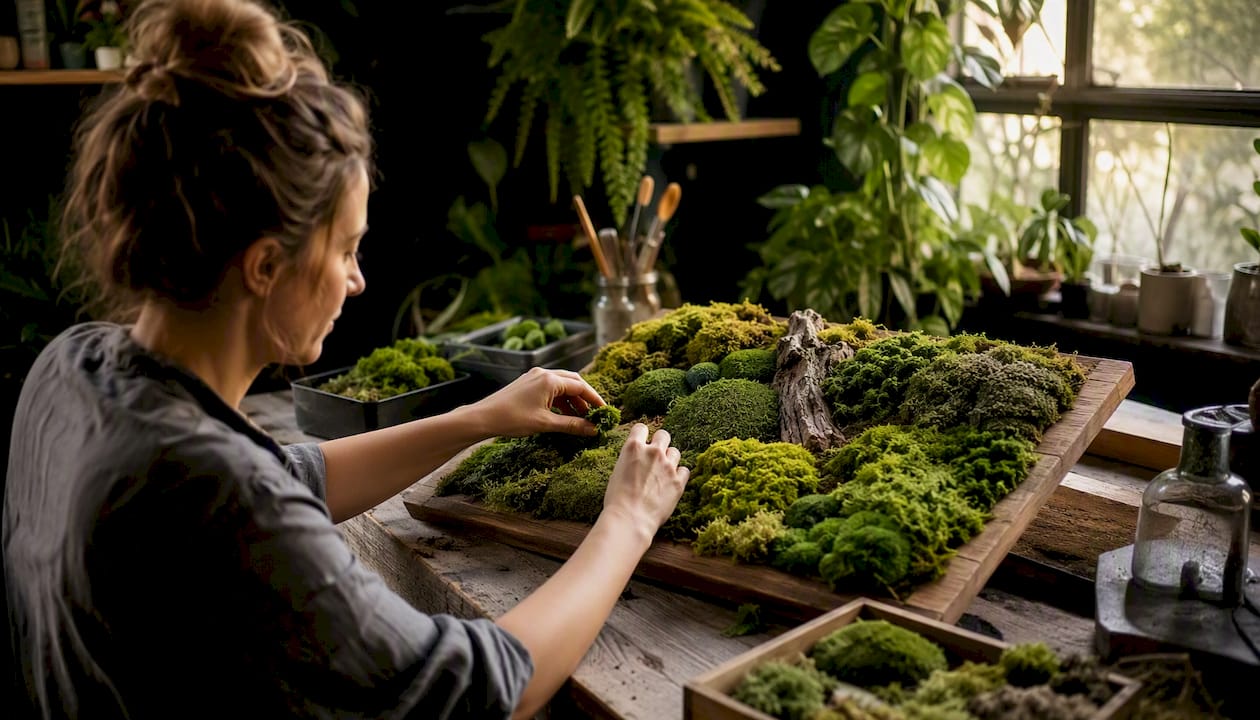
Per-square-foot pricing is driven by four primary inputs: size, material selection, fabrication method, and installation conditions. Installation labor alone typically represents a significant portion of total project cost, depending on site complexity. That share rises sharply when scaffolding, after-hours access, or structural reinforcement enters the picture.
| Pricing tier | Typical rate (per sq ft) | What's generally included |
|---|---|---|
| Supply-only material | $60 | Preserved moss, backing substrate |
| Supply + fabrication | $88–$115 | Materials, framing, panel assembly |
| Installed mid-range | $110–$150 | Above + delivery, labor, site cleanup |
| High-end custom | $150–$175+ | Above + logo work, 3D relief, specialty moss |
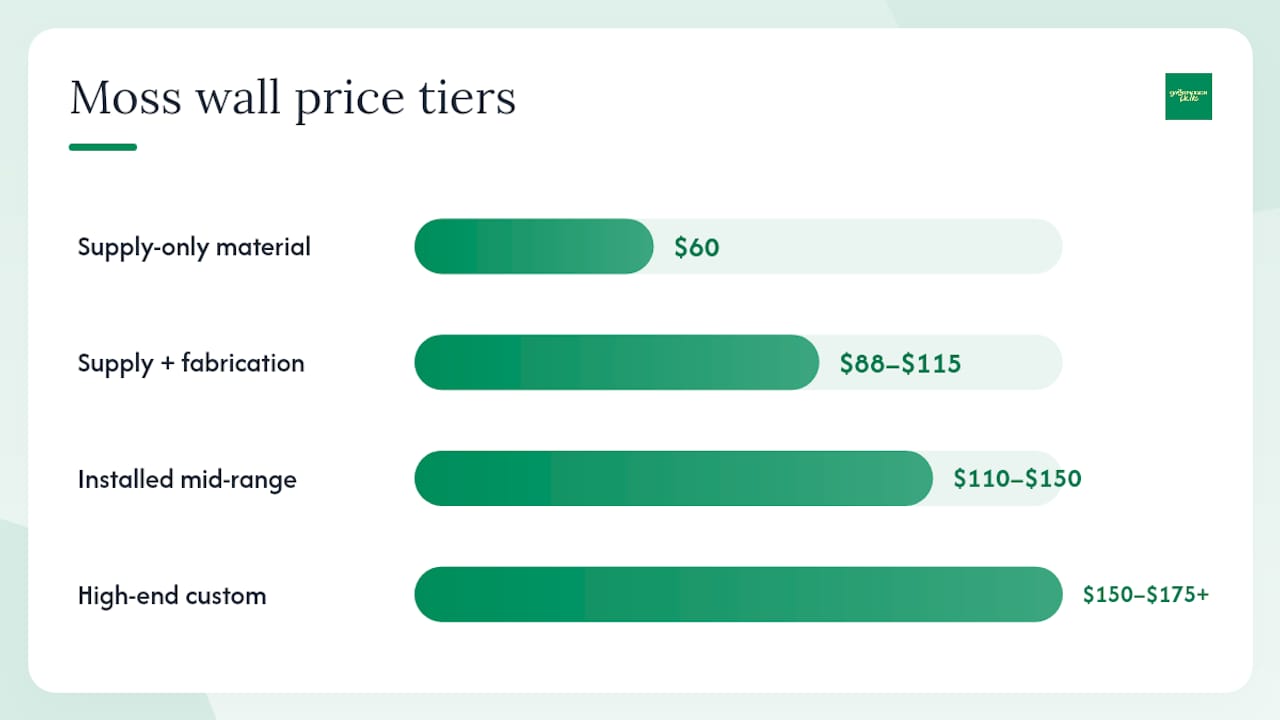
One supplier, for example, lists standard panel pricing at $88/sq ft and custom artwork at $115/sq ft, illustrating how the gap between modular and custom can be meaningful even before installation labor is added.
When you receive a quote, expect to see line items for: preserved moss materials, backing substrate (aluminum composite, PVC foam board, or wood), framing, fabrication labor, freight/delivery, on-site installation labor, and site cleanup. Optional line items that often appear as add-ons include custom dyeing, recessed mounting hardware, logo or branding work, transport insurance, and after-hours labor premiums.
Pro Tip: Ask every vendor to provide a standardized line-item quote rather than a single lump-sum number. When you can see materials, fabrication, delivery, and labor as separate figures, comparing bids from three suppliers becomes straightforward instead of guesswork.
What does a typical commercial installation quote include?
Knowing what's standard versus what's extra lets you catch gaps in a quote before you sign anything. Most commercial installed quotes cover the following as standard:
- Preserved moss materials (flat/woodland, reindeer, or bun/cushion moss, or a mix)
- Backing substrate and basic framing
- Panel fabrication and quality inspection
- Freight to your site
- On-site installation labor
- Post-installation site cleanup
The items below are frequently variable or quoted separately, and each one can move the final number meaningfully:
- Custom or recessed framing: Recessed frames require additional millwork and wall preparation, adding cost and lead time.
- Logo or branding work: Cutting moss panels to a brand shape or integrating signage letters is hand-intensive fabrication that suppliers price as a premium.
- Custom dyeing: Non-natural colors (black, white, branded hues) require a dyeing process that adds both material cost and drying time.
- 3D relief design: Layered depth using different moss heights and species is one of the highest-cost design choices.
- Transport insurance: Worth confirming for large or high-value panels shipped across provinces.
- After-hours labor: Evening or weekend installation in occupied commercial buildings often carries a 15%–25% labor premium.
Of these variables, custom dyeing, 3D relief, and logo work tend to have the largest individual impact on total price. A flat, single-species panel in a standard frame is the most budget-predictable option; a multi-species, relief-sculpted logo wall is the least.
Why does moss wall pricing swing so much?
The $100–$175/sq ft installed range isn't vague — it reflects genuinely different products. Design choices are the primary driver, but several other factors compound or reduce cost in ways that are worth understanding before you brief a supplier.
Size and scale: Larger projects don't always benefit from strong economies of scale in preserved moss work, because fabrication is largely hand-assembled. A 300 sq ft wall costs more in absolute terms than a 30 sq ft panel, but the per-square-foot rate may not drop dramatically unless the design is simple and repetitive.
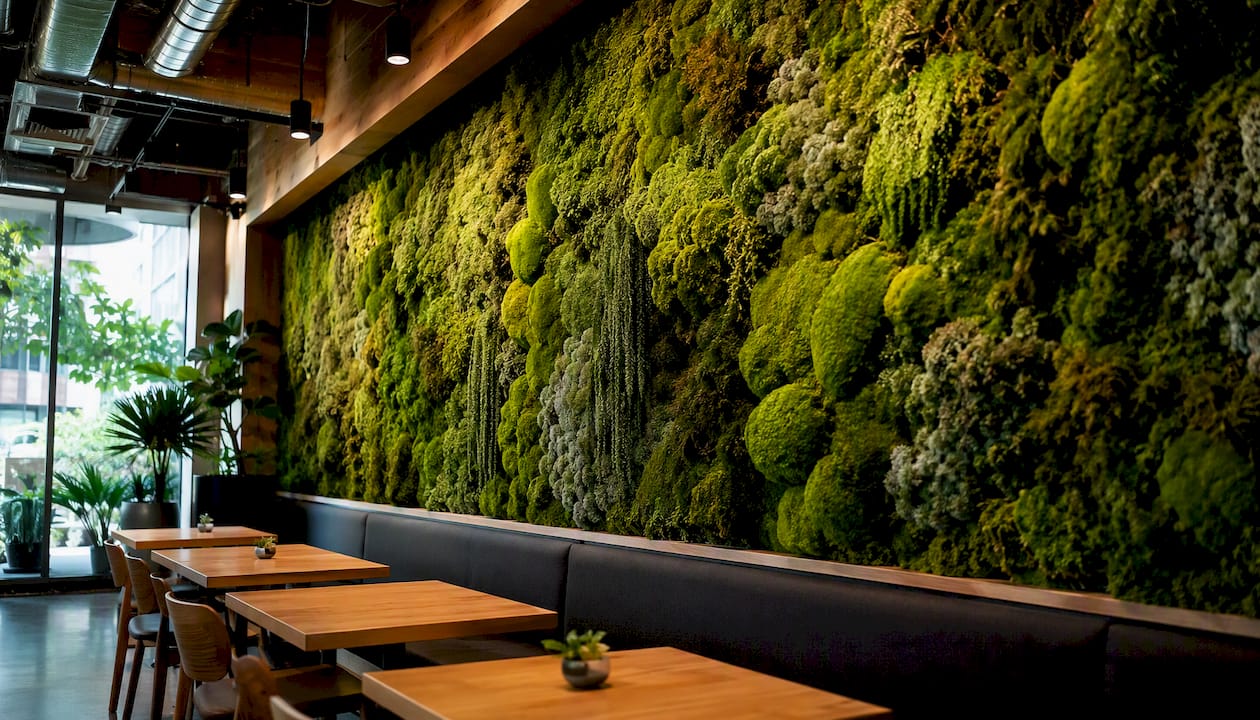
Moss type and density: Woodland/flat moss sits at the lower end of per-area cost, reindeer moss in the mid-range, and bun/cushion moss at the higher end. Density matters too — a lush, tightly packed panel uses more material and more labor to assemble than a sparse one. Mixing lower-cost woodland moss with accent patches of reindeer or bun moss is a common strategy designers use to achieve visual depth without paying full bun-moss rates across the entire surface.
Design complexity: Flat, rectangular panels in a single moss species are the most straightforward to price and fabricate. Curved shapes, layered relief, multiple species, and integrated branding each add fabrication hours.
- Flat single-species panel: baseline cost
- Mixed-species flat panel: 10%–20% above baseline
- 3D relief or layered design: 25%–40% above baseline
- Logo/branding cutouts or lettering: quoted separately, often significant
Site and installation complexity: Ground-level installation on a standard drywall surface is the simplest scenario. High ceilings requiring scaffolding, concrete or masonry mounting surfaces, structural reinforcement, or restricted-access sites all raise the installation labor share of the total.
Geography and logistics: Shipping large panels across provinces adds freight cost. Metropolitan labor rates in Toronto and Vancouver run higher than in smaller markets, which is one reason moss wall cost in Toronto tends to sit at the upper end of Canadian ranges.
Pro Tip: If your budget is fixed, specify a flat single-species design in your brief and ask suppliers to price it first. Once you have that baseline, you can price individual upgrades (a second moss species, a logo element) as separate line items and decide which ones are worth the premium.
What does the installation process look like, and how long does it take?
A preserved moss wall project in Canada typically moves through six phases. The timeline varies by project size, but here's what to plan for:
- Inquiry and site assessment: You share dimensions, photos, and a brief. For commercial projects, a supplier visit to measure and assess the wall surface, ceiling height, and access is standard.
- Design mockup and pricing: The supplier produces a design rendering and a line-item quote. Expect 3–7 business days for this step on mid-size projects.
- Fabrication: Once you approve the design and deposit, fabrication begins. Small framed pieces: 1–2 weeks. Medium panels (8–50 sq ft): 2–4 weeks. Large commercial walls (100+ sq ft): 4–8 weeks.
- Delivery: Panels ship or are transported to site. Fragile panels for large installations are often crated; confirm packaging with your supplier.
- On-site installation: A professional crew mounts, levels, and secures the panels. A 100 sq ft wall typically takes a half-day to a full day with a two-person crew.
- Final inspection and handover: The crew checks for gaps, loose moss, and level alignment, then walks you through care instructions.
For facility managers coordinating install day, prepare the following:
- Clear the staging area adjacent to the wall (at least 6 feet of clearance)
- Confirm elevator or freight access for large panels
- Protect adjacent finishes (flooring, furniture) with drop cloths
- Arrange power access for drills and lighting
- Brief building security on crew arrival and access hours
How long does preserved moss last, and what maintenance does it need?
This is where preserved moss walls earn their reputation as a low-operational-cost option. Because the moss is preserved rather than living, it requires no irrigation, no drainage infrastructure, no grow lights, and no horticultural service visits. Preserved moss walls eliminate the ongoing irrigation, drainage, lighting, and horticultural service costs that make living green walls significantly more expensive to operate over time.
In typical Canadian commercial interior conditions, a well-maintained preserved moss wall lasts 8–12 years before color or texture degradation becomes noticeable. Three factors shorten that lifespan meaningfully:
- Direct sunlight: UV exposure bleaches moss color. Keep preserved moss out of direct sun or use UV-filtering window film.
- High humidity or moisture: Preserved moss is not waterproof. Bathrooms, kitchens, and exterior-facing walls with condensation risk are poor locations.
- Physical contact: High-traffic corridors where people brush against the wall accelerate shedding and compression.
Routine maintenance is genuinely minimal:
- Dusting: A soft brush or low-pressure compressed air every 3–6 months keeps the surface clean.
- Environmental monitoring: Maintain interior humidity between 40%–60% and avoid temperature extremes near the wall.
- Spot repairs: Loose or shed moss patches can be re-adhered with a compatible adhesive; most suppliers sell touch-up kits or offer repair visits.
Unlike living walls, preserved moss installations don't require a recurring maintenance contract to stay healthy. That said, some commercial clients opt for an annual inspection visit from their supplier to address any spot repairs and confirm the installation remains secure.
When does DIY make sense, and when should you hire a professional?
For a small framed piece in a low-traffic area, a quality DIY moss panel kit is a reasonable option. For anything going into a commercial lobby, boardroom, or client-facing space, professional installation is almost always the better call. Here's a practical decision checklist:
DIY may work if:
- The piece is under 10 sq ft and purely decorative
- It will hang in a low-traffic, low-humidity interior space
- You have no branding or custom-shape requirements
- Warranty and liability are not concerns
Hire a professional when:
- The wall exceeds 20 sq ft or involves multiple panels
- The design includes logos, custom shapes, or 3D relief
- The installation surface is concrete, masonry, or a rented commercial space
- Your lease or building management requires licensed contractors for wall modifications
- You need a supplier warranty on materials and workmanship
Mounting failures are the most common risk in DIY commercial installations. Large preserved moss panels are heavier than they look, and standard drywall anchors are often insufficient for panels over 15 lbs. A panel that falls in a lobby or meeting room creates both a liability issue and a costly repair. Professional installers assess load-bearing capacity, use appropriate hardware, and typically carry liability insurance that covers the installation.
Sample Canadian quotes: what three real scenarios look like
These examples use conservative assumptions and reflect the installed price ranges cited by Canadian and North American suppliers. Use them as orientation, not as fixed quotes — your actual price depends on the variables covered above.
| Scenario | Size | Moss mix | Framing | Install included | Estimated installed range |
|---|---|---|---|---|---|
| Framed art piece | 2×3 ft (6 sq ft) | Flat/woodland | Standard wood frame | No (supply only) | CA$600–$900 |
| Feature panel | 4×5 ft (20 sq ft) | Mixed (woodland + reindeer) | Aluminum frame | Yes | CA$2,200 |
| Commercial feature wall | 10×20 ft (200 sq ft) | Mixed (reindeer + bun moss) | Recessed aluminum | Yes | CA$22,000–$35,000 |
For the framed art piece, supply-only retail pricing starts around $100/sq ft for simple panels, which puts a 6 sq ft piece in the $600–$900 range before any custom work. The Etsy market confirms this band: a 48×28 preserved moss art panel lists at CA$453.02 for a ready-to-hang piece, representing the lower end of retail sizing.
For the 200 sq ft commercial wall, the $110–$175/sq ft installed range produces a total of $22,000–$35,000. The upper end assumes a mixed reindeer and bun moss design with recessed aluminum framing and standard business-hours installation. A Calgary installer's starting rate of $110/sq ft anchors the lower bound; the WabiMoss pricing guide's custom artwork rate of $115/sq ft for fabrication alone illustrates how quickly the total climbs once installation labor is added.
How Greenspace Plants approaches preserved moss wall projects
Greenspace Plants designs and installs preserved moss walls and green walls for commercial spaces across Toronto, Vancouver, and Calgary. The team handles the full project arc: site assessment, design mockup, fabrication coordination, installation, and optional ongoing care through the Greenspace+ program.
For buyers evaluating a moss wall, here's what working with Greenspace Plants typically looks like:
- Supply-only: Sourcing and delivering fabricated panels to your site for your team or contractor to install.
- Supply + install: Full-service delivery and professional installation, including hardware, leveling, and site cleanup.
- Greenspace+ (all-inclusive): A fixed monthly program that covers design, installation, and ongoing maintenance with a healthy-plant guarantee and no long-term lock-in. This option suits clients who want the visual impact of a moss wall without managing any aspect of it themselves.
Greenspace Plants also brings turnkey commercial project experience to custom installations, which matters when a project involves unusual site conditions, branding requirements, or phased delivery across multiple locations.
To prepare for a quote, have the following ready:
- Wall dimensions (width × height in feet or meters)
- Photos of the space and the target wall surface
- Your preferred moss style or reference images
- Budget target or range
- Access notes (freight elevator, after-hours requirements, parking for a crew vehicle)
Pro Tip: Sharing a reference image of a moss wall you like alongside your dimensions gives a supplier the fastest path to an accurate quote. It removes ambiguity about moss density, color palette, and design complexity in a single step.
Why most businesses choose preserved moss over living walls
Here's an opinion worth stating plainly: for the majority of Canadian commercial interiors, preserved moss is the more practical choice, and the decision usually becomes obvious once you compare the full lifecycle cost rather than just the installation price.
Living green walls are genuinely beautiful, and for clients whose brief is explicitly biophilic — where the goal is a living, breathing ecosystem visible to occupants — they deliver something preserved moss cannot. But for the much larger group of clients who want a striking, low-maintenance visual feature in a lobby, boardroom, or corridor, living walls carry operational overhead that rarely justifies itself. Irrigation systems fail. Grow lights burn out. Plants die in patches and need replacement. The horticultural service visits that keep a living wall healthy are a recurring cost that compounds over years.
Preserved moss sidesteps all of that. The upfront cost is comparable, the visual impact is strong, and the operational cost after installation is close to zero. For a facility manager juggling a dozen other building systems, that simplicity has real value. The one situation where I'd push back on a preserved-moss recommendation is when a client's brief specifically calls for air quality improvement or a demonstrably living feature — in those cases, a living wall with proper infrastructure is the right answer, and no amount of preserved moss changes that.
Greenspace Plants can quote your moss wall project
Greenspace Plants gives Canadian businesses a direct path from "I want a moss wall" to a measured, line-item quote without the back-and-forth that typically slows commercial projects. The team serves Toronto, Vancouver, and Calgary with on-site measuring, design mockups, and professional installation, so you're not estimating from a website calculator.
Whether you need a single framed panel for a reception desk or a 200 sq ft feature wall for a flagship office, Greenspace Plants can scope the project, present design options, and deliver a fixed price before any work begins. The Greenspace+ program also means you can hand off ongoing care entirely if you want the wall maintained without adding it to your team's task list. To get started, request a quote through the green walls page or browse the client lookbook to see installed examples before your first conversation.
Sources
The sources below are worth consulting when you're validating a quote or comparing supplier approaches:
- 8 Aspects That Influence Moss Wall Cost
- Moss Wall Pricing Guide: What to Expect & How to Budget - WabiMoss
- Moss Wall - How Much Do Moss Walls Cost? - Leaflike
- Low Maintenance Moss Wall Panels | Forage + Design Calgary
- Moss Wall Art – The Botaness
- Preserved Moss Wall Art: Eco-friendly Nature Decor (48x28)
- Understanding The Cost Of A Moss Wall | Green Oasis
- Indoor Plant Service Canada / Green Plant Walls