
Chlorophyll is the green pigment in plants that captures light energy and converts it into the chemical energy plants use to build sugars, releasing oxygen as a byproduct. It lives inside the chloroplasts of plant cells, packed into structures called thylakoids. Most land plants rely on two main forms, chlorophyll a and chlorophyll b, working together to catch light across a wider slice of the spectrum than either could alone.
- Chlorophyll powers photosynthesis: light in, sugar and oxygen out.
- It sits inside chloroplasts, concentrated in thylakoid membranes.
- Chlorophyll a and b are the workhorses in plants and green algae.
Quick fact: Chlorophyll absorbs light most efficiently in the blue and red bands of the visible spectrum and barely touches green wavelengths, which is the entire reason plant tissue looks green to your eye.
Key Takeaways
Chlorophyll is the pigment inside chloroplasts that absorbs blue and red light to power photosynthesis, and its poor absorption of green wavelengths is why plants appear green.
| Point | Details |
|---|---|
| Chlorophyll's core function | It absorbs light energy and converts it into chemical energy, producing sugars and releasing oxygen. |
| Cellular location | It's embedded in thylakoid membranes inside chloroplasts, packed alongside electron transport proteins. |
| Main types | Chlorophyll a is universal in oxygenic photosynthesis; chlorophyll b, c, d, and bacteriochlorophyll extend the usable light range. |
| Why leaves look green | Chlorophyll absorbs blue and red light strongly but reflects green wavelengths, producing the visible color. |
| Professional upkeep matters | Greenspace+ provides design, installation, maintenance, and a healthy plant guarantee to help preserve vibrant, chlorophyll-rich foliage in commercial spaces. |
Table of Contents
- What Is Green Pigment, Exactly? A Definition and Its Origins
- Where Does Chlorophyll Live Inside a Plant Cell?
- What Are the Different Types of Chlorophyll?
- How Does Chlorophyll Actually Drive Photosynthesis?
- Does Chlorophyll Absorb Green Light? Why Plants Look Green
- What Other Pigments Show Up Alongside Chlorophyll?
- How Do Professionals Assess Plant Health From Leaf Color?
- What Does Chlorophyll Look Like at the Molecular Level?
- Who First Identified Chlorophyll and Why It Mattered
- Where Else Do Green Pigments Show Up Beyond Photosynthesis?
- A Professional Alternative to DIY Plant Upkeep
- Sources
What Is Green Pigment, Exactly? A Definition and Its Origins
A pigment, in biological terms, is any molecule that absorbs specific wavelengths of visible light and reflects the rest. That reflected light is what you perceive as color. Chlorophyll falls into this category, but it does something most pigments in nature do not: it acts as a photochemical catalyst, using the light energy it absorbs to drive a chemical reaction rather than just displaying color.
That reaction is photosynthesis. Chlorophyll molecules sit inside protein complexes and, when a photon strikes them, an electron gets knocked loose. That electron kicks off a chain of energy transfers that eventually produces the sugars a plant runs on. Without this pigment acting as the spark, none of that chemistry happens.
The name itself has a specific origin story worth knowing. Two French pharmacists, Joseph Bienaimé Caventou and Pierre Joseph Pelletier, coined the term in 1817. They built it from Greek roots: chloros, meaning pale green, and phyllon, meaning leaf. Literally, "leaf green." It's a tidy example of a scientific name that says exactly what it means, no more, no less.
Worth noting: not every green pigment you encounter is chlorophyll. Industrial and art pigments like Phthalocyanine Green G are synthetic compounds built for color stability in paint and plastics, and they share nothing biologically with the pigment doing the work inside a leaf. Keeping that distinction straight matters if you're ever comparing "green pigment" across a chemistry textbook and an art supply catalog.
Where Does Chlorophyll Live Inside a Plant Cell?
Chlorophyll doesn't float freely inside a cell. It's anchored inside chloroplasts, the specialized organelles responsible for photosynthesis, and its exact location inside that structure is not an accident.
- The chloroplast has an outer envelope enclosing a fluid interior called the stroma.
- Inside the stroma sit stacks of membrane sacs called thylakoids, often bundled into structures called grana.
- Chlorophyll molecules are embedded directly in those thylakoid membranes, alongside the proteins that carry out electron transport.
That membrane placement isn't incidental. Packing pigments and proteins tightly together on the thylakoid surface lets excited electrons move to the next protein in line almost instantly, which is what makes the light-dependent reactions efficient. You'll find the same basic setup in algae and cyanobacteria, including the phytoplankton that turn ocean surface water visibly green during a bloom, a phenomenon trackable from satellite chlorophyll maps.
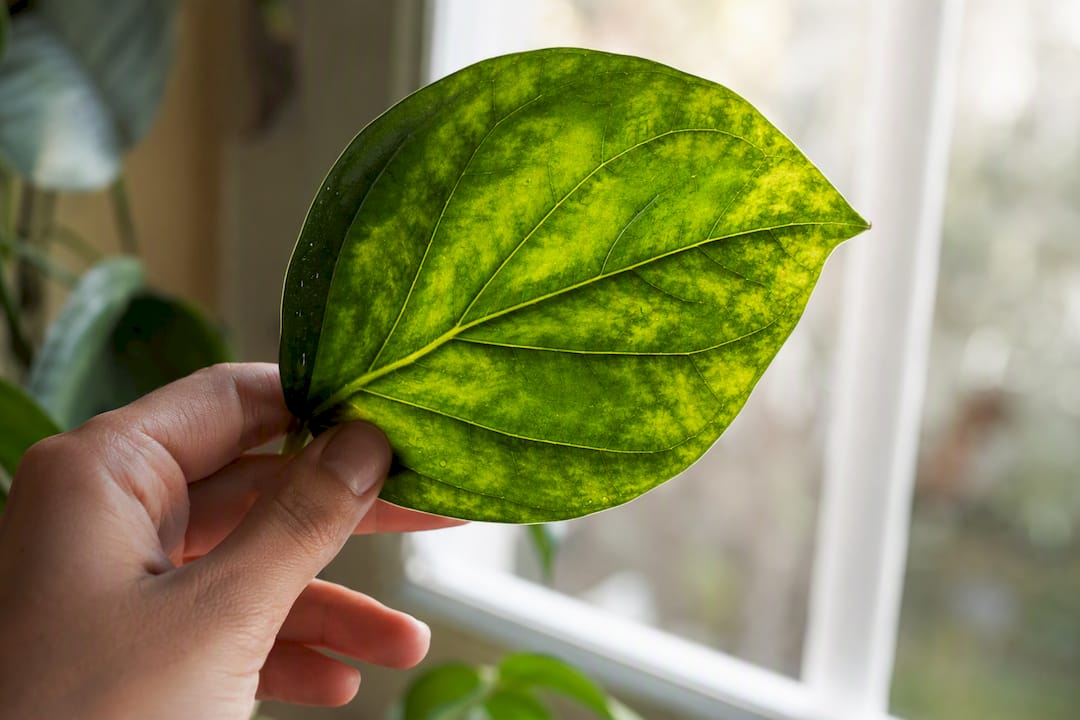
Pro Tip: Hold a healthy leaf up to a bright window and look closely at the veins. You'll notice the green is denser around the leaf's photosynthetic tissue and thinner near the vascular strands, a quick visual cue for where chloroplast concentration is highest.
What Are the Different Types of Chlorophyll?
Not all chlorophyll is identical, and the differences aren't cosmetic. Each type absorbs a slightly different slice of the light spectrum, which lets different organisms make use of light conditions that would leave a single-pigment system in the dark.
- Chlorophyll a is the universal pigment of oxygenic photosynthesis, present in every plant, alga, and cyanobacterium that releases oxygen. It's the molecule that actually feeds electrons into the transport chain.
- Chlorophyll b acts as an accessory pigment in higher plants and green algae, absorbing wavelengths chlorophyll a misses and passing that energy along, according to Khan Academy's overview of photosynthetic pigments.
- Chlorophyll c shows up in certain algae, including diatoms, broadening the light range those organisms can use in murky or deep water.
- Chlorophyll d is rarer, found in a handful of cyanobacteria adapted to unusual light niches.
- Bacteriochlorophyll appears in anoxygenic bacteria, organisms that photosynthesize without producing oxygen, often in low-light or sulfur-rich environments where oxygenic plants couldn't survive.
The functional payoff across all these variants is the same: extend the usable light range. A single pigment absorbing only one narrow band would waste most of the light hitting it. Layering multiple chlorophyll types, each tuned to a different wavelength, lets an organism harvest far more of the available spectrum.
How Does Chlorophyll Actually Drive Photosynthesis?
Chlorophyll's absorption pattern is not evenly spread across visible light. It has two strong peaks, one in the blue range and one in the red range, and a pronounced dip in the middle of the spectrum where green wavelengths fall.
| Wavelength Band | Approximate Range | Chlorophyll Absorption |
|---|---|---|
| Blue light | blue range | High |
| Green light | green wavelengths | Low |
| Red light | red range | High |
That action spectrum, documented by Britannica, explains the entire mechanism that follows. When a photon in the blue or red range strikes a chlorophyll molecule, it excites an electron to a higher energy state. That electron gets passed down a chain of proteins embedded in the thylakoid membrane, and the energy released along the way pumps hydrogen ions across the membrane and ultimately generates two energy-carrying molecules: ATP and NADPH.
Those two molecules are the currency the plant spends in the next stage, the Calvin cycle. There, in the chloroplast's stroma, the plant uses ATP and NADPH to convert carbon dioxide pulled from the air into glucose. No light is directly involved in this second stage, but it cannot run without the energy chlorophyll generated moments earlier in the thylakoid membrane.
Quick fact: A gap of roughly 75 nanometers separates chlorophyll's blue and red absorption peaks, and green wavelengths sitting between them are largely bounced back rather than absorbed, according to Britannica's chlorophyll entry.
Does Chlorophyll Absorb Green Light? Why Plants Look Green
Chlorophyll's poor absorption of green wavelengths is the direct cause of a plant's color. Rather than absorbing that middle band of the spectrum, chlorophyll reflects and transmits most of it, and your eye registers that reflected light as green.
- Chlorophyll absorbs strongly at the blue and red ends of the spectrum.
- It reflects and transmits most of the green band instead of absorbing it.
- That reflected green light is what reaches your eye and registers as leaf color.
Leaf structure adds another layer to this. Cell walls, internal air spaces, and the waxy cuticle on a leaf's surface scatter light before it even reaches the chloroplasts, which is part of why a young, thin leaf looks a lighter, almost translucent green compared to a mature, waxier one. The pigment concentration is similar in both cases; the physical structure around it changes how that green gets perceived.
Pro Tip: If two leaves from the same plant look noticeably different shades of green, check leaf age and thickness before assuming a health problem. Structural differences alone can shift the shade.
So does chlorophyll absorb any green light at all? A small amount, yes, but not enough to change the overall picture. The pigment's absorption at that middle wavelength stays low enough that green remains the dominant reflected color across nearly all chlorophyll-rich tissue.
What Other Pigments Show Up Alongside Chlorophyll?
Chlorophyll rarely works alone. Plants also carry carotenoids and anthocyanins, pigments that absorb different wavelengths and, in some cases, protect the plant from excess light energy.
- Carotenoids absorb blue and green light, giving them the yellow and orange tones you see in carrots and in autumn foliage.
- Anthocyanins produce red, purple, and blue tones, often synthesized in response to stress, cold, or high light exposure.
- Chlorophyll's high concentration typically masks these other pigments during the growing season.
Autumn is the clearest real-world demonstration of that masking effect. As days shorten, plants break down chlorophyll faster than they replace it, and the carotenoids that were there all along finally become visible. Anthocyanins can add to the display, particularly in trees experiencing cold, sunny fall days, which tends to intensify red tones.
How Do Professionals Assess Plant Health From Leaf Color?
Leaf greenness is one of the fastest, cheapest indicators of plant vigor available, and it's a signal Greenspace Plants' technicians rely on during every routine maintenance visit. Uneven color, dulling, or premature yellowing often points to light stress, watering issues, or a pest problem well before other symptoms show up.
- Look for uniform green tone across the plant rather than one section fading while others stay vibrant.
- Check leaf turgor. Firm, upright leaves generally correlate with healthy chlorophyll levels.
- Note new growth color. Pale or yellow-tinged new leaves can signal nutrient gaps.
Quantitative chlorophyll meters exist for lab-level plant diagnostics, but for commercial interiorscapes, a trained visual check catches most issues early.
Consistent, professional maintenance is what keeps a commercial plant's chlorophyll-rich color intact over months and years, not just after installation day.
Greenspace Plants builds this kind of routine inspection into every account, which is part of why its plant health guarantee holds up across office towers, restaurants, and retail floors alike.
What Does Chlorophyll Look Like at the Molecular Level?
Chlorophyll's structure explains both its color and its function. At the center of every chlorophyll molecule sits a porphyrin ring, a large flat structure built from four smaller nitrogen-containing rings, with a single magnesium ion locked in the middle. That magnesium ion is essential. Without it, the ring loses its ability to absorb light efficiently and shift electrons in response.
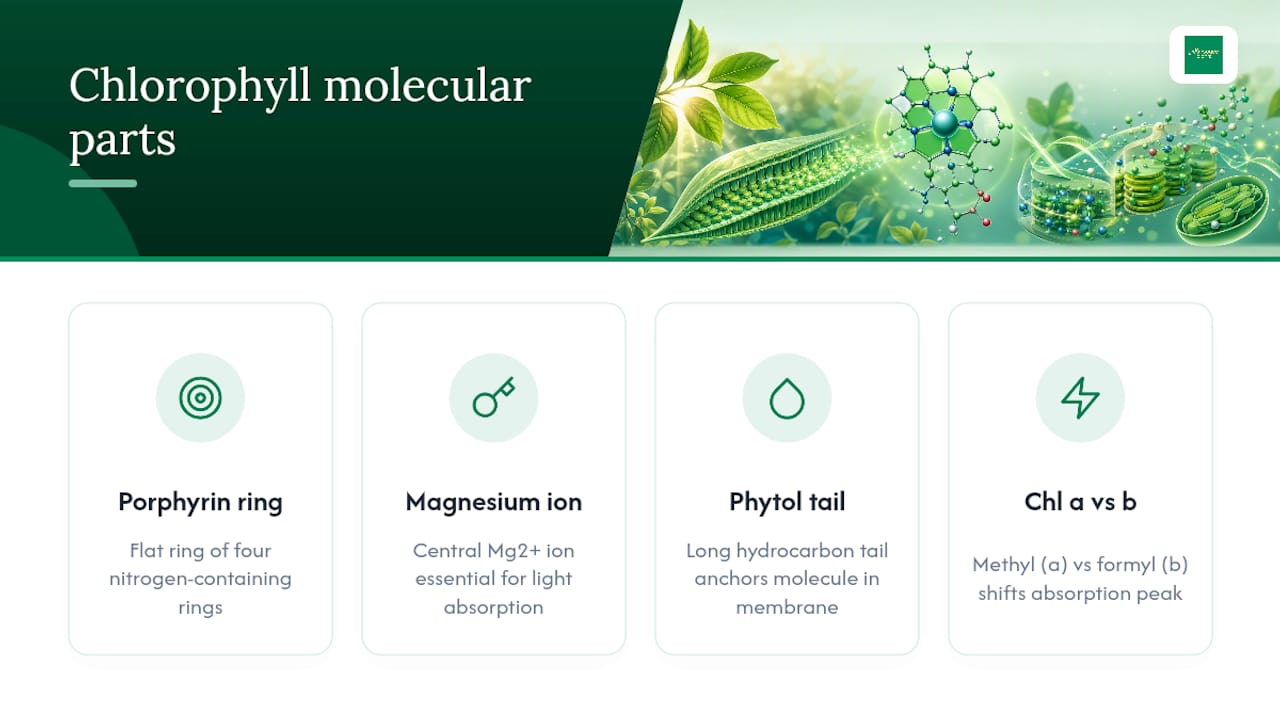
Attached to the ring is a long hydrocarbon tail called a phytol chain. This tail doesn't participate in light absorption directly, but it anchors the molecule firmly inside the thylakoid membrane, keeping it positioned correctly among the surrounding proteins.
The small differences between chlorophyll a and chlorophyll b come down to a single side group on the porphyrin ring. Chlorophyll a carries a methyl group at one position, while chlorophyll b carries a formyl group in that same spot. That's a minor structural swap, but it's enough to shift each molecule's absorption peak slightly, which is exactly why the two forms complement each other rather than compete for the same light.
This structure also explains why chlorophyll degrades the way it does. Heat, strong light, and low pH can knock the magnesium ion out of the ring, a process called pheophytinization, which turns bright green chlorophyll into a dull olive brown. It's the same chemistry behind cooked vegetables losing their vivid green color.
Who First Identified Chlorophyll and Why It Mattered
Before 1817, scientists knew plants were green, but no one had isolated the compound responsible or understood its role. Caventou and Pelletier's extraction of chlorophyll that year gave biology its first real foothold into plant chemistry, a foundational moment that eventually connected plant color directly to the process of photosynthesis.
The decades that followed built steadily on that discovery. Chemists worked out chlorophyll's porphyrin structure over the following century, and the magnesium-centered ring turned out to closely resemble the iron-centered heme molecule found in animal blood. That structural parallel became one of the more striking findings in comparative biochemistry, hinting at a shared evolutionary ancestry between energy-transport molecules across radically different kingdoms of life.
Chlorophyll's discovery also reshaped how scientists thought about the food chain itself. Once researchers understood that this single pigment was responsible for converting sunlight into usable chemical energy, it became clear that nearly every terrestrial and marine ecosystem traces its energy budget back to chlorophyll-driven photosynthesis. Phytoplankton in particular turned out to be a global-scale example, producing a meaningful share of the planet's oxygen through the same pigment sitting in a backyard tree.
That historical arc, from a simple extraction in a French lab to a pigment now tracked by satellite across entire oceans, is part of why chlorophyll remains one of the more studied molecules in biology.
Where Else Do Green Pigments Show Up Beyond Photosynthesis?
Green pigments have a life well outside the plant kingdom, and it's worth separating those uses from chlorophyll's biological role. In industry, synthetic pigments like Phthalocyanine Green G dominate paint, plastic, and ink production because they hold color intensity and resist fading far longer than older mineral-based greens ever did.
Art history tells a similar story. Painters once relied on mineral pigments and, later, arsenic-based compounds like Scheele's Green and Paris Green for vivid green tones, both of which carried serious toxicity risks that eventually pushed the art supply industry toward safer synthetic alternatives.
Health and nutrition research has taken a different angle, extracting chlorophyll itself for use in supplements and topical products, often marketed around antioxidant or deodorizing claims. That extracted chlorophyll is chemically the same molecule doing photosynthetic work inside a leaf, just repurposed outside its original biological context.
It's worth being precise here: none of these industrial, artistic, or wellness applications involve the pigment performing photosynthesis. They borrow chlorophyll's color or its chemistry, not its biological function, and conflating the two is a common source of confusion when the term "green pigment" gets used loosely across such different fields.

A Closing Thought on Why This Pigment Deserves More Credit
Most people learn that chlorophyll "makes plants green" and stop there, missing the more interesting part: it's a molecule doing real chemical work, not just displaying color. That gap between the popular oversimplification and the actual mechanism is worth closing, because understanding how light becomes sugar changes how you look at every leaf you pass. This connects directly to why healthy, well-maintained plants matter in commercial spaces, a link Greenspace Plants applies daily in its own polycarbonate greenhouse plant care work.
A Professional Alternative to DIY Plant Upkeep
Understanding chlorophyll is one thing. Keeping it vibrant across dozens of plants in a busy office or restaurant is another challenge entirely, and it's one many businesses underestimate until leaves start yellowing. Greenspace+ handles that gap directly: a fixed monthly service covering plant design, installation, ongoing maintenance, and replacements, backed by a healthy plant guarantee, with no upfront costs or long-term contracts required.

The service exists precisely because chlorophyll-rich, vibrant foliage doesn't happen by accident. It takes consistent watering schedules, correct light placement, and early intervention when a leaf's color starts to shift. Greenspace Plants' technicians build that routine into every visit, which is why offices, restaurants, and retail spaces across Toronto, Vancouver, and Calgary rely on the program rather than handling plant care in-house. If you're weighing whether to keep plants healthy on your own or hand that responsibility off, take a look at indoor plant care and maintenance to see what a managed program actually includes.
Sources
- Photosynthesis — Monash University
- Chlorophyll — National Geographic Education
- Light and photosynthetic pigments — Khan Academy