
Yes, green walls measurably improve acoustic comfort, but the effect is frequency-dependent and modest compared to dedicated soundproofing. Studies report weighted sound absorption coefficients (αw) between 0.40 and 0.75 and weighted sound reduction indices (Rw) around 15 to 16 dB, concentrated in mid to high frequencies. Green walls supplement conventional acoustic treatment for low-frequency control. They rarely replace it.
TL;DR:
- The sound absorption capacity of green walls primarily depends on substrate depth and air cavity, with thicker media delivering better low-frequency control.
- Green walls perform best at mid to high frequencies, offering limited reduction in bass-heavy noise like traffic or machinery hum.
- Modular living wall systems with deeper substrates and an air gap can reach absorption coefficients up to 0.75 and sound reduction indices around 16 dB, but field results may be lower than lab reports.
- For effective acoustic performance, specify testing methods such as impedance-tube tests and in-situ measurements, and verify lab results with real-world installation data.
- Green walls should be integrated into a hybrid acoustic strategy, as they are a supplementary tool that works alongside mass-based or resonant absorbers for low-frequency noise mitigation.
Table of Contents
- What Does the Research Say About Green Wall Acoustics?
- How Do Green Walls Reduce Sound?
- Which Green Wall System Performs Best Acoustically?
- What Test Methods Should Architects Request?
- What Belongs on a Green Wall Acoustic Specification?
- What Are the Downsides of Green Walls for Acoustics?
- What Greenspace Plants Sees in Real Installations
- A Professional's Take: Green Walls as Multifunctional Elements, Not Silver Bullets
- Bring Green Wall Acoustics Into Your Next Project
- Sources
- FAQ
What Does the Research Say About Green Wall Acoustics?
Numbers vary a lot by system and test method, which trips up a lot of first-time specifiers. A frequently cited study on green walls as passive acoustic insulation found weighted sound reduction indices near 15 dB and absorption coefficients around 0.40 for certain configurations. That is a meaningful reduction in transmitted noise that is roughly comparable to swapping a hollow-core door for a solid one.
Push into modular living wall systems (LWS) with deeper substrate and an air cavity, and the numbers climb. A comparative experimental assessment recorded modular LWS reaching αw = 0.75, with continuous LWS hitting Rw ≈ 16 dB, and adding the air cavity consistently helped at lower frequencies.
Statistic Callout: An αw of 0.75 means a wall absorbs roughly three-quarters of incident sound energy at the tested frequencies. In a mid-sized meeting room, that kind of coverage can meaningfully shorten reverberation time (RT60), improving speech clarity without a single acoustic tile.
Lab results and field results rarely match exactly, and the gap matters for anyone writing a spec:
- Lab impedance-tube tests isolate small samples under ideal conditions, so they tend to report higher absorption.
- Field tests capture furniture, irrigation lines, mounting gaps, and real airflow, which usually pulls the number down.
- Urban applied reports cite ambient noise cuts of roughly 9 to 11 dB for living walls facing street noise, a useful real-world anchor distinct from lab αw figures.
How Do Green Walls Reduce Sound?
Two mechanisms do the work: absorption and scattering. The growing substrate behaves like a porous acoustic absorber, similar in principle to mineral wool or acoustic foam, pulling sound energy into its pore structure and converting it to heat through friction. Foliage adds a second, smaller layer of benefit: leaves and stems scatter and diffuse sound waves, particularly at mid and high frequencies.
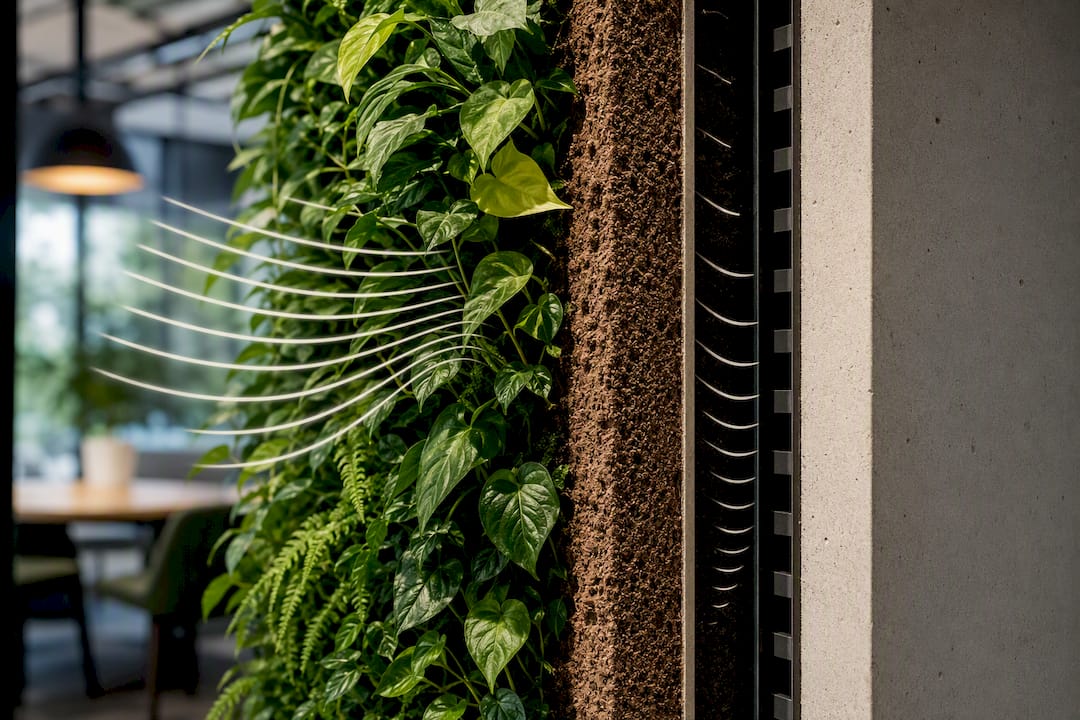
The split between the two isn't close to even. A lab and field study using an impedance gun found substrate responsible for 80 to 90 percent of measured absorption, with vegetation contributing only 4 to 20 percent depending on leaf coverage and plant morphology. That ratio should reset how architects think about green walls: the growing medium is the acoustic engine, and the plants are largely a finishing layer.
Frequency behavior follows a predictable pattern:
- Performance is strongest above roughly 1 kHz, where porous absorption works best.
- Low frequencies (below 500 Hz) are the weak point for any thin, lightweight system.
- Getting real low-frequency control requires either substantial mass or a purpose-built resonant absorber behind the wall.
That frequency ceiling should shape material selection and wall depth from the earliest design phase, not as a retrofit fix.
Which Green Wall System Performs Best Acoustically?
Not all "green wall" is one product, and the acoustic gap between system types is wide enough to change a spec. Modular living wall systems and continuous LWS, which build in substrate depth and an air gap by design, outperform façades by a wide margin.
A configuration that shows up repeatedly across impedance-tube studies is telling: plant plus 20 centimeters of potting soil plus a 10 centimeter air gap outperforms thinner assemblies, while green façades trail behind every modular and continuous system tested.
A few design variables decide where a project lands on that performance curve:
- Substrate depth: thicker growing media generally absorbs more, up to a point of diminishing returns.
- Air cavity: a gap between the module and the structural wall improves low-frequency absorption, according to the same experimental assessment.
- Cell size and compartmentalization: small, rigid module cells can create resonant cavities that color the sound rather than dampen it, so module geometry needs acoustic review, not just plant-health review.
- Artificial or replica panels: these solve aesthetic and maintenance concerns but don't replicate substrate porosity, so treat them as decorative rather than acoustic.
Pro Tip: Ask any green wall vendor for the module's internal cell dimensions before specifying acoustic performance. A module built from many small, sealed pockets can trap reflections and create narrow-band resonances that a single large-cavity design avoids.
What Test Methods Should Architects Request?
Specification language needs to name a method, not just a target number, or you'll get marketing copy instead of data. Request these:
- ISO 10534-2 impedance-tube testing on a substrate sample, which isolates the growing medium's absorption coefficient under controlled lab conditions.
- In-situ verification using an impedance gun or intensity probe on the finished, installed wall, since lab numbers from a sample rarely match field performance exactly.
- XYZ gantry measurement, a method that maps absorption across the wall surface and helps flag resonances that a single-point reading would miss, as demonstrated in a parametric transducer and gantry study.
- Full metric disclosure: αw, Rw, the tested frequency range, sample thickness, and mounting details (Type A flush mount versus Type E with air cavity).
- Post-installation acceptance testing, with tolerance language that accounts for irrigation state and plant maturity at the time of measurement.
Vendors who can't produce test data by method name usually haven't tested under realistic conditions.
What Belongs on a Green Wall Acoustic Specification?
A specification that protects acoustic performance has to cover site conditions, materials, and long-term care in the same document, because a beautiful install that dries out or gets under-watered stops performing acoustically within months.
Start with the physical constraints: available wall depth, distance from the dominant noise source, and the frequency range that noise occupies. An open-plan office fighting HVAC hum needs a different substrate depth than a restaurant managing dining-room chatter.
From there, lock down the substrate composition and depth, the air cavity dimension, and how modules mount and seal against the structural wall. Gaps at module edges leak sound around the absorptive material entirely, undermining lab-tested numbers.
Plant selection matters more for maintenance than for acoustics, but leaf area density still plays a role. Choose species that can sustain dense coverage indoors without constant replacement.
- Coordinate irrigation lines with mechanical, electrical, and plumbing (MEP) teams early, since moisture management prevents both fungal issues and structural damage.
- Confirm fire and safety compliance for the substrate and backing materials before ordering.
- Build maintenance frequency and responsibility into the contract itself, not as an afterthought.
Pro Tip: A recurring maintenance model, like the all-inclusive Greenspace+ program, keeps substrate moisture and plant density consistent over time, which matters acoustically as much as aesthetically since a patchy or drying wall loses absorption where coverage thins.
What Are the Downsides of Green Walls for Acoustics?
Low-frequency control is the biggest limitation. Without significant mass or a dedicated resonant absorber, no green wall system will meaningfully cut bass-heavy noise like traffic rumble or mechanical equipment hum.
Cost and maintenance obligations run higher than a standard acoustic panel, and they run for the life of the installation, not just at handover.
- Poorly detailed modules with small, sealed cells can create resonances that scatter sound unpredictably rather than absorb it, according to the same field research on living wall acoustics cited earlier.
- Green façades, the cheapest and lowest-maintenance option, also test as the weakest acoustic performer, so cost savings and acoustic goals often pull in opposite directions.
- Treat green walls as one layer in a hybrid acoustic strategy: pair them with mass-based or resonant absorbers wherever low-frequency control actually matters.
What Greenspace Plants Sees in Real Installations
Nicole, editorial contributor at Greenspace Plants, notes that most commercial clients ask about acoustics only after noticing an echo problem, not before. In practice, specifying substrate depth and irrigation up front avoids costly retrofits. Post-install, checking plant coverage density and substrate moisture gives a fast, practical read on whether a wall is still performing as designed, even before formal acoustic testing.
A Professional's Take: Green Walls as Multifunctional Elements, Not Silver Bullets
Treat green walls as one tool among several, not a replacement for acoustic engineering. The absorption is real and well documented, but it's frequency-limited by nature. Specify measurable targets, plan for ongoing maintenance, and require test data before and after installation.
— Nicole
Bring Green Wall Acoustics Into Your Next Project
The research is clear that substrate depth, air cavity, and long-term plant health determine whether a green wall performs acoustically or just looks good on installation day. Greenspace Plants is the practical route to get that balance right without managing a separate design team, an installer, and a maintenance contractor for every wall in a building. Clients get design, installation, and ongoing maintenance for a fixed monthly fee, with no upfront cost and no long-term commitment locking them in.
When you reach out for an initial consultation, ask specifically for a site survey, a recommended substrate depth for your noise conditions, and available options for post-install acoustic verification. That conversation, not a generic quote, is what determines whether the wall you get actually does what the literature promises. Start by reviewing the green wall program details or browsing the client look-book for real installation examples before requesting a survey.
Sources
- Evaluation of green walls as a passive acoustic insulation system for buildings
- Experimental assessment of different green wall systems: A comparative study
- Evaluating the Acoustic Absorption of Modular Vegetation Systems: Laboratory and Field Assessments Using an Impedance Gun
- Sound absorption properties of different green wall systems
FAQ
Do Acoustic Wall Panels Actually Work?
Yes. Conventional acoustic panels use porous or resonant materials engineered specifically for sound absorption, and they typically outperform green walls at low frequencies where vegetation and thin substrate struggle. Guidance on acoustic wall options covers the material trade-offs in more depth.
What Are the Downsides of Green Walls?
The main downsides are limited low-frequency sound control, higher ongoing maintenance and irrigation demands, and the risk that poorly detailed modules create resonances instead of absorption. Green façades, the lowest-cost option, also test as the weakest acoustic performer among all system types.
What Is a Green Wall System?
A green wall system is a vertical structure that supports living plants, typically as a green façade (climbing plants on a support frame), a modular living wall (individual planted panels), or a continuous living wall (a single substrate layer across the surface). Each type differs substantially in substrate depth, air cavity, and resulting acoustic performance.
Does Green Glue Actually Work?
Green Glue is a viscoelastic damping compound used between building materials like drywall, unrelated to green walls or plant-based systems. It targets structural sound transmission rather than room absorption, which is a different acoustic problem than what green walls address.
How Do Green Walls Improve Acoustics?
Green walls improve acoustics mainly through the porous substrate absorbing sound energy, with foliage adding secondary scattering at mid to high frequencies. Studies show substrate contributes roughly 80 to 90 percent of total absorption, making growing medium selection the most important acoustic decision in the design.