
Green walls are maintainable indefinitely when you run them on a predictable schedule built around four pillars: irrigation, lighting, pruning and replacement, and structural inspection. Most systems need a visual and irrigation check twice a month and a full horticultural service visit monthly or quarterly, depending on how complex the planting scheme is. Skip that cadence, and small problems become expensive ones fast.
TL;DR:
- Visual and irrigation checks should be conducted twice a month, with horticultural service visits occurring monthly or quarterly depending on plant complexity.
- Closed-loop irrigation requires regular reservoir cleaning and water testing, whereas open-loop systems need backflow checks, filter cleaning, and drain inspections to prevent clogs and leaks.
- Indoor green walls need supplemental LED lighting of about 5000K for 12 to 14 hours daily, with periodic intensity checks to compensate for bulb dimming.
- Monthly pruning and fertilizer application, either via fertigation or slow-release granules, maintain plant density and prevent neglect-related decline.
- A comprehensive maintenance budget should include routine visits, replacement plants, equipment servicing, and contingency funds for emergency repairs, with regular inspections preventing costly failures.
Table of Contents
- What Should a Green Wall Maintenance Checklist Include?
- Should You Choose Open-Loop or Closed-Loop Irrigation?
- How Much Light Does an Indoor Green Wall Need?
- How Often Should You Prune and Fertilize a Living Wall?
- Spring Refresh vs. Winter Freeze Protection
- How Do You Troubleshoot a Failing Green Wall?
- What Should a Green Wall Maintenance Budget Include?
- Why Full-Service Contracts Cut Maintenance Risk for Property Managers
- Greenspace+ Handles the Maintenance So You Don't Have To
- Sources
What Should a Green Wall Maintenance Checklist Include?
Two different visit types keep a wall healthy, and confusing them is where most facility teams go wrong. Inspection visits are quick, twice-monthly walk-throughs to catch problems early. Horticultural service visits are the deeper monthly or quarterly sessions where a technician actually works on the plants and the mechanical systems, with frequency scaled to how dense and complex the planting is.
A solid service visit runs through the same sequence every time:
- Scan the wall for wilting, yellowing, or bare patches
- Run the irrigation system briefly to confirm even coverage across every zone
- Clean drip trays and drains to prevent standing water and root rot
- Wipe or mist dusty foliage, since accumulated dust blocks light absorption
- Prune spent growth and deadhead flowering plants to preserve density
- Remove clippings and debris before they attract pests
- Update the maintenance log with run times, issues found, and any replacements made
That log matters more than most managers assume. A simple spreadsheet tracking irrigation run times, emitter or pump issues, and plant swaps by date gives you a paper trail when warranty or budget questions come up later, and it flags recurring problems before they become system failures.
Pro Tip: Keep the log on a shared drive, not a single technician's clipboard. When staff turnover happens, an undocumented wall starts from zero.
Should You Choose Open-Loop or Closed-Loop Irrigation?
Every green wall runs on one of two irrigation strategies, and the choice you make at design phase determines your maintenance workload for the life of the installation.
Closed-loop systems recirculate water through a reservoir and pump. A 100 square foot wall typically needs a reservoir around 150 gallons, and that reservoir needs monthly cleaning, water testing, and recharge. Mis-sizing it is one of the most common causes of pump burnout and plant stress.
Open-loop systems send water through once and drain it away, which trades reservoir upkeep for a different maintenance list:
- Backflow preventer checks per local plumbing code
- Mesh filter cleaning to stop emitter clogging
- Injector calibration for any fertigation feed
- Drain route inspection to confirm water is leaving the building safely
Open-loop systems generally lower ongoing maintenance on large installations, while closed-loop systems trade that convenience for higher reservoir and service demands. Either way, irrigation supply lines, drain routing, and backflow device placement have to be coordinated with the design team before construction, because retrofitting either system after rough-in gets expensive fast. A cheap pressure regulator set to roughly 30 PSI and a mesh filter, both inexpensive line items, prevent a disproportionate share of emergency service calls.
How Much Light Does an Indoor Green Wall Need?
Ambient window light rarely does the job on its own. Dense indoor foliage generally needs front-facing supplemental LED lighting, and industry guidance points to roughly 5000K as the color temperature that keeps foliage full without washing plants out.
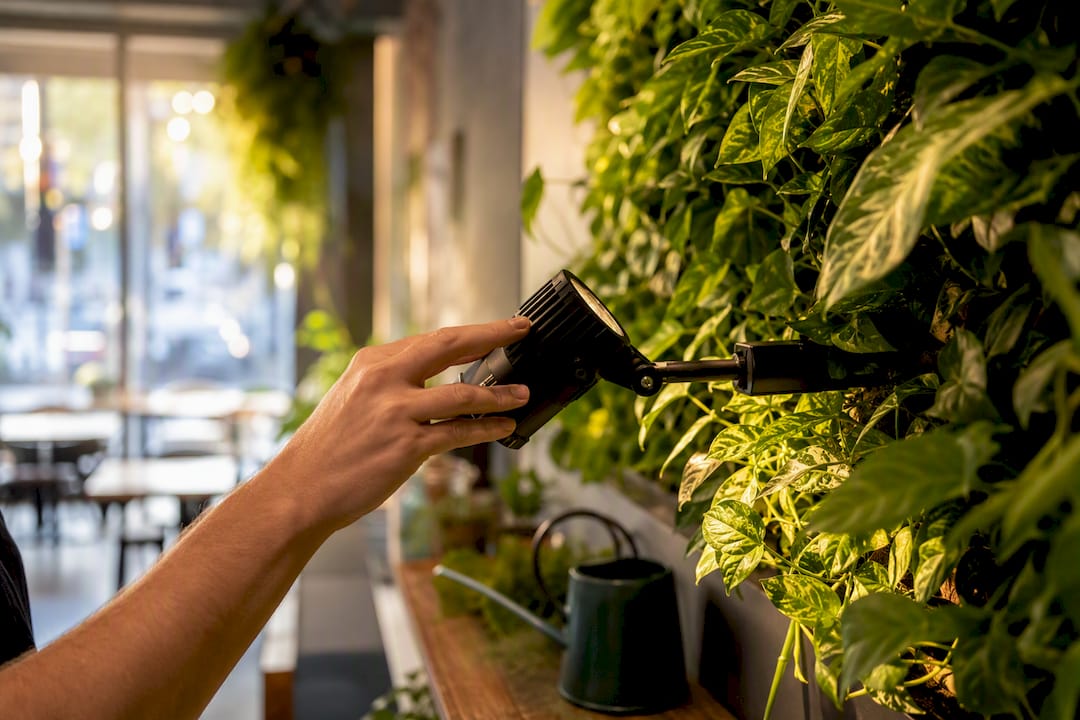
Run those LEDs on a timer, not a switch someone has to remember. Most interior installations do well with 12 to 14 hours of light daily, and it's worth checking intensity periodically with a basic lux meter rather than trusting a fixture's spec sheet forever, since bulbs dim with age. Beyond light, watch temperature swings near HVAC vents, keep humidity in a range that doesn't invite fungal growth, and make sure air actually moves across the foliage. Stagnant air behind dense plantings is a reliable way to grow mold instead of moss.
How Often Should You Prune and Fertilize a Living Wall?
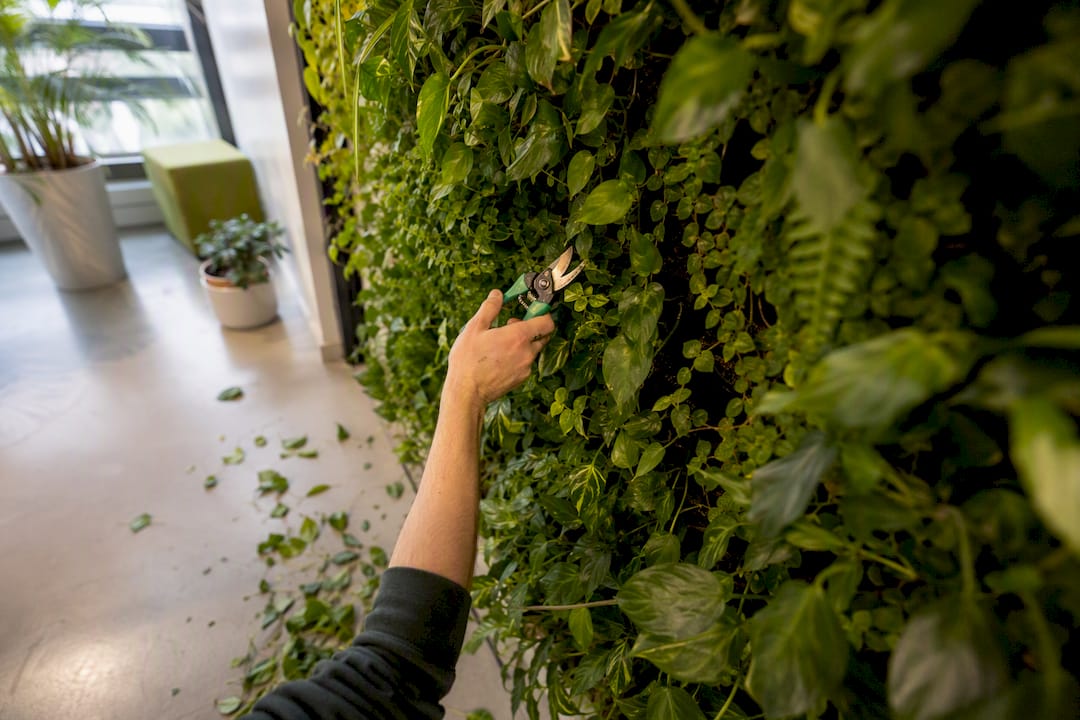
Pruning on a monthly rhythm keeps a wall looking intentional instead of overgrown. Deadheading spent flowers and trimming leggy stems preserves the density that makes a green wall worth installing in the first place, and it's far easier to maintain that density with small monthly trims than to fix a wall that's gone six months without attention.
Fertilization depends entirely on your irrigation setup:
- Fertigation (fertilizer dosed automatically through the irrigation line) suits closed-loop and larger open-loop systems, since the injector handles consistent, low-dose feeding without manual work
- Slow-release granular feed works better for smaller, hand-watered walls, applied at the interval the product label specifies, never eyeballed
Watch for replacement signals rather than waiting for total plant failure: root-bound growth pushing out of the pocket, stunted new growth after a full season, or discoloration that persists after you've ruled out light and water problems. Seasonal replanting, typically in spring, is the natural point to swap out anything that's declined.
Spring Refresh vs. Winter Freeze Protection
Spring and winter demand opposite playbooks. In spring, inspect the whole wall, apply a light fertilizer dose, swap out any thinning or leggy plants, and extend irrigation run times as growth ramps up and days lengthen.
Winter is where outdoor systems get damaged if you skip prep. Blow out irrigation lines before freeze risk arrives, drain reservoirs completely, and move or insulate pumps and controllers so a cold snap doesn't crack a housing overnight. Indoor walls need a lighter touch: shorter days outside often mean supplemental lighting runs longer, and drier heating-season air usually means slightly more frequent watering even though growth has slowed.
How Do You Troubleshoot a Failing Green Wall?
Work through diagnostics in this order when something looks off:
- Structural check first. Confirm fixings are secure, waterproofing membranes are intact, and the wall's load is within design limits before anyone works near it.
- Irrigation diagnostics. Test line pressure, look for emitters that have clogged or popped off, and check for leaks pooling behind the substrate or a pump that's stopped cycling.
- Horticultural diagnostics. Check leaf undersides for pest signs, look for fungal spotting associated with tight plantings, and note whether discoloration points to a nutrient deficiency rather than a watering problem.
Address whatever you find immediately with interim fixes, isolating an infested plant or adjusting a single zone's run time, and escalate anything structural to a specialist rather than a horticultural technician.
Pro Tip: Photograph the same three or four plants each visit. Side-by-side comparisons catch slow decline that a single glance misses.
What Should a Green Wall Maintenance Budget Include?
A realistic budget has to plan past labor. Line items should include routine technician visits, replacement plants, pump and filter servicing, LED replacement as fixtures age, and a reserve for emergency repairs.
Technical components have finite service lives, and operational budgets commonly miss those replacement cycles, which is how a five-year-old pump failure turns into an unplanned emergency instead of a scheduled swap. Scale visit frequency up during peak growing months and back down in slower seasons, but never drop inspections below twice monthly. If your maintenance plan needs outside structural or landscaping expertise, a local landscaping contractor can supplement in-house horticultural staff for the mechanical side of the job.
Why Full-Service Contracts Cut Maintenance Risk for Property Managers
At Greenspace Plants, we've built our Greenspace+ program around one idea: inspection, servicing, and plant replacement work better bundled under one predictable fee than split across vendors. We serve Toronto, Vancouver, and Calgary with a healthy-plant guarantee behind every wall we maintain. If your team lacks a dedicated horticultural staffer, outsourcing removes the single biggest point of failure we see in self-managed walls: inconsistent visits.
— Nicole
Greenspace+ Handles the Maintenance So You Don't Have To
Greenspace Plants built Greenspace+ specifically for facility teams who don't have the bandwidth to run irrigation checks, pruning schedules, and pump servicing in-house, so you get the design, installation, and every scheduled visit for one predictable monthly fee with no upfront cost.
Every Greenspace+ contract includes scheduled service visits, plant replacements under our healthy-plant guarantee, and no long-term commitment locking you in if your space changes. We design and maintain everything from green plant walls to full interior plant programs across Toronto, Vancouver, and Calgary, and our technicians follow the same inspection and logging discipline this article just walked through. Want to see what your space could look like before committing to anything? Browse our client look-book and request a quote to get a site visit scheduled.
Sources
For deeper technical detail, see the irrigation system comparison referenced above, or read our guide on moss wall maintenance.
- The Water Behind the Wall: Choosing the Right Irrigation System for Living Plant Walls | Lily Turner
- Canadian plant health and surveillance report (2025-2026)