
Indoor plants are defined as a measurable contributor to indoor air quality (IAQ), capable of reducing particulate matter, volatile organic compounds (VOCs), and carbon dioxide in commercial environments. The industry term for this process is phytoremediation, and understanding how plants affect indoor air standards is the first step toward using them effectively. Research shows plants can reduce PM2.5 by up to 96.7% in controlled settings and cut VOC concentrations by 25–50% in offices. The catch is that real-world performance depends heavily on species selection, placement, and how plants integrate with your existing ventilation and filtration systems.
How do plants affect indoor air standards in commercial spaces?
Plants improve indoor air through three distinct mechanisms: particulate capture, VOC absorption, and microclimate regulation. Each mechanism works differently, and each has a ceiling that matters for commercial IAQ planning.
Particulate and VOC reduction
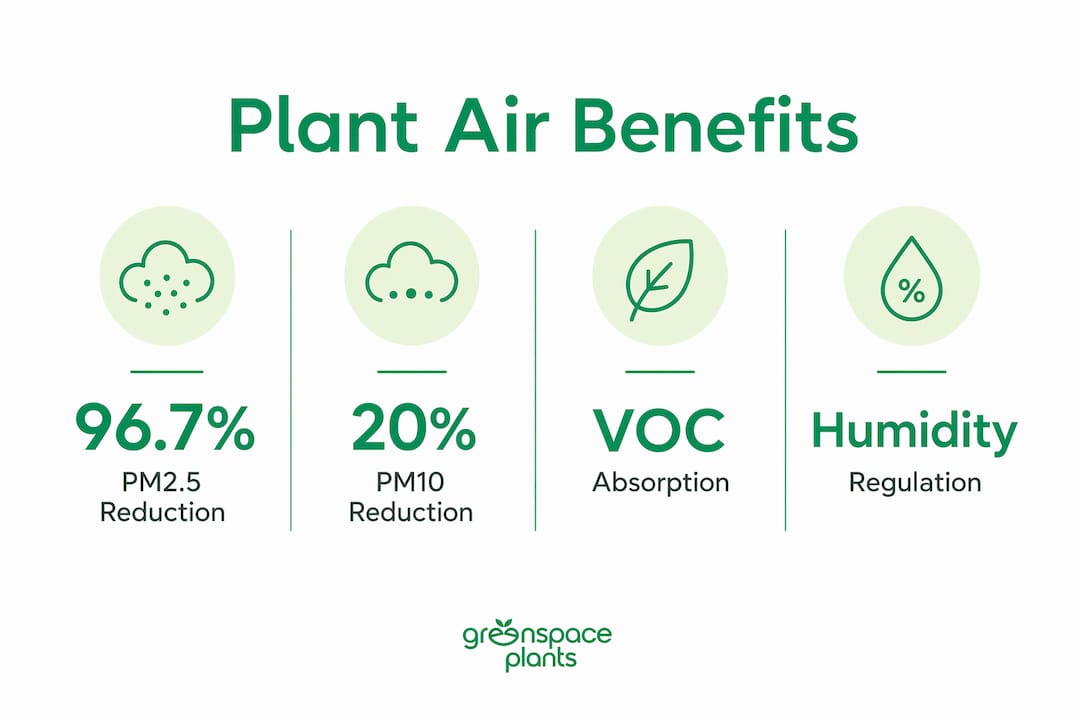
The numbers from recent research are striking. PM10 drops by 18–20% and PM2.5 by up to 96.7% in sealed commercial rooms with plant coverage. VOC reductions of 25–50% appear consistently in office environments. These figures come from controlled conditions, which means real-world results in ventilated, occupied spaces will be lower. Still, the directional evidence is clear: plants do remove pollutants from indoor air.
Leaf surfaces capture fine particles through electrostatic attraction and surface texture. Stomata, the tiny pores on leaves, absorb gaseous pollutants like formaldehyde, benzene, and toluene directly into plant tissue. The soil microbiome also plays a role, breaking down certain VOCs at the root zone. This three-layer filtration effect is what makes a well-chosen plant more than a decorative object.

Microclimate benefits
Plants also regulate temperature and humidity in ways that mechanical systems alone cannot replicate. Indoor greenery lowers air temperature by 1–2 °C and raises relative humidity by 6–15% through transpiration. In a dry Toronto or Calgary office in winter, that humidity increase directly reduces respiratory irritation and static electricity. These microclimate effects contribute to perceived air quality even when pollutant concentrations are not dramatically changed.
Pro Tip: Place plants near air return vents to increase the volume of air passing over leaf surfaces, which raises the effective pollutant contact rate without adding mechanical complexity.
| Pollutant type | Plant effect | Conditions |
|---|---|---|
| PM2.5 | Up to 96.7% reduction | Sealed or low-ventilation rooms |
| PM10 | 18–20% reduction | Controlled commercial settings |
| VOCs (formaldehyde, benzene) | 25–50% reduction | Office environments with plant coverage |
| Temperature | 1–2 °C drop | Spaces with sufficient plant density |
| Relative humidity | 6–15% increase | Transpiring plants in occupied rooms |
Why can't plants replace mechanical filtration and ASHRAE ventilation standards?
Plants cannot match the Clean Air Delivery Rate (CADR) of mechanical filtration systems. Mechanical filtration removes over 90% of PM1–3 micron particles, a performance level no realistic plant installation can reach in a ventilated, occupied commercial space. ASHRAE Standard 62.2 sets minimum ventilation rates precisely because natural airflow and plant-based removal are insufficient for occupied buildings.
The most cited illustration of this gap comes from a Drexel University meta-analysis. It found you would need 10 to 1,000 plants per square meter to match the pollutant removal rate of typical home ventilation. Commercial spaces generate pollutants far faster than any plant arrangement can process. People, printers, cleaning products, and building materials all off-gas continuously.
The 1989 NASA plant air purification study is the source of much of the public optimism about plants as air filters. NASA's findings are frequently misinterpreted because the original experiments used sealed chambers with no ventilation, conditions that bear no resemblance to a working office or restaurant. Real-world ventilation cycles air through a space many times per hour, diluting pollutants faster than plants can absorb them.
This does not mean plants are ineffective. It means their role is complementary, not primary.
- Plants reduce background VOC and particulate levels between air exchanges
- Plants improve humidity and temperature in ways HVAC systems often do not address
- Plants provide psychological benefits that mechanical systems cannot replicate
- Plants perform best in lower-occupancy periods and overnight, especially CAM-pathway species like Sansevieria and Dracaena that fix CO2 at night
Pro Tip: If your space uses MERV 13 or higher filters, plants work best as a humidity and VOC buffer rather than a particle filter. Let the HVAC handle particles and let the plants handle the microclimate.
Which plant species best improve air quality in commercial spaces?
Not all plants perform equally. The Air Pollution Tolerance Index (APTI) is the standard metric for ranking plant species by their ability to absorb pollutants without suffering damage. APTI ranks Cordyline fruticosa highest among ornamental species at 14.76%, correlating directly with pollutant removal efficiency.
The physiological traits that drive high APTI scores include stomatal density, cuticle wax thickness, and leaf surface area. Cuticle wax and stomatal behavior are the two most critical factors for VOC adsorption. Species with waxy, broad leaves and high stomatal counts absorb more gaseous pollutants per unit of leaf area.
Here are the top-performing species for commercial IAQ applications:
- Cordyline fruticosa: Removes VOCs up to 87.5% and CO by 88.2% in pharmaceutical lab settings. Tolerates low light and irregular watering, making it practical for office environments.
- Syngonium podophyllum: Strong VOC and CO2 absorption, with CO2 reductions of 20–37%. Grows well in indirect light and adapts to a range of humidity levels.
- Sansevieria (Snake Plant): A CAM-pathway plant that absorbs CO2 and releases oxygen at night. Ideal for spaces occupied primarily during the day.
- Dracaena species: Proven formaldehyde and benzene absorbers with high drought tolerance. Low maintenance requirements make them reliable in busy commercial settings.
- Spathiphyllum (Peace Lily): High transpiration rate supports humidity regulation. Performs well in low-light lobbies and reception areas.
Species selection should match both the dominant pollutant type in your space and the light conditions available. A pharmaceutical lab with solvent exposure needs different plants than a law firm lobby with off-gassing furniture.
How to integrate plants into a commercial IAQ management plan
Combining plants with mechanical systems produces better IAQ outcomes than either approach alone. Mechanical filtration and ventilation remain the primary IAQ controls, and plants work best when layered on top of a functioning HVAC and filtration baseline. The goal is to use plants where they add the most value: humidity control, VOC buffering, and occupant wellbeing.
Here is a practical integration sequence for commercial spaces:
- Audit your baseline IAQ. Measure PM2.5, PM10, VOC levels, temperature, and humidity before adding plants. This gives you a reference point for tracking improvement and helps identify which pollutants are most problematic. An indoor air quality improvement checklist should include all five metrics.
- Confirm your mechanical baseline. Plants complement MERV 13+ filtration and ASHRAE 62.2-compliant ventilation. If your HVAC system is underperforming, fix that first. Plants cannot compensate for inadequate air exchange rates.
- Select species by zone. Use high-APTI species like Cordyline fruticosa and Syngonium podophyllum in areas with known VOC sources such as print rooms, kitchens, and newly furnished spaces. Use Sansevieria and Dracaena in overnight-occupied or low-light zones.
- Distribute plants strategically. Cluster plants near pollutant sources and air circulation paths rather than placing them purely for aesthetics. A plant near a printer absorbs more VOCs than one in a corner with no airflow.
- Maintain plant health proactively. Stressed or dying plants stop absorbing pollutants and can introduce mold spores into the air. Regular professional maintenance, including soil checks, pruning, and pest management, keeps plants functioning as IAQ assets rather than liabilities.
- Reassess quarterly. Measure the same five IAQ metrics every quarter and adjust plant placement or species mix based on results. Office greenery benefits extend beyond air quality to productivity and mood, so track those outcomes too.
Pro Tip: Diversity matters. A mix of five or more species covers a broader range of pollutants and reduces the risk of a single pest or disease wiping out your entire plant-based IAQ contribution.
Key Takeaways
Plants measurably improve indoor air quality in commercial spaces, but their greatest value comes when integrated with MERV 13+ filtration and ASHRAE-compliant ventilation, not used as a standalone solution.
| Point | Details |
|---|---|
| Plants reduce real pollutants | PM2.5, PM10, and VOCs all drop measurably in spaces with adequate plant coverage. |
| Mechanical systems come first | ASHRAE 62.2 ventilation and MERV 13+ filters remain the primary IAQ controls. |
| Species selection drives results | High-APTI species like Cordyline fruticosa and Syngonium podophyllum outperform generic office plants. |
| Placement amplifies impact | Positioning plants near pollutant sources and airflow paths increases effective pollutant contact. |
| Maintenance is non-negotiable | Unhealthy plants stop filtering and can introduce new contaminants. Professional upkeep is required. |
What I've learned from watching plants work in real commercial spaces
After seeing dozens of commercial plant installations across offices, restaurants, and lobbies, the pattern is consistent. Businesses that treat plants as a standalone air quality fix are always disappointed. Businesses that treat plants as one layer of a broader IAQ strategy are consistently satisfied.
The psychological and aesthetic benefits are real and should not be dismissed. Plants contribute stress relief and mood benefits that no HEPA filter can replicate. Occupants in greener spaces report feeling better even when the measured air quality improvement is modest. That perception matters for employee retention and client impressions, especially in competitive markets like Toronto and Vancouver.
My honest advice: set realistic expectations about what plants can do for your air quality numbers, then let the plants exceed expectations on everything else. The combination of cleaner air, better humidity, lower stress, and a more appealing environment is a genuinely strong business case. You just have to build it honestly.
— Nicole
How Greenspace Plants supports your commercial IAQ goals
Choosing the right species, placing them where they perform best, and keeping them healthy enough to actually filter air requires expertise that goes well beyond buying plants from a garden center.

Greenspace Plants designs and maintains commercial plant installations across Toronto, Vancouver, and Calgary with IAQ performance in mind. Through the Greenspace+ program, your business gets species selection, professional installation, and ongoing maintenance for a fixed monthly fee with no upfront cost. Every plant stays healthy and productive because our team handles everything from soil amendments to pest management. If you want to see what a well-designed plantscape looks like in practice, the Greenspace client look-book shows real installations across a range of commercial settings.
FAQ
How do plants filter indoor air pollutants?
Plants absorb gaseous pollutants like formaldehyde and benzene through leaf stomata and capture fine particles on leaf surfaces. Soil microbes at the root zone also break down certain VOCs, adding a second layer of filtration.
Can plants replace air purifiers in a commercial office?
Plants cannot replace mechanical air purifiers or HVAC filtration. A Drexel University meta-analysis found you would need 10 to 1,000 plants per square meter to match standard ventilation pollutant removal rates. Plants work best as a complement to MERV 13+ filtration.
Which plants are best for improving indoor air quality?
Cordyline fruticosa and Syngonium podophyllum rank highest on the Air Pollution Tolerance Index and remove VOCs and CO most effectively. Sansevieria and Dracaena are strong secondary choices for low-light or overnight-occupied spaces.
How do you measure indoor air quality improvement from plants?
Track PM2.5, PM10, VOC concentrations, temperature, and relative humidity before and after adding plants. Quarterly measurements give you enough data to identify trends and adjust plant placement or species mix accordingly.
Do live plants outperform faux plants for air quality?
Live plants outperform faux plants entirely on air quality. Artificial plants provide no pollutant absorption, no humidity regulation, and no microclimate benefit. Only living plants with active stomata and soil microbiomes contribute to phytoremediation.