
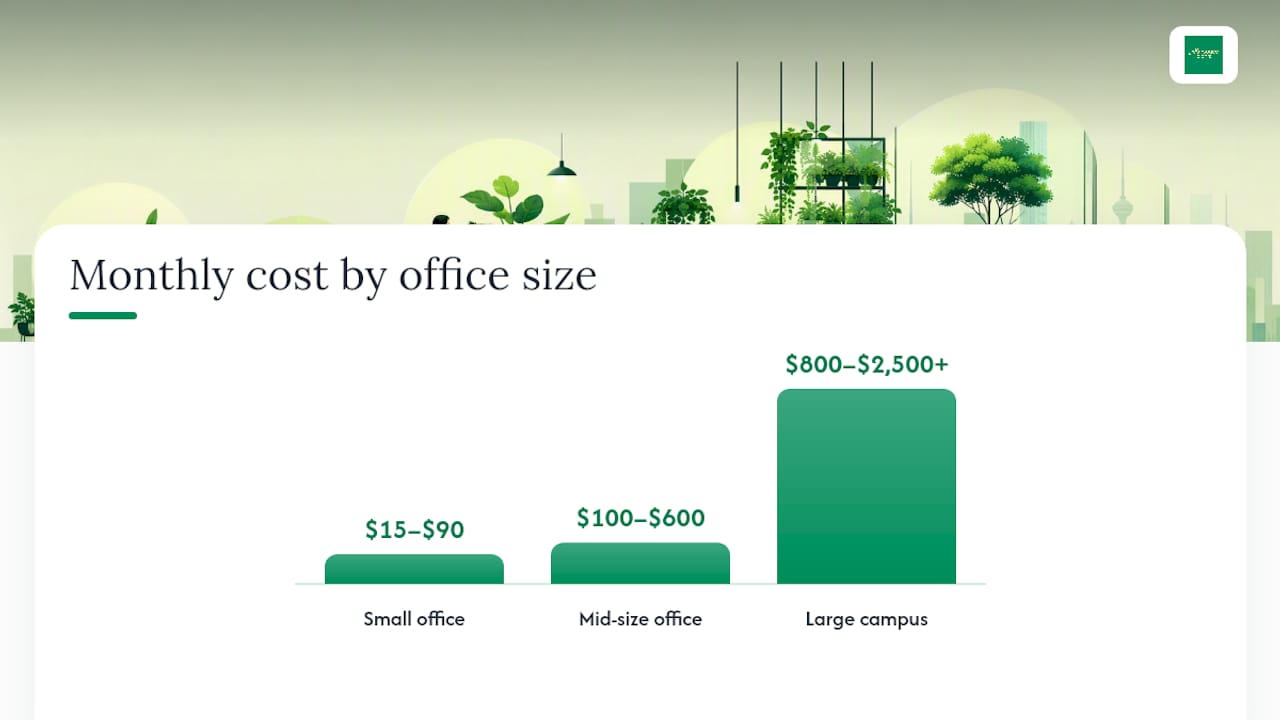
Most Canadian offices with 5 to 15 plants spend roughly $15 to $90 a month on professional care, mid-size offices with 20 to 60 plants land between $100 and $600, and larger campuses with 100 or more plants typically run $800 to $2,500 or higher. If your space has harsh lighting, aggressive HVAC, or heavy foot traffic, an all-inclusive rental program generally offers steadier budgeting compared to paying for maintenance alone.
TL;DR:
- Office plant maintenance costs vary widely depending on office size, ranging from $15 to $90 monthly for small offices and up to $2,500 or more for large campuses with 100+ plants.
- Rental programs offer predictable monthly fees and include design, installation, and guaranteed replacements, making budgeting easier in environments with harsh lighting or aggressive HVAC.
- Maintenance costs are influenced mainly by plant size, visit frequency, species complexity, and access logistics, with per-plant expenses typically falling between $3 and $25 monthly.
- Detailed quotes should itemize labor, materials, and services to prevent hidden charges, and guaranteed replacements help shift risk away from the client.
- Most routine office plant expenses are treated as operating costs in Canadian accounting, while large installations like living walls may be capitalized depending on organizational policies.
Table of Contents
- What Does Office Plant Maintenance Cost Depend On?
- What Drives the Cost of Plant Maintenance Services?
- How Much Should You Budget Per Plant Each Month?
- How Do You Read a Plant Maintenance Quote?
- Should Plant Maintenance Be an Operating Expense in Canada?
- How Can You Reduce Ongoing Office Plant Costs?
- What Canadian Clients Get Wrong About Plant Maintenance Budgets
- A Predictable Monthly Plant Program for Canadian Offices
- Sources
- FAQ
What Does Office Plant Maintenance Cost Depend On?
The number tied to "office plant maintenance cost" changes dramatically depending on which pricing model you choose. Canadian vendors generally offer three routes, and each shifts risk and cashflow differently.
Rental or all-inclusive programs are the most predictable option. The provider owns the plants, charges a flat monthly fee, and typically covers design, installation, and replacements under a guarantee. Setup fees are sometimes waived, and contracts are often flexible rather than locked in for years.
Maintenance-only service works when you already own healthy plants. You pay for labor and materials as billed, and maintenance-only pricing usually runs lower per visit, but you absorb the cost of replacing plants that fail.
One-time purchase plus ad hoc care suits offices with minimal greenery and staff willing to handle basic watering themselves.
- Choose rental if your office has unpredictable light, dry HVAC air, or you want zero capital outlay.
- Choose maintenance-only if you have healthy specimens already and someone in-house tracking plant health.
- Choose one-time purchase only for small, low-visibility spaces where plant failure carries little cost.
What Drives the Cost of Plant Maintenance Services?
Vendors build quotes around a handful of variables, and understanding them lets you predict how a quote changes before you even ask.
Plant count and specimen size matter most. A six-foot fiddle leaf fig costs more to maintain than a desktop succulent, both in materials and in the technician's time.
Visit frequency cuts the other way. Weekly visits raise your monthly total but catch problems early. Monthly visits lower labor costs but raise the odds a struggling plant gets replaced instead of saved.
Species and container complexity affect replacement likelihood. Tropical plants in decorative ceramic containers need more attention than hardy species in standard plastic liners.
Access and logistics add cost too:
- Multi-floor buildings with slow elevators increase technician time per visit.
- Loading dock restrictions or after-hours access requirements often carry surcharges.
- Downtown high-rises with tight security checkpoints add delays vendors have to price in.
Optional add-ons like pest audits, irrigation checks, or green wall maintenance sit outside standard visits and get quoted separately.
Pro Tip: Ask any vendor to break out their quote by plant count versus visit frequency. If a proposal only shows one lump number, you can't tell which lever to pull if you need to trim your budget later.
How Much Should You Budget Per Plant Each Month?
Per-plant monthly maintenance typically ranges from $3 to $25, with most standard office care landing between $5 and $12 per plant. The lower end covers basic watering and dusting on a monthly rotation. The higher end includes weekly visits, fertilizing, pest monitoring, and guaranteed replacement.
Here's how that scales into monthly totals for typical Canadian offices:
| Office size | Plant count | Typical monthly range |
|---|---|---|
| Small office | 5–15 plants | $15–$90 |
| Mid-size office | 20–60 plants | $100–$600 |
| Large campus | 100+ plants | $800–$2,500+ |
Per-visit pricing tells a similar story. Small offices often pay $40 to $120 per visit, while larger, denser installations run $200 to $400 per visit. Specialized services like disease diagnostics or full plant health audits cost more on top of that.
Higher prices are justified when a space includes large feature plants, a green wall installation, or a site that's genuinely hard to service, think loading docks with restricted hours or buildings requiring escort access. A reception area with one dramatic six-foot specimen can cost more to maintain than twenty small desk plants scattered across cubicles.
How Do You Read a Plant Maintenance Quote?
A proposal that just lists one number tells you nothing about what you're actually paying for. Ask vendors to itemize their quote breakdown into distinct line items, since labor and plant materials typically make up the largest share of the bill.
Look for these components broken out separately:
- Labor (technician visits and time on-site)
- Plant materials and soil amendments
- Equipment (irrigation tools, pruning gear)
- Delivery and installation
- Replacement plants under guarantee
Replacement guarantees deserve extra scrutiny. A strong guarantee shifts risk to the provider rather than leaving you to absorb the cost every time a plant declines. Ask specifically what triggers a free replacement and how fast it happens.
Before signing anything, ask each vendor the same set of questions so you're comparing apples to apples: What's included in the base visit? What counts as an "out of scope" repair? Are travel fees built in, or added separately for distant locations? Watch for hidden charges tied to after-hours access or specialty containers that aren't mentioned until the first invoice arrives.
Should Plant Maintenance Be an Operating Expense in Canada?
In Canadian accounting practice, ongoing office plant service is almost always treated as an operating expense rather than a capital purchase. Monthly maintenance fees, replacement plants, and routine service visits flow through your operational budget like cleaning or facilities contracts.
Large architectural installations, such as a built-in living wall, sometimes get capitalized depending on your organization's accounting policy and the installation's expected useful life. That distinction is worth raising with your finance team early, before the invoice arrives.
For smooth approvals, your finance department will want itemized invoices that separate labor, materials, and replacement costs, plus a clear service-level description and replacement terms in writing. GST/HST documentation should appear on every invoice the same way it would for any other service contract. Because tax treatment can vary by organization and by the scale of the installation, consult a tax professional for guidance specific to your books.
How Can You Reduce Ongoing Office Plant Costs?
Cutting your plant maintenance bill without sacrificing quality comes down to a few concrete moves.
- Choose hardy species. Sansevieria, ZZ plants, and Dracaena tolerate low light and dry HVAC air far better than tropical varieties, which cuts your replacement rate significantly.
- Use standard planters. Custom or oversized containers add labor time and complicate replacements; standard sizing keeps service simple.
- Set zone-based service levels. Give high-visibility areas like reception more frequent visits, and let back-of-house zones run on a lighter schedule.
- Negotiate a trial period. A short trial with a documented replacement cadence shows you actual vendor responsiveness before you commit long term.
When you're ready to send out an RFP, build it around scope, plant counts by zone, visit frequency, access assumptions, vendor response times, and how often you'll receive service reports.
Pro Tip: Vendors often set a minimum monthly fee to cover travel and account management, so a tiny account with just a handful of plants may still face a fixed floor price regardless of plant count.
What Canadian Clients Get Wrong About Plant Maintenance Budgets
The biggest mistake we see is underbudgeting for replacements. Office managers often price out the monthly visit fee and stop there, forgetting that a struggling plant near a drafty window or an aggressive HVAC vent will need replacing eventually, and that cost has to live somewhere in the budget.
We also see clients underestimate access constraints. A building with a slow freight elevator or a strict after-hours policy adds real time to every visit, and that shows up in the invoice whether it was priced in upfront or not.
In our experience, Canadian offices with harsh microclimates, think dry winter air fighting constant forced air heating, do best with all-inclusive programs. It shifts replacement risk off your books entirely. Whatever route you choose, always ask for an itemized proposal and a short trial period before signing anything long term.
— Nicole
A Predictable Monthly Plant Program for Canadian Offices
If you've read this far, you already know the real cost driver isn't the plants themselves, it's the unpredictability of replacements, access surprises, and line items buried in a vague office furniture removal quote that your vendor should clearly explain. One fixed monthly fee covers design, installation, ongoing maintenance, and guaranteed replacements, with no upfront cost and no long-term lock-in.
This fits best for office managers who want plant care to behave like every other predictable line item on the budget, not a source of surprise invoices. Whether you're outfitting a reception area, a boardroom, or a full floor, our team designs around your space and handles everything after that. If you're weighing interior plant services across Canada, the next step is simple: request a site audit and get an itemized proposal built around your actual square footage and plant count, no guessing required.
Sources
- Office plant service cost, price ranges, and how to budget smartly
- Can you hire a professional plant maintenance service for your office? Costs, contracts, and benefits
- Greenspace Plants — service and procurement guidance
- Are plants an office expense? Workplace budget guide
FAQ
What Is a Good Low-Maintenance Office Plant?
Sansevieria (snake plant), ZZ plant, and Dracaena are among the most reliable choices for Canadian offices because they tolerate low light and dry, climate-controlled air far better than tropical species. These species also lower your replacement rate over time, which keeps monthly maintenance costs more predictable.
How Much Does Office Plant Maintenance Typically Cost Per Month?
Small offices with 5 to 15 plants usually pay $15 to $90 monthly, mid-size offices with 20 to 60 plants pay $100 to $600, and large campuses with 100 or more plants often pay $800 to $2,500 or more. The exact figure depends on plant size, visit frequency, and site access.
Is It Cheaper to Buy Plants Outright or Rent Them?
Buying plants outright can look cheaper upfront, but it shifts all replacement risk and long-term care costs to you. Rental or all-inclusive programs cost more per month on paper but include guaranteed replacements, which often makes them more cost-effective over a full year in harsh office environments.
What Does Greenspace+ Include?
There is an all-inclusive monthly service that covers plant design, installation, ongoing maintenance, and guaranteed replacements with no upfront cost. It's built for office managers who want plant care handled as one predictable line item rather than a series of separate invoices.
Should Office Plants Be Classified as a Capital Expense?
Most routine plant maintenance and rental fees are treated as an operating expense in Canadian accounting practice. Large installed features like living walls sometimes get capitalized depending on your organization's policy, so check with a tax professional for guidance specific to your books.
Recommended
- Indoor Office Plant / All about indoor plant rental
- 12–18 Months Payback: Office Plant ROI for Facilities Managers
- Indoor Office Plant / How Much Does a Commercial Indoor Plant Service Cost?
- Indoor Office Plant / More Than Just a Watering Can: What to Expect During a Greenspace Plants Maintenance Visit