
Hire a full-service commercial plantscaping provider that handles design, installation, irrigation commissioning, and fixed-fee maintenance — that's the single best decision you can make for a high-ceiling atrium. Request a no-obligation site survey and a written quote with line-item pricing and a replacement guarantee before signing anything. Greenspace+ is a turnkey example of this model: one fixed monthly fee covers everything from specimen sourcing to emergency plant replacement, with no upfront capital outlay.
Here's what to request in every proposal:
- A documented site survey with lighting measurements at multiple heights
- Line-item pricing that separates installation, planters, irrigation, and monthly maintenance
- A written replacement guarantee with stated response times
- Proof of commercial liability insurance and lift/crane operator certificates
- References from comparable atrium projects with contactable clients
Key Takeaways
Full-service atrium plantscaping requires commercial-grade specimens, engineered irrigation, and a written replacement guarantee — not a retail plant list and a monthly watering visit.
| Point | Details |
|---|---|
| Hire full-service from day one | Require design, installation, irrigation commissioning, and maintenance in a single contract. |
| Demand line-item pricing | Separate labor, equipment, plant allowances, and replacement terms so proposals are comparable. |
| Require irrigation commissioning | Soil probing at handover catches cracked lines and dry pockets before plant loss occurs. |
| Insist on maintenance logs | Monthly reports and inventory records are standard in commercial contracts and protect your investment. |
| Greenspace Plants | Greenspace+ bundles all deliverables under a fixed monthly fee with a guaranteed replacement policy. |
Pro Tip: Walk the atrium with your shortlisted vendor before awarding the contract. How they read the space — sightlines, light levels, HVAC vents, floor loading — tells you more about their competence than any proposal document.
Table of Contents
- What does a full-service atrium plantscaping engagement cover?
- What should you measure before specifying plants for high-ceiling atriums?
- Which plant categories work best in tall commercial atriums?
- How does installation work for tall atrium spaces?
- What does ongoing maintenance cost and how is it priced?
- What questions should you ask vendors before signing?
- What do successful atrium projects look like in practice?
- What most providers get wrong about atrium plantscaping
- Greenspace Plants brings full-service atrium expertise to your space
- Sources
What does a full-service atrium plantscaping engagement cover?
A well-structured commercial plantscaping contract covers four distinct deliverable categories. Knowing each one helps you spot gaps in vendor proposals before you sign.
Design deliverables include a site survey, photometric lighting analysis, a scaled planting plan, planter specifications, and layout drawings. These documents become the basis for procurement and building approvals.
Installation deliverables cover specimen procurement, nursery acclimation, rigging and lift work, planter installation, and irrigation commissioning. Each step requires coordination with your building operations team.
Maintenance deliverables are where most contracts fall short. Per commercial procurement standards, a complete scope includes scheduled watering, fertilization, pruning, Integrated Pest Management (IPM), monthly reporting, emergency response, and a plant replacement guarantee. Anything less is a gap.
Administrative deliverables should include insurance certificates, maintenance logs, a live plant inventory, and a single point of contact for building coordination.
Pro Tip: Schedule service windows to align with your building's HVAC maintenance cycles. Technicians working alongside HVAC crews reduces disruption and lets both teams flag shared issues — like supply vents blowing directly onto specimen canopies — before they cause plant stress.
What should you measure before specifying plants for high-ceiling atriums?
The site survey is where atrium projects succeed or fail. Vague measurements produce inaccurate proposals; accurate ones let designers specify the right specimens and planters the first time.
Measure and document:
- Clear vertical dimensions from finished floor to the underside of the structure
- Glazing orientation (north, south, east, west) and shading obstructions
- Light levels at multiple heights using a foot-candle meter, not just at floor level
- HVAC supply and return locations, and any cold-air drafts near planting zones
- Floor loading capacity and structural zones where heavy planters can be placed
- Service elevator dimensions, stair access widths, and overhead rigging points
Design constraints worth flagging early include sightlines from reception desks and elevator lobbies, glare on glazed façades that can scorch foliage, and planter weight limits that restrict rootball size. For glazing with significant sun exposure, pairing light-control treatments with your planting plan — similar to how arch window treatments manage solar gain in tall spaces — can protect sensitive specimens from hot spots.
Protect interior finishes by specifying planter skirt details, drip trays sized to the irrigation volume, and a routed overflow line that drains to a floor drain rather than onto tile or carpet.
Pro Tip: Preserve sightlines by using tiered planting and deliberate negative space rather than filling every square foot. For large specimen trees, specify a sacrificial lower-branch pruning zone — the bottom 18–24 inches of canopy — so foot traffic and maintenance access don't damage the tree over time.
Which plant categories work best in tall commercial atriums?
The right answer here is categories and sourcing standards, not a retail plant list. Commercial atriums need commercial-grade specimens.
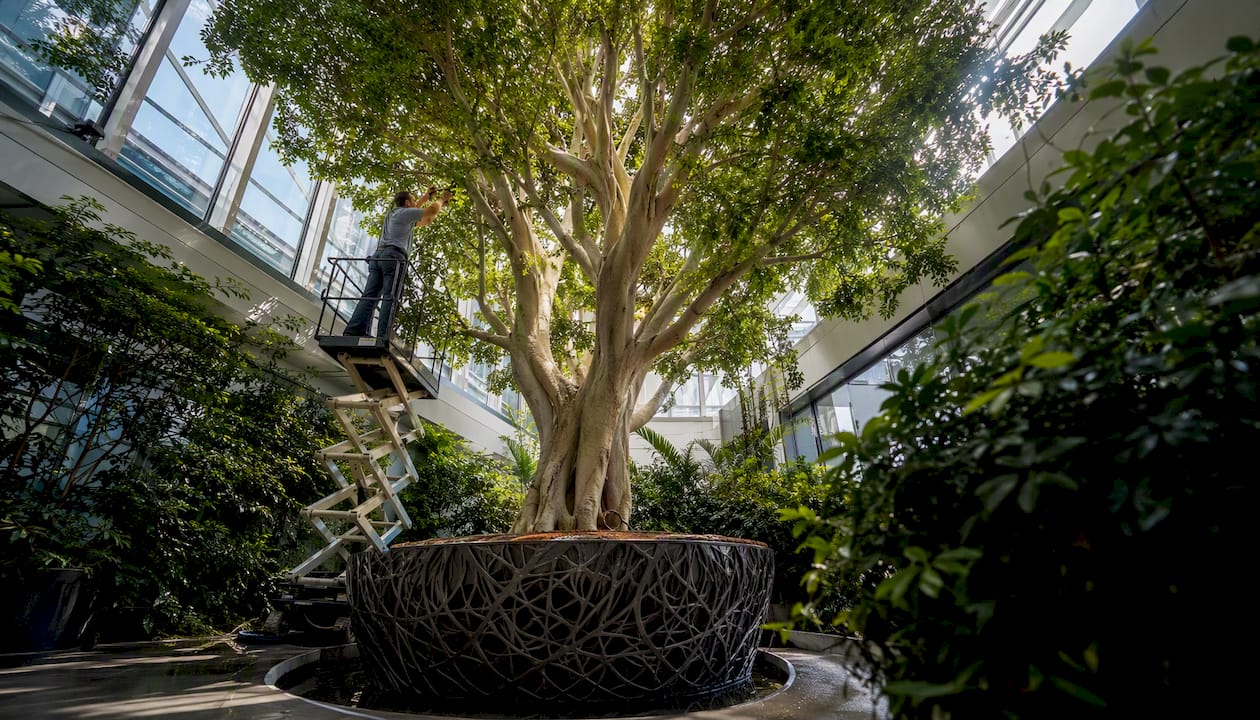
Focal specimen trees anchor the design. Look for architectonic trunk form, a rootball sized to your structural planter, and documented nursery conditioning. Large-trunk specimens and indoor-adapted ficus varieties are common choices; what matters more than species is that your vendor supplies a written acclimation record. High light in atriums drives fast growth and increases nutrient demand, so quarterly fertilization is the minimum for specimens under direct glazing.
Palms and columnar species add vertical emphasis and translucency under high light. They work well in atriums where you want height without blocking sightlines, because their canopy is open rather than dense.
Understory and filler species cover soil surfaces and provide lower-level screening. Choose low-shedding, durable varieties. Trailing species like pothos can overtake beds quickly if pruning isn't scheduled — unchecked growth in dense plantings creates hazardous zones and accelerates pest spread.
For planters, specify structural containers rated to your building's floor-load limits, engineered soil mixes with appropriate drainage, root barriers where irrigation lines run beneath pavers, and drip-irrigation interfaces built into the planter base. See large-statement indoor plant examples for visual reference on scale and arrangement.
Pro Tip: Require commercial nursery sourcing — not retail houseplants — and a 30–90 day acclimation and conditioning period after installation. Specimens moved directly from a greenhouse to a high-ceiling atrium without conditioning drop foliage, stress their root systems, and often fail within the first season.
How does installation work for tall atrium spaces?
Installation in a high-ceiling atrium is a construction-grade operation, not a plant delivery. Treat it that way in your contract.
A typical project sequence runs:
- Design approval and building permit submission
- Nursery procurement and conditioning period (30–90 days)
- Delivery scheduling, staging area setup, and rigging plan approval
- Lift or crane operation, planter placement, and specimen installation
- Irrigation commissioning and line pressure testing
- Post-install pest inspection and commissioning walk-through
- First-year maintenance schedule handover
Before installation begins, confirm:
- Building permits and management approvals are in hand
- Lift access plans are reviewed by your building's structural engineer
- Staging and laydown areas are designated away from fire exits
- Fire-suppression and glass-protection protocols are documented
- Lift operator certificates and contractor insurance are on file
OSHA standards for elevated work apply to any contractor performing lift or crane operations in your building. Require proof of OSHA-compliant training and current insurance before any rigging begins — your building's liability depends on it.
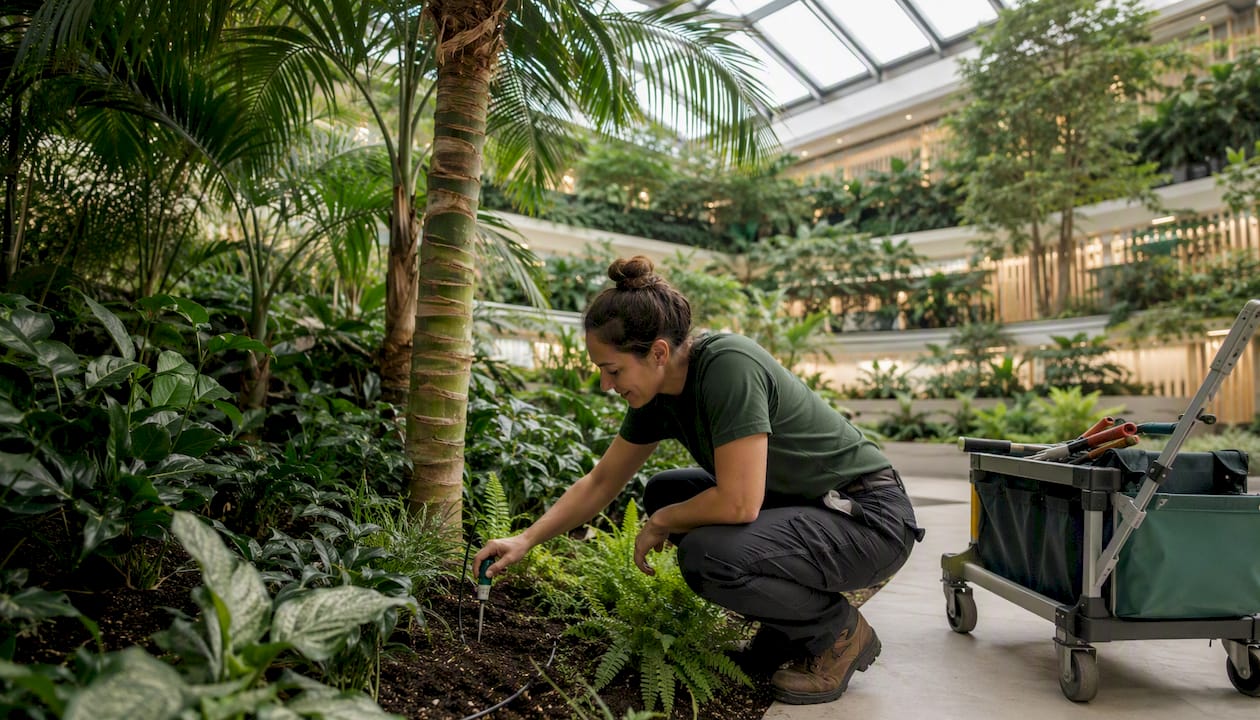
At commissioning, use a soil probe across multiple bed locations to verify moisture distribution. Wet spots indicate cracked drip lines; dry pockets suggest clogs. Catching either before handover prevents plant loss in the first 90 days.
What does ongoing maintenance cost and how is it priced?
Maintenance for tall atriums is more labor-intensive than standard office plantscaping, primarily because access equipment is often needed for canopy work.
| Task | Typical Frequency |
|---|---|
| Watering | Weekly or biweekly |
| Pest inspection (IPM) | Weekly or biweekly |
| Pruning | Monthly or as needed |
| Fertilization | Quarterly (more under high light) |
| Irrigation inspection | Monthly or quarterly |
| Soil probing and testing | Quarterly |
| Maintenance reporting | Monthly |
| Emergency visits | As needed, per SLA |
The three most common pricing models are: an all-inclusive fixed monthly fee (the subscription model, which bundles all tasks and replacements); tiered service levels with a base fee plus add-on rates for lift work or emergency visits; and a one-time installation plus time-and-materials maintenance arrangement.
The line items that drive price upward are specimen size and quantity, custom planters, irrigation complexity, lift or crane requirements, travel and access time, and the scope of the replacement guarantee.
Pro Tip: Request line-item pricing that separates labor, equipment, parts, and plant replacement allowances. A single bundled number makes it impossible to compare proposals or identify where costs will escalate over time.
What questions should you ask vendors before signing?
Use this checklist when evaluating proposals. It covers the questions that separate professional commercial plantscapers from general landscapers who occasionally work indoors.
Contract terms to require:
- Commercial general liability and workers' compensation certificates
- Lift and crane operator certificates
- Written replacement guarantee with stated response time
- Maintenance logs and inventory reports delivered monthly
- Schedule of service visits with named technician contacts
Questions to ask every vendor:
- Who sources your specimens, and can you provide nursery conditioning records?
- What is your acclimation process for large specimen trees?
- How do you handle irrigation failures and emergency plant replacement?
- Can you provide site-specific maintenance logs from a comparable project?
- Do you carry out soil testing, and how do you handle remediation if a problem is found?
Red flags to watch for:
- Vague replacement terms ("we'll replace as needed") with no defined timeline
- No insurance certificates or refusal to name the carrier
- One-size-fits-all service frequency that doesn't account for atrium light levels
- Refusal to provide line-item pricing or contactable references
What do successful atrium projects look like in practice?
Two project types illustrate how full-service delivery works in commercial atriums.
Large-statement specimen installation: A corporate lobby atrium receives two architectonic specimen trees, each requiring a 48-hour nursery conditioning period on-site before placement. A scissor lift positions the rootballs into structural planters rated to the floor load. Irrigation lines are pressure-tested at commissioning, and a 12-month maintenance cadence begins the following week. The outcome: zero plant loss in the first year, with monthly reporting delivered to the property manager.
Multi-level atrium with palms and understory mix: A restaurant group's multi-story dining atrium receives a palm canopy layer at the upper level and a low-shedding understory mix at the mezzanine. Integrated drip irrigation feeds both levels from a single controller. The client signs a fixed monthly service agreement that covers all maintenance visits, fertilization, IPM, and plant replacements. No surprise invoices, no separate call-out fees.
Both projects follow the Greenspace+ service model: a fixed monthly fee that bundles design, installation, ongoing care, and guaranteed replacements. The Greenspace Plants portfolio includes large-statement installations developed in collaboration with interior designers — a useful benchmark when requesting references from any vendor.
What most providers get wrong about atrium plantscaping
The most common atrium failure we see isn't a plant choice problem. It's an irrigation problem that nobody caught in time.
Drip lines in large planters crack or shift during the first season as soil settles. Without monthly irrigation inspections and soil probing, those breaks go undetected for weeks. By the time foliage loss is visible, the root system is already compromised. In one documented case, a well-intentioned cleaning crew used a disinfectant spray near a planting bed; the resulting salt buildup required a professional lab test to diagnose and a full soil remediation to fix. That's an expensive lesson in why maintenance logs and proactive soil testing belong in every contract, not just the premium tier.
The practical tip we give every new client: ask your vendor to show you the soil probe readings from their last three service visits on a comparable account. If they don't have them, that tells you everything about how they'll manage yours.
Greenspace Plants brings full-service atrium expertise to your space
Your atrium deserves more than a plant delivery and a handshake. Greenspace Plants provides complete commercial plantscaping — from the initial site survey through specimen sourcing, installation, and every maintenance visit after that. The Greenspace+ program covers design, installation, scheduled maintenance, and guaranteed plant replacements under a single fixed monthly fee, with no long-term lock-in and no surprise invoices.
We collaborate with interior designers and property managers to specify the right specimens, planters, and irrigation for your specific atrium dimensions and light conditions. Our client lookbook shows large-statement installations at the scale your space requires. Request a site survey and written quote to get line-item pricing and a replacement guarantee in writing.
Sources
- 5 Expert Tips for Easy Atrium Maintenance
- Infrastructure - Invitation to Bid - Interior… | CLEATUS
- Indoor Plant Service Canada / Collaborating with Interior Designers