
Lighting is the single decisive factor in choosing which plants will survive and thrive in a commercial interior. Before specifying a single species, measure the intended placement in foot-candles or PPFD at pot height, then match that reading to each plant's documented light band — or specify a supplemental full-spectrum LED fixture that meets the required Daily Light Integral (DLI). Research confirms that plants starve or etiolate when placed in spots that don't meet their stated light band, and that intensity drops sharply with even a few feet of distance from a window. At Greenspace Plants, every installation brief starts with a site light audit — because the role of lighting in plant selection is not a detail, it's the foundation.
Table of Contents
- How light intensity, duration, and spectrum control what plants can do
- Why sun-loving and shade-tolerant species behave so differently
- How to measure light in real interiors before you specify anything
- Matching plant families to common commercial light scenarios
- What to call out in your fixture spec for plant performance
- Maintenance, monitoring, and lifecycle: what to track month by month
- When lighting isn't the problem: diagnosing other environmental limits
- Spec checklist and RFP language you can use today
- Key Takeaways
- What commercial plant installers actually see in the field
- Greenspace Plants: spec-ready indoor plant service for commercial interiors
- Curated sources for further reading and measurement tools
How light intensity, duration, and spectrum control what plants can do
Three physical variables govern whether a plant photosynthesizes well enough to hold its form in a commercial interior.
Intensity is the amount of photosynthetically active radiation reaching the leaf. It's measured in lux (total visible light), foot-candles (lux ÷ 10.76), or PPFD (photosynthetic photon flux density, in µmol/m²/s). PPFD is the most precise unit for plant work because it counts only the wavelengths plants actually use. Photosynthesis rate increases with intensity up to a species-specific saturation point; beyond that, excess light causes bleaching rather than faster growth.
Duration, or photoperiod, is how many hours of light a plant receives per 24-hour cycle. Foliage houseplants generally need 12–14 hours; flowering species need 14–16 hours. Critically, plants need a dark period — running supplemental fixtures beyond roughly 16 hours per day disrupts internal rhythms and can impair development. Program timers accordingly.
Spectrum (the color balance of light) shapes plant morphology as much as it fuels photosynthesis. Key points:
- Blue light (400–500 nm) drives compact, leafy growth and stomatal opening.
- Red light (600–700 nm) promotes flowering and stem elongation.
- Balanced white or full-spectrum LEDs support most foliage species at any growth stage.
- Intermediate blue proportions of 25–35% produce plant traits closest to field-grown controls indoors.
Of the three variables, intensity is the easiest to measure on-site with a handheld meter. Spectrum requires fixture selection to control; duration requires a programmable timer.
Why sun-loving and shade-tolerant species behave so differently
Leaf architecture is the clearest signal of a plant's light tolerance, and reading it correctly saves you from costly replacements.
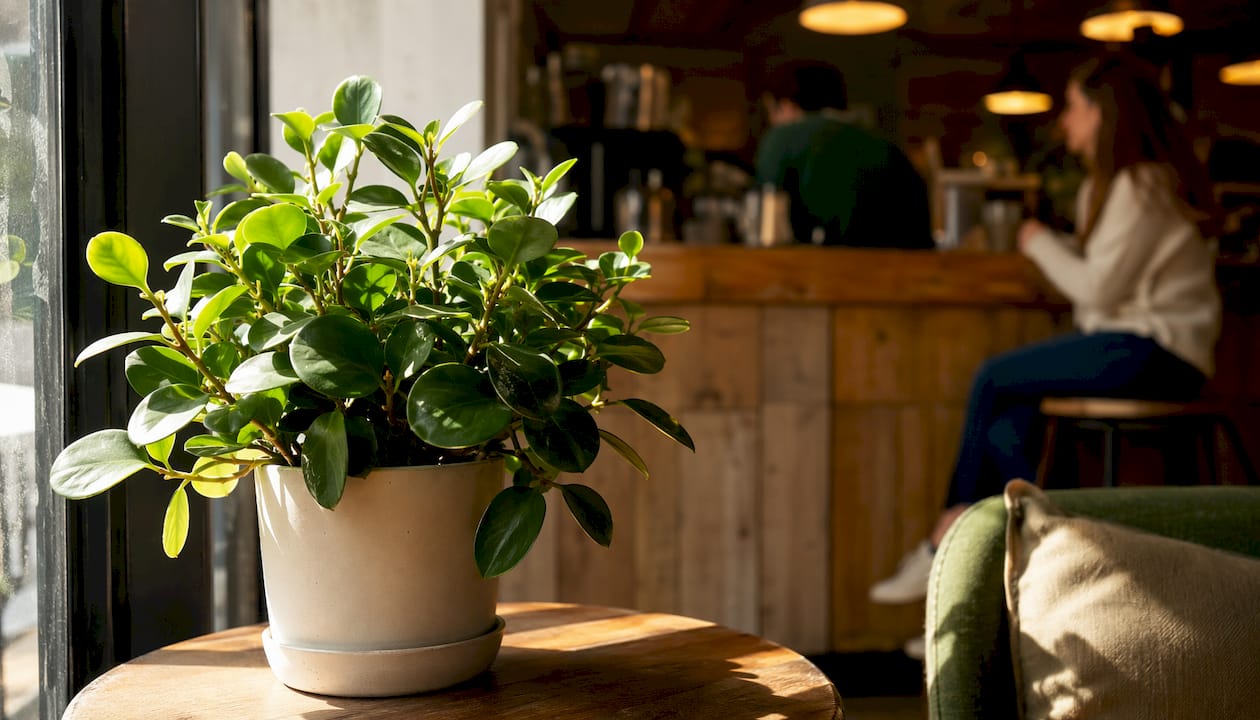
Sun-adapted species carry thick, waxy leaves with a compact cell structure that dissipates excess radiation without scorching. Think Agave, Aloe, or Ficus elastica in bright positions. Shade-adapted species do the opposite: broad, thin leaves with dense chlorophyll capture every available photon in low-light conditions. Pothos, Dracaena marginata, and Spathiphyllum are built this way. Put a shade-adapted plant under direct afternoon sun and you'll see photobleaching within days; put a sun-adapted succulent in a dim corridor and it will etiolate — stems stretch thin and pale, reaching for light that isn't there.
The biological constraint worth knowing: most species cannot acclimate quickly to dramatically different light regimes. A Sansevieria moved from a bright lobby to a windowless hallway will survive for months on stored energy before visibly declining. That lag fools many designers into thinking the placement is fine — until it isn't.
Pro Tip: Before finalizing a species list, photograph each intended planting spot at noon on a clear day and again on an overcast day. If the overcast reading falls below 50 foot-candles, restrict your selection to confirmed low-light genera only — no exceptions, regardless of how the space looks to the human eye.
How to measure light in real interiors before you specify anything
A defensible lighting spec starts with on-site measurement, not window-orientation assumptions. Intensity drops sharply with distance — a spot three feet from a south-facing window can read half the foot-candles of a spot right at the glass.
- Choose a representative clear-weather day and an overcast day; measure both.
- Set your meter at planned pot height (typically 24–36 inches from floor).
- Record readings at 8 AM, noon, and 4 PM to capture the daily arc.
- Repeat the sequence in December and June to capture seasonal extremes.
- Average the noon readings across both weather conditions for your working intensity figure.
- Convert to PPFD if specifying supplemental LEDs (rough rule: 1 foot-candle ≈ 1–1.2 µmol/m²/s for white light).
Tool guidance: Smartphone lux apps are adequate for a rough site survey but vary widely in accuracy. A dedicated lux meter (Extech LT300 or similar) gives reliable readings for design documents. For supplemental LED specification, a PAR meter (Apogee MQ-500 or equivalent) measures PPFD directly and is worth the investment on any project with grow-light components.
| Interior zone | Typical foot-candles | Rough PPFD (µmol/m²/s) | Light classification |
|---|---|---|---|
| Glazed atrium, south-facing | 250–500+ | — | High / direct |
| Perimeter workstation, 3–6 ft from window | 75–150 | 75–180 | Medium-high |
| Open-plan interior, 10+ ft from window | 25–50 | 25–60 | Medium-low |
| Corridor / interior core | 5–25 | 5–25 | Low |
Matching plant families to common commercial light scenarios
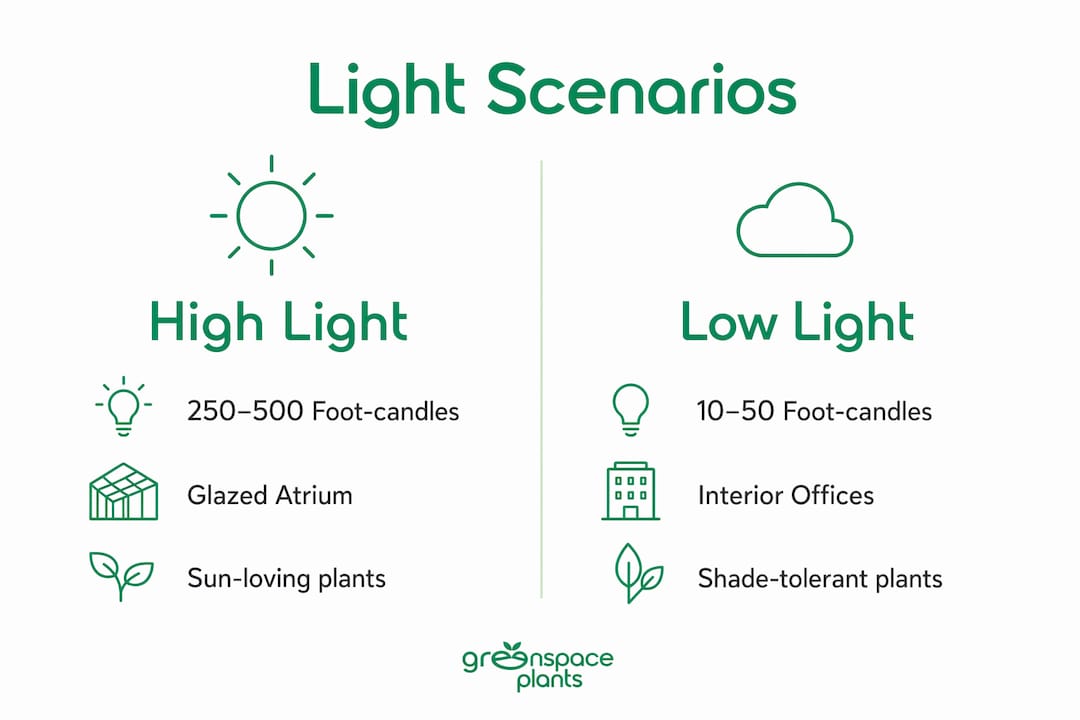
The table below maps measured light bands to recommended genera and practical notes for commercial installs.
| Light scenario | Foot-candles | Recommended genera | Notes |
|---|---|---|---|
| Glazed atrium / high-light | 250–500 | Ficus, Strelitzia, Yucca, Agave | Rotate quarterly to prevent one-sided lean; monitor for heat stress near glass |
| Perimeter workstation | 75–150 | Dracaena, Schefflera, Chamaedorea palm | Excellent scale for desk-adjacent planters or troughs |
| Open-plan interior | 25–50 | Pothos, Philodendron, Spathiphyllum, ZZ plant | Workhorse species; tolerate fluorescent ambient light |
| Low-light corridor | 5–25 | Sansevieria, Aspidistra, Aglaonema | Slow-growing; low replacement frequency; ideal for planted troughs |
| Living walls (mixed light) | Supplemental LED required | Pothos, Ferns, Peperomia | Specify PPFD ≥ 100 µmol/m²/s at wall face; use rotation panels |
For open-plan and corridor scenarios, potted specimens in individual containers outperform planted troughs when rotation is part of the maintenance plan. Living walls in low-light cores require supplemental LEDs from day one — no amount of window proximity substitutes for measured canopy PPFD.
What to call out in your fixture spec for plant performance
LEDs are the practical long-term choice for supplemental plant lighting: they run cool, allow spectral tuning, and consume far less energy than incandescent alternatives. Here's how to translate that into spec language.
Spectral balance: Request fixtures with a CCT between 3,000K and 5,000K for mixed-species installations. A design study testing CCT ranges from 2,800K to 5,000K produced practical guidelines confirming that balanced white LEDs in this range support both plant health and visual appeal. Avoid narrow-band red-only or blue-only fixtures for mixed foliage; the extreme ratios produce abnormal morphologies.
PPFD at canopy: Specify a minimum of 50–100 µmol/m²/s at canopy height for low-to-medium foliage species; 150–250 µmol/m²/s for medium-high or flowering specimens.
Mounting and beam angle: For ceiling-mounted troffers over planters, a 60° beam angle at 8–10 feet mounting height typically delivers adequate coverage without hot spots. Adjustable linear fixtures give you more flexibility in open-plan retrofits.
Diffusers: Shade-adapted species near south-facing glass benefit from diffusing film or internal blinds that scatter direct sun into softer ambient light, reducing scorching risk without eliminating photosynthetically useful radiation.
Sample spec language: "Supplemental grow fixtures shall be full-spectrum LED, CCT 3,000K–5,000K, delivering a minimum PPFD of [X] µmol/m²/s at canopy height as measured by a calibrated PAR meter. Fixtures shall be controlled by a programmable timer set to [12–16] hours per day with a mandatory dark period of at least 8 hours."
Maintenance, monitoring, and lifecycle: what to track month by month
Light-related plant decline is almost always gradual, which means a monthly monitoring cadence catches problems before they become replacements.
- Monthly visual check: Look for bleached or papery leaf patches (too much intensity), pale yellowing with stretched internodes (etiolation from too little), or one-sided lean (phototropism from a single directional source).
- Quarterly light re-measurement: Seasonal sun angles shift dramatically between June and December. Re-measure foot-candles at each planting spot every quarter and adjust supplemental fixture schedules accordingly.
- Rotation schedule: Rotate potted specimens 90–180° every 4–6 weeks to counteract phototropic lean and distribute light stress evenly across the canopy.
- Pruning windows: Remove etiolated stems promptly — they won't re-thicken, and they divert energy from healthy growth. Prune after repositioning, not before, so the plant stabilizes in its new light environment first.
- Replacement triggers: A plant that has lost more than 30% of its canopy density despite correct light levels likely has a root or pest issue, not a lighting problem. Flag it for replacement rather than adjusting fixtures.
Higher-intensity placements dry out faster and accumulate salt stress more quickly, which shortens service intervals. Budget for more frequent plant service visits in high-light zones than in low-light corridors.
When lighting isn't the problem: diagnosing other environmental limits
Not every struggling plant needs a new fixture. Misdiagnosing the cause wastes budget and delays recovery.
Quick diagnostic decision tree: Stem stretching or pale yellowing in a uniform pattern → suspect insufficient light intensity or duration first. Leaf bleaching or papery patches on sun-facing surfaces → suspect excess intensity or direct sun exposure. Brown leaf tips or irregular marginal browning despite adequate light → suspect low humidity or salt accumulation from over-fertilizing. Wilting despite moist soil and adequate light → suspect root rot, compacted media, or temperature stress (below 55°F or above 85°F). Sticky residue, webbing, or stippled leaves → suspect pests; call your plant service team before adjusting any environmental controls.
Spectrum alone cannot replace appropriate temperature and humidity controls. HVAC vents positioned directly above planters create temperature swings and low-humidity microclimates that mimic light-stress symptoms. Always check ambient temperature and relative humidity (target 40–60% RH for most foliage species) before concluding that a fixture upgrade is the answer.
Spec checklist and RFP language you can use today
A concise checklist you can attach to any plant installation brief or vendor RFP.
Pre-specification checklist:
- Measured foot-candles or PPFD at each planting location (clear day + overcast day, 8 AM / noon / 4 PM)
- Seasonal measurement repeated in summer and winter
- Species light band confirmed against measured range low / medium / high
- Supplemental LED specified if measured PPFD falls below species minimum
- Fixture CCT range: 3,000K–5,000K for mixed foliage
- Photoperiod timer programmed: 12–16 hours light, minimum 8 hours dark
- Mounting height and beam angle documented
- Monitoring cadence defined: monthly visual, quarterly re-measurement
- Replacement SLA tied to survival rate (e.g., 90% canopy retention at 6 months)
Sample RFP language: "Vendor shall provide documented PPFD readings at canopy height for all supplemental fixtures prior to installation. All grow fixtures shall be full-spectrum LED with CCT 3,000K–5,000K. Maintenance visits shall occur no less than [monthly / bi-weekly] with written records of light measurements and plant health observations. Replacement of any specimen falling below 70% canopy health shall occur within [14] days at no additional cost."
Pro Tip: Ask your vendor to include a light-measurement log as a contract deliverable — not just a one-time reading at install. Seasonal drift is real, and a vendor who tracks it proactively will cost you less in replacements over a 12-month contract. At Greenspace Plants, we build this into every Greenspace+ agreement.
For detailed indoor plant design blueprints and spec language, our team has additional practitioner templates available.
Key Takeaways
Lighting intensity, duration, and spectrum together determine which plants survive in a commercial interior — measure first, match species to those measurements, and write monitoring into every contract.
| Point | Details |
|---|---|
| Measure before you specify | Record foot-candles or PPFD at pot height at three times of day, on clear and overcast days. |
| Match species to measured light band | Low-light corridors need Sansevieria or Aglaonema; high-light atria support Ficus or Yucca. |
| Balanced LEDs outperform extreme spectra | Fixtures with 25–35% blue proportion and CCT 3,000K–5,000K produce the most natural foliage indoors. |
| Cap photoperiod at 16 hours | Plants need a dark period; exceeding roughly 16 hours of daily light disrupts development. |
| Greenspace Plants | Greenspace+ includes light-aware species selection, installation, monthly maintenance, and guaranteed replacements for a fixed monthly fee. |
What commercial plant installers actually see in the field
The conventional wisdom that "south-facing equals bright" causes more failed installs than almost any other assumption. A south-facing window is a directional signal, not a measurement. We've walked into spaces where a designer specified Strelitzia based on window orientation, only to find that a deep ceiling overhang and interior tinted glass cut the actual PPFD at pot height to under 80 µmol/m²/s — well below what that species needs to hold its form. The plant looked fine for two months, then dropped leaves steadily until it was unsalvageable.
The practical lesson: conservative species choices and a single on-site measurement session cost almost nothing compared to a replacement cycle. When in doubt, specify one light band lower than your estimate suggests. A Pothos that thrives is a better outcome than a Bird of Paradise that declines. Small measurement steps and honest species matching are what separate a low-maintenance installation from a recurring warranty dispute.
Greenspace Plants: spec-ready indoor plant service for commercial interiors
Getting the lighting spec right is only half the equation. The other half is having a service partner who maintains that spec over time, adjusts for seasonal shifts, and replaces struggling specimens before they become an eyesore.
Greenspace Plants delivers exactly that through Greenspace+: a fixed monthly fee covers design, installation, regular maintenance visits, and plant replacements — no upfront capital outlay, no long-term lock-in. Every installation begins with a site light audit, and every maintenance visit includes a documented health check tied to the light conditions we specified at the start. If a plant isn't performing, we replace it. If seasonal light shifts require a species swap or fixture adjustment, we flag it proactively.
For interior designers, our plant design collaboration service integrates directly into your project workflow, from concept through installation and ongoing care. Reach out to our team to schedule a site assessment and get a specification package tailored to your space.
Curated sources for further reading and measurement tools
- Lighting for indoor plants and starting seeds — University of Minnesota Extension: practical photoperiod and intensity guidance for foliage and flowering species.
- Light quality effects on plant performance in indoor facilities — PMC: peer-reviewed research on balanced spectra and morphological outcomes.
- Light, temperature, and humidity for ornamental production — Texas A&M AgriLife Extension: applied guidance on photoperiod limits and intensity trade-offs.
- LED light spectra and intensities on plant growth — MDPI Plants: evidence base for LED fixture selection and spectral tuning.
- Illuminating indoor plants sustainably — IOPscience: design-focused study on CCT ranges and practical spectral guidelines.
- Role of light in plant growth and sugar metabolism — PMC: comprehensive review of how light intensity, photoperiod, and spectrum interact at the cellular level.
Measurement tools to source: For lux and foot-candle readings, a dedicated lux meter (Extech LT300 or Dr.meter LX1330B) provides reliable accuracy for design documents. For PPFD measurement when specifying supplemental LEDs, an Apogee MQ-500 PAR meter is the field standard; spec sheets are available directly from Apogee Instruments.