
Plants do raise oxygen in a workspace, but the honest answer is that measurable room-scale increases require the right species, enough leaf area, adequate light, and real numbers. A single potted Pothos on a corner desk won't shift your office's CO2 reading; dense plantings or green walls are needed to achieve room-scale CO2 reductions, while individual pots mostly improve the local microclimate, as detailed in office studies and green-living wall research. What it will do is improve local humidity, reduce occupant complaints about dry air, and contribute to the wellbeing gains that office plant research consistently documents. The Royal Horticultural Society and University of Reading experts put it plainly: plants have measurable, beneficial effects on air quality, but those effects are modest and should complement ventilation, not replace it. The EPA agrees, treating ventilation and source control as primary levers and plants as a valuable complement for humidity and wellbeing.
For practical ways to boost oxygen levels with workspace plants, the playbook comes down to five moves: choose high-leaf-area species (Spathiphyllum, Chlorophytum comosum, Areca palm), position them where people actually sit, optimize light so photosynthesis runs during work hours, keep soil healthy so the root-zone microbiome stays active, and pair the whole setup with your HVAC or a HEPA/activated-carbon purifier when occupancy or VOC sources are high.
Pro Tip: Install a low-cost CO2 and relative humidity sensor before you add any plants. That one-week baseline reading is the only way to know whether your plant program is actually moving the numbers.
Key Takeaways
The most effective way to boost oxygen and air quality with workspace plants is to combine high-leaf-area species, adequate light, healthy soil, and mechanical ventilation into one integrated strategy.
| Choose the right species | Spathiphyllum and Chlorophytum comosum outperform most plants under typical office light (50–100 μmol m⁻² s⁻¹ PPFD). | Density and light drive results | Room-scale CO2 reductions require dense plantings or green walls; single pots improve local microclimate only, as supported by the ranges found in office and green-living wall studies (CO2 reductions averaging about 5% and sometimes up to 50% in a 15 m² test area). | | Healthy soil is non-negotiable | The root-zone microbiome handles most VOC breakdown; overwatering kills it and eliminates the air benefit. | | Pair with mechanical systems | EPA guidance treats ventilation and filtration as primary; plants are a proven complement for humidity and wellbeing. | | Greenspace Plants | The Greenspace+ program provides design, installation, and professional maintenance to keep plants healthy and air benefits sustained. |
Table of Contents
- Six Immediate Steps to Increase Oxygen and Air Quality in Your Office
- The Best Office Plants for Oxygen, Humidity, and Low Maintenance
- How Do Plants Actually Change the Air in Your Office?
- How to Maximize Your Plants' Air-Quality Contribution
- When Should You Pair Plants with Ventilation or Air Purifiers?
- How to Measure Plant Impact and What Timeline to Expect
- Common Cautions and Myths Worth Knowing
- What Does the Research Actually Say?
- An Office Manager's Honest Take on Running a Plant Program
- Greenspace Plants Makes the Plant Program Work for Your Office
- Sources
Six Immediate Steps to Increase Oxygen and Air Quality in Your Office
These six actions are sequenced by impact. You can complete the first three in a single afternoon.
-
Place 1–2 large-leaf plants at each workstation cluster and in conference rooms. Spathiphyllum (peace lily) and Chlorophytum comosum (spider plant) perform well under typical office light (50–100 μmol m⁻² s⁻¹ PPFD) and are among the species shown to reduce CO2 most effectively in real workplace tests.
-
Group plants together rather than scattering them. Clustered plants create a shared microclimate: transpiration rates stack, local humidity rises, and the combined leaf area drives more meaningful gas exchange than isolated pots.
-
Move plants toward windows or add targeted LED grow lights. Photosynthesis stops when light drops below a plant's compensation point. During overcast winters or in interior zones, a dedicated LED panel running at the right PPFD keeps your plants actively producing oxygen during work hours rather than just respiring.
-
Clean leaves monthly and maintain soil health. Dust on leaves cuts light absorption and gas exchange. Healthy, well-aerated soil supports the microbial communities that break down VOCs at the root zone, which is where much of the real pollutant reduction happens.
-
Pair plants with ventilation or a HEPA+activated-carbon air cleaner when occupancy is high or when VOC sources (new furniture, carpets, cleaning products) are present. Plants complement mechanical systems; they don't substitute for them.
-
Set a sensor baseline before and after. A CO2 meter and a relative humidity monitor placed at desk height give you before/after data. Without measurement, you're guessing.
Pro Tip: For conference rooms that fill up quickly, a spider plant or peace lily on the table combined with a portable air cleaner running on low is a practical, low-cost starting point that addresses both CO2 and dry-air complaints simultaneously.
The Best Office Plants for Oxygen, Humidity, and Low Maintenance
The seven plants below are the top performers for office environments, selected for their photosynthetic output under low-to-moderate light, transpiration rates, and realistic maintenance demands. For each, we note pet toxicity, because a pet-friendly office policy changes your shortlist fast.
Peace lily (Spathiphyllum)
- Best for: Low light, humidity, aesthetics
- Oxygen/CO2 impact: High relative to its size; one of the top performers under office PPFD ranges
- Transpiration: High — noticeably raises local humidity
- Maintenance: Low to medium; water when soil surface dries
- Pet safety: Toxic to cats and dogs
Snake plant (Sansevieria / Dracaena trifasciata)
- Best for: Very low light, neglect-tolerant environments
- Oxygen/CO2 impact: Moderate daytime; performs CAM photosynthesis, so it also exchanges gas at night (though not enough to meaningfully deplete room oxygen)
- Transpiration: Low
- Maintenance: Very low; water every 2–6 weeks
- Pet safety: Toxic to cats and dogs
Spider plant (Chlorophytum comosum)
- Best for: Low light, pet-friendly offices, rapid propagation
- Oxygen/CO2 impact: Strong for its leaf area; UTS office studies highlight it as a reliable CO2 reducer
- Transpiration: Medium
- Maintenance: Low; tolerates irregular watering
- Pet safety: Non-toxic to cats and dogs
Pothos / Devil's ivy (Epipremnum aureum)
- Best for: Interior zones with minimal natural light, trailing displays
- Oxygen/CO2 impact: Moderate; good leaf area per pot
- Transpiration: Medium
- Maintenance: Very low; one of the most forgiving office plants available
- Pet safety: Toxic to cats and dogs
Areca palm (Dypsis lutescens)
- Best for: Open-plan offices, high-humidity needs, statement pieces
- Oxygen/CO2 impact: High; large total leaf area drives meaningful transpiration and CO2 uptake
- Transpiration: High — among the best natural humidifiers in this list
- Maintenance: Medium; needs consistent moisture and bright indirect light
- Pet safety: Non-toxic to cats and dogs
Rubber plant (Ficus elastica)
- Best for: Bright offices, design-forward spaces
- Oxygen/CO2 impact: Good; large waxy leaves provide solid photosynthetic surface
- Transpiration: Medium
- Maintenance: Low to medium; wipe leaves regularly to maintain gas exchange
- Pet safety: Toxic to cats and dogs
Aloe vera (Aloe spp.)
- Best for: Sunny windowsills, low-water environments
- Oxygen/CO2 impact: Modest; CAM plant, primarily active at night
- Transpiration: Low
- Maintenance: Very low; water every 3–4 weeks
- Pet safety: Toxic to cats and dogs
Pro Tip: For a pet-friendly office, build your shortlist around spider plants and Areca palms. Both are non-toxic, and together they cover the humidity and CO2-reduction bases that matter most in occupied rooms.
Pro Tip: Rubber plant leaves accumulate dust faster than most species. A monthly wipe with a damp cloth isn't just cosmetic — it directly preserves the leaf's ability to absorb light and exchange gas.
How Do Plants Actually Change the Air in Your Office?
The mechanism matters, because it tells you where plants help and where they hit a ceiling.
Photosynthesis is the core process: plants absorb CO2 and release O2 when light is available. The rate is governed by light intensity (measured in PPFD, or photosynthetic photon flux density) and total leaf area. Under typical office lighting of 50–100 μmol m⁻² s⁻¹ PPFD, most plants operate well below their photosynthetic maximum. Species like Spathiphyllum and Chlorophytum comosum are adapted to these lower ranges and outperform others for CO2 uptake in real office conditions.
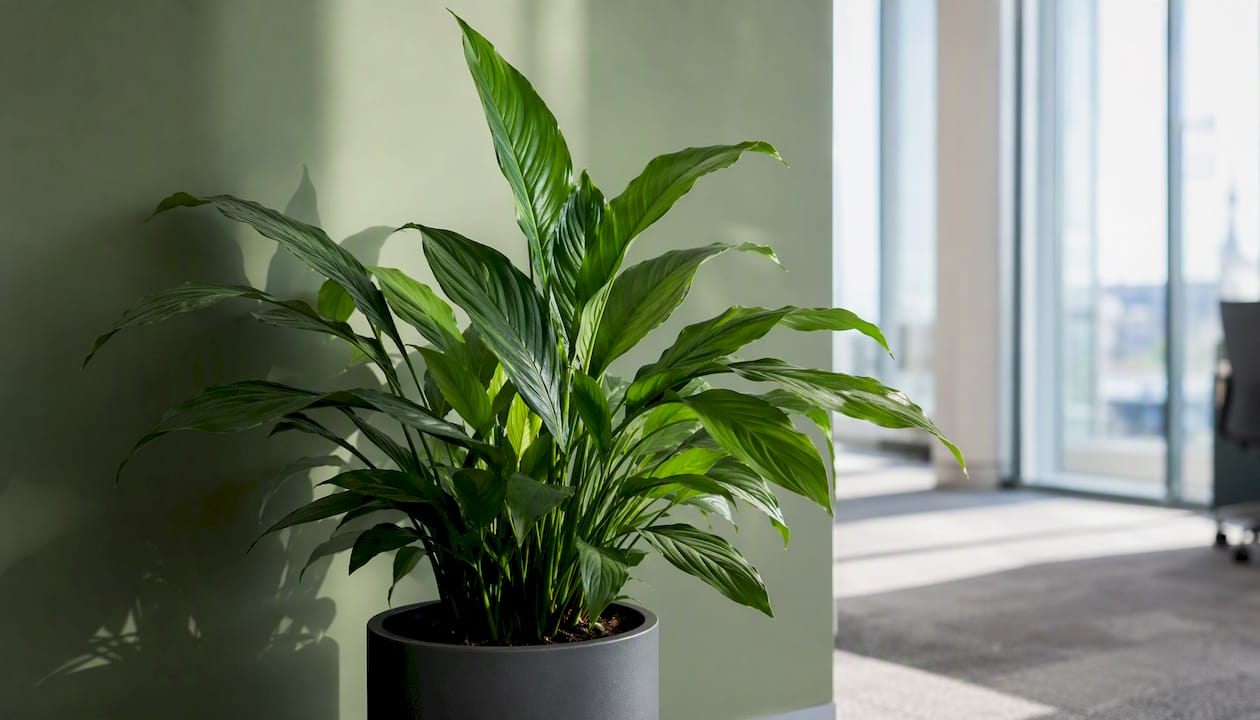
Transpiration is often underestimated. Plants release water vapor through their leaves, raising local relative humidity. In dry, heated offices, this matters for comfort and for VOC chemistry: higher humidity slows the off-gassing of some compounds from furniture and flooring. Areca palms and peace lilies are the strongest transpirers on this list.
VOC removal happens partly through leaf uptake but primarily through the root-zone microbiome. Soil microbes metabolize compounds like formaldehyde, benzene, and toluene. A systematic review of 95 studies confirmed that plants reduce certain pollutants and increase humidity, but noted that many findings came from sealed laboratory chambers, not real offices with ventilation. NASA's original chamber research showed plants can remove VOCs in sealed environments, and that combining plants with activated carbon filters and active airflow improves practical performance significantly.
The root-zone microbiome and substrate are thought to be the main engine for VOC breakdown. A stressed plant with compacted or waterlogged soil has a less active microbial community and therefore reduced pollutant-degrading capacity. This is why professional maintenance and healthy soil matter for sustained air benefits, not just for aesthetics.
The hard limit: a single potted plant, or even a dozen, rarely moves room-average CO2 in a ventilated office. UTS research found that CO2 reductions of 10% or more in office setups require adequate leaf area and light. A vertical green-living wall study in an actual workplace recorded CO2 reductions averaging about 5% and sometimes up to 50% in a 15 m² test area, with results varying sharply by species and light level. For room-scale change, density and active systems matter.
How to Maximize Your Plants' Air-Quality Contribution
Turning the science into a practical office setup takes a few deliberate choices.
-
Audit your light zones first. Walk the office and note which areas receive direct window light, which get bright indirect light, and which are interior zones with only overhead fluorescents. Match species to zones: Areca palms and rubber plants near windows; snake plants and Pothos in interior corridors.
-
Calculate a rough plant density target. A commonly cited lab-based benchmark from UTS work suggests approximately one Chlorophytum per roughly 5 m³ of room volume as a starting point for noticeable local effects. This is a guideline, not a guarantee, and real offices with HVAC dilute those effects, so room-scale CO2 reductions typically require higher density plantings or a green wall. Use it to set a minimum, then measure.
-
Add LED grow lights for interior zones. Look for panels delivering 50–150 μmol m⁻² s⁻¹ PPFD at leaf level, running during work hours (roughly 8–10 hours per day). Full-spectrum LEDs designed for low-light tropical species are the right category. For optimal airflow around plants, avoid placing lights or plants directly in front of HVAC intake vents, which desiccates soil and stresses roots.
-
Set a care schedule and stick to it. Water when the top inch of soil is dry (not on a fixed calendar), wipe leaves monthly, and inspect for pests quarterly. Overwatering is the most common cause of root rot, which kills the microbiome and eliminates the plant's air benefits.
-
Consider a professional maintenance program for offices with more than 15–20 plants. The UConn Home & Garden guidance on plant care and realistic expectations reinforces that healthy, well-maintained plants deliver sustained benefits, while neglected ones become pest and mold sources.
Pro Tip: A low-maintenance hydroculture setup (plants grown in inert medium with a water reservoir) reduces overwatering risk significantly and is worth considering for high-traffic areas where watering schedules are hard to keep.
When Should You Pair Plants with Ventilation or Air Purifiers?
Plants work best as part of a layered strategy, not as a standalone solution. Here's how to decide when to escalate.
- Plants alone are reasonable when your primary goals are humidity improvement, occupant wellbeing, and modest VOC reduction in a well-ventilated office with low occupancy.
- Add a HEPA+activated-carbon air cleaner when VOC sources are present (new furniture, carpet, adhesives, cleaning products), when occupancy spikes in conference rooms, or when outdoor air quality is poor and you're limiting fresh-air intake.
- Upgrade to active botanical systems or green walls when you want measurable room-scale pollutant reduction. NASA research showed that active systems, where air is forced through a planted substrate, scale pollutant removal far better than passive potted plants.
- Rely on HVAC and source control first for CO2 management in high-occupancy spaces. The EPA's indoor air quality guidance is clear that ventilation and source control are the primary tools for reliable indoor-air improvements.
Keep plants away from HVAC intake and exhaust paths. Direct airflow dries soil rapidly, stresses plants, and reduces their photosynthetic and transpiration output. A gentle background air movement (a low-setting fan nearby) actually benefits plant health, but strong directional HVAC flow does not.
Pro Tip: Run your air cleaner during occupancy AND for 30–60 minutes after the office empties. That post-occupancy window, when CO2 and VOCs are still elevated, is when filtration does its most useful work.
How to Measure Plant Impact and What Timeline to Expect
Measurement removes the guesswork and gives you something concrete to report to leadership.
- Install sensors before you add any plants. Place a CO2 meter and a combined RH/temperature monitor at desk height in your target zone. Record readings for one full work week.
- Install plants and run a 2–4 week retest. Keep all other variables (HVAC settings, occupancy, cleaning products) constant. Compare average CO2, RH, and any TVOC readings.
- Interpret results with realistic expectations. Small localized oxygen bumps and humidity increases are the most consistent findings. VOC decreases for targeted compounds are possible but depend on species, soil health, and light.
| Timeline | What to expect |
|---|---|
| — | Microclimate shifts near plant clusters; occupants may notice improved humidity |
| Weeks 2–8 | Measurable RH increase in dry offices; some VOC reduction for targeted compounds |
| Months 2–6 | Stable root-zone microbiome effects if plants are healthy; sustained humidity and wellbeing gains |
A Frontiers in Psychology office intervention found that introducing many plants with professional maintenance produced persistent improvements in perceived air dryness, workplace appearance, and employee wellbeing over months. The psychological benefits were robust even when air chemistry changes were modest.
Pro Tip: Place your CO2 sensor at seated head height (roughly 3–4 feet from the floor), not on a shelf or windowsill. CO2 stratifies in occupied rooms, and desk-height readings reflect what your team is actually breathing.
Common Cautions and Myths Worth Knowing
A few misconceptions can derail an otherwise solid plant program.
Night respiration: Plants respire (consume O2, release CO2) at night when photosynthesis stops. In a normal office with a typical plant density, this does not lower room oxygen to harmful levels. The only scenario where it could matter is an unusually high plant density in a very small, sealed room with no ventilation overnight.
Allergies and mold: Overwatered soil is the primary culprit for mold growth and spore release. Stick to well-draining potting mixes, pots with drainage holes, and a sensor-informed watering schedule. For staff with known mold sensitivities, low-spore species like snake plants and Pothos are safer choices than high-transpiration plants in enclosed spaces.
Pet toxicity: Several popular office plants are toxic to cats and dogs. Peace lily, snake plant, Pothos, rubber plant, and aloe vera all carry toxicity warnings for pets. For pet-friendly offices, prioritize spider plants and Areca palms, both of which are non-toxic.
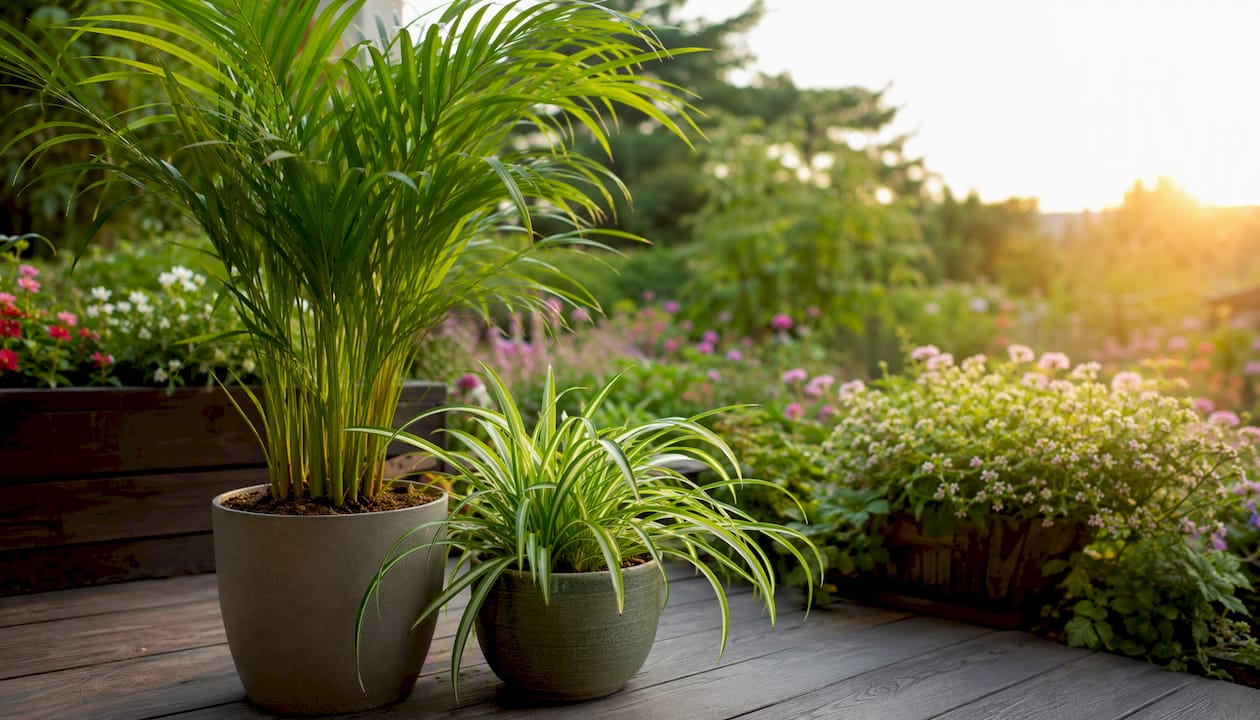
Pest risk: Stressed plants attract pests, and a pest-stressed plant has reduced photosynthetic output and a compromised microbiome. Signs to watch for include sticky residue on leaves (scale or aphids), webbing (spider mites), and yellowing. Basic Integrated Pest Management, including regular inspection, isolating new plants for two weeks before placing them in the office, and maintaining good airflow, keeps infestations from spreading.
Pro Tip: Quarantine every new plant for two weeks in a separate room before introducing it to your office. This single step prevents the most common pest introductions and protects your existing plant investment.
What Does the Research Actually Say?
The evidence base for office plants is genuine but nuanced. Here's an honest summary.
"Indoor plants have measurable, beneficial effects on air quality, but the impacts are modest and should complement — not replace — ventilation and professional air purification." This is the consensus position from the Royal Horticultural Society and University of Reading experts, as reported by the BBC.
The systematic review of 95 studies found that plants reduce certain pollutants (notably formaldehyde, benzene, and toluene), increase humidity, and can improve microclimate, but many studies were laboratory-based with varied designs. Real-office results are more modest.
UTS office research found CO2 reductions of 10% or more are possible in some office setups when adequate leaf area and light are provided, with species selection and hydroculture both influencing outcomes. The green-living wall study in an actual workplace showed CO2 reductions averaging 5% and sometimes up to 50% in a 15 m² test area, with Spathiphyllum and Chlorophytum among the most effective species.
Key takeaways from the evidence:
- Wellbeing and perceived air quality improvements are the most consistent and robust outcomes across studies.
- VOC removal is real but requires healthy soil, sufficient leaf area, and adequate light.
- Room-scale oxygen or CO2 changes need dense plantings, green walls, or active botanical systems.
- Plants' contribution to productivity and occupant satisfaction is well-supported and often the strongest business case for office plantscaping.
An Office Manager's Honest Take on Running a Plant Program
We've seen this play out in offices across Toronto, Vancouver, and Calgary: a manager installs a dozen plants with good intentions, and six months later half of them are yellowing, the soil is waterlogged, and the team has stopped noticing them. The air benefits evaporate with the plant health.
The offices where plants genuinely move the needle share three things. First, they started with a sensor baseline, so they knew what they were working with. Second, they chose species matched to their actual light conditions, not the ones that looked best in a showroom. Third, they had a maintenance plan, whether in-house or professional, that kept soil healthy and leaves clean. The ROI case for live plants in offices is real, but it depends entirely on the plants staying healthy.
One practical lesson: schedule a quarterly plant health audit alongside your monthly leaf-cleaning. A 20-minute walk-through to check soil moisture, pest signs, and light adequacy catches problems before they become replacements.
Greenspace Plants Makes the Plant Program Work for Your Office
Keeping 20 or 30 office plants healthy, pest-free, and photosynthetically active is a real operational commitment. Most facilities teams don't have the bandwidth for it, and that's exactly where the air and wellbeing benefits tend to slip.
Greenspace Plants's Greenspace+ program handles design, installation, ongoing maintenance, and plant replacements under a healthy-plant guarantee, for a fixed monthly fee with no upfront costs and no long-term commitment. Our plant clinicians keep root-zone microbiomes active, soil healthy, and leaf surfaces clean, which are the three factors that determine whether your plants are actually improving air quality or just occupying floor space. For offices ready to scale up, we also design and install green walls that deliver the kind of room-scale CO2 and VOC reductions that potted plants alone can't reach. Browse our indoor plant rental programs or request a consultation to get a custom plant plan for your space.
Sources
- Can houseplants purify the air in your home? — BBC
- Cooling, CO2 reduction, and energy-saving benefits of a green-living wall in an actual workplace — ScienceDirect
- Systematic review of indoor plants and air quality — PubMed
- Interior Landscape Plants for Indoor Air Pollution Abatement — NASA NTRS
- Plant introduction in offices improved perceived air quality and wellbeing — Frontiers in Psychology
- Indoor plant brochure and office study — UTS
- Houseplants for Healthier Indoor Air — UConn Home & Garden
- Indoor air quality — EPA