
Run this order every visit: inspect before you water, prune and clean foliage, check for pests on stems and undersides, log what you find, and flag any plant for replacement before it fully declines. Water only when soil tests dry a few inches down, never on a fixed schedule. Living walls and complex irrigation setups fall outside this routine and need specialist attention.
TL;DR:
- Regular inspection before watering is crucial, as overwatering causes most plant failures and often results from staff watering on a fixed schedule.
- Moisture checks should be performed at two to three inches deep, and watering should only occur when soil readings indicate dryness, regardless of preset routines.
- Documentation of each visit, including photos and notes, is essential to identify long-term patterns and avoid repeating mistakes that can lead to plant decline.
- High-visibility areas require weekly maintenance, while less trafficked zones can be serviced biweekly or monthly, with escalation for pest issues or irrigation failures.
- Staff should be trained to recognize common issues like overwatering, pests, and sunscald, and to escalate problems beyond their scope to prevent long-term damage.
Table of Contents
- What Should a Facility Manager Plant Checklist Cover Weekly?
- How Often Should You Handle Fertilizing, Rotation, and Repotting?
- Why Is My Office Plant Dying? Quick Fixes for Common Problems
- How Often Should Plants Be Serviced in a Commercial Space?
- What Tools and Records Do You Need for Plant Rounds?
- What Safety Precautions Should Staff Follow When Handling Plants?
- How Much Should You Budget for Plant Maintenance and Replacements?
- What Training Do Facility Staff Need for Plant Care?
- The Practitioner's Take: Why the Inspection Habit Is Everything
- A Simpler Way to Guarantee Healthy Plants Year-Round
- Sources
What Should a Facility Manager Plant Checklist Cover Weekly?
Most plant failures in commercial spaces trace back to one habit, watering on autopilot instead of checking first. A weekly rounds checklist breaks that habit and catches problems while they're still cheap to fix.
Here's the sequence we recommend to every facilities team we train, whether they're doing this in-house or coordinating with a contracted service:
- Inspect before touching a watering can. Look at leaf surfaces for discoloration or webbing, check the soil surface for crust or mold, and glance at the drainage layer. This single habit is the difference between a healthy plantscape and one that quietly declines. Overwatering causes most office plant failures, and most of it comes from staff who water because it's Tuesday, not because the soil needs it.
- Measure moisture 2 to 3 inches down. A cheap moisture meter tells you in seconds; a finger works too if you don't mind the mess. Water only when that zone reads dry.
- Prune and clean. Snip dead or yellowing leaves, wipe dust from broad foliage with a soft cloth, and clear any debris that's collected in the pot or on the floor around it.
- Check for pests. Turn a few leaves over and look at stem junctions. Spider mites and mealybugs both start small and spread fast if nobody's looking.
- Check drainage and saucers. Standing water in a saucer or liner is a breeding ground for root rot and fungus gnats. Empty it every time.
- Document the visit. Note the plant, its location, what you did, anything unusual, and whether it needs to be flagged for replacement.
Pro Tip: Keep a simple photo log on your phone. A picture taken today makes it obvious three weeks from now whether a plant is actually declining or just having an off week.
Skipping the documentation step is the most common shortcut we see, and it's the one that costs facilities teams the most in the long run. Without notes, nobody remembers whether a plant has been struggling for one week or eight.
How Often Should You Handle Fertilizing, Rotation, and Repotting?
Weekly rounds keep plants alive. Monthly and quarterly work is what keeps them looking good long-term, and it's where a lot of facility teams fall behind because these tasks don't announce themselves the way a wilting leaf does.
- Fertilizing: Feed most interior plants monthly during active growth periods, using a diluted liquid feed at roughly half the strength recommended on the label. Overfeeding shows up as salt crust on the soil surface or leaf tip burn, and it's more common than underfeeding in commercial settings where well-meaning staff overcompensate.
- Rotation: Turn each plant a quarter turn every few weeks. Phototropism, meaning a plant's tendency to grow toward its light source, causes lopsided growth fast in low-light interiors if nobody rotates the pot.
- Substrate checks: Look at the top inch of soil for compaction or a white mineral crust from hard water. Top-dress with fresh soil when needed, and repot once roots start circling the container or pushing up through the surface.
- Seasonal adjustments: Heating season dries interior air fast, so increase moisture checks when the HVAC system switches to heat. Shrinking daylight hours in fall and winter also slow growth, which means some plants need less water even as indoor air gets drier. Watch for cold drafts near doors and hot air blasting from vents. Both stress plants in ways that look like disease but aren't.
Why Is My Office Plant Dying? Quick Fixes for Common Problems
Speed matters here. A plant that's declining for a week is a quick fix. A plant that's been declining for six weeks is often a write-off.
- Soggy soil, yellowing lower leaves, a musty smell: That's overwatering. Hold off on water entirely, check that drainage holes aren't blocked, and repot into fresh, well-draining soil if the roots look brown or mushy.
- Wrinkled or curling leaves, soil pulling away from the pot edge: That's underwatering. Water thoroughly and check moisture more often going forward, since this usually means someone skipped a scheduled check.
- Fine webbing or tiny moving specks on leaf undersides: Spider mites. Isolate the plant immediately and treat with insecticidal soap or neem oil, both office-safe options that don't require evacuating the space. Weekly visual inspections of leaf undersides catch infestations before they spread to neighboring plants.
- Cottony white clusters near stems or leaf joints: Mealybugs. Same isolation and treatment protocol applies.
- Brown, crispy leaf tips: Usually low humidity or fertilizer buildup, not disease. Check the nearest HVAC vent or window first.
- Bleached or papery patches on leaves facing a window: Sunscald from direct light exposure. Move the plant back a few feet or add a sheer filter.
When a plant genuinely can't be saved, document the likely cause before requesting replacement. If the same species keeps failing in the same spot, the problem usually isn't the plant. It's the placement or the specification, and that pattern only becomes visible when someone's kept records.
How Often Should Plants Be Serviced in a Commercial Space?
Cadence should follow risk, not convenience. A lobby with 40 plants and heavy foot traffic needs more frequent attention than a back-office corridor with two snake plants.
- High-visibility zones (lobbies, reception, client-facing floors): weekly service. Frequent visits are standard for high-visibility installations, since a single browning leaf near the front door reflects on the whole business.
- Standard work areas (open floor plans, break rooms, hallways): biweekly is usually sufficient for most commercial maintenance programs.
Escalate to a specialist when you see repeated replacements of the same plant, a pest outbreak that isn't responding to office-safe treatment, irrigation failures, or anything involving a living wall, which runs on different hardware entirely.
If you're evaluating a provider, require four things: inspect-before-water discipline, written visit notes for every stop, technicians trained beyond basic watering, and a clear replacement guarantee. Think of maintenance frequency as insurance against replacement costs, not a line item to trim.
What Tools and Records Do You Need for Plant Rounds?
You don't need a horticulture degree to run a solid rounds checklist. You need the right handful of tools and a system for recording what you find.
Carry these on every visit:
- A moisture meter for consistent readings across multiple locations.
- Pruning shears, cleaned between plants if you're dealing with any pest issue.
- Soft cloths for wiping dust from broad-leafed foliage.
- A small spray bottle for spot pest treatments.
- A waste bag for clippings and debris.
- A phone camera for photo logs.
- A light meter app to confirm a spot still gets the exposure a plant needs.
Simple handheld tools remove the guesswork from watering and placement decisions, which matters most when different staff members rotate through rounds duty.
Your template should follow the same order every time: inspect, check moisture, prune, clean, treat or flag, document. Each record should capture the plant ID and location, what was done, anything unusual, and a photo when relevant. Photo-backed visit notes create an audit trail that reveals patterns, like a species that keeps failing in the same low-light corner, long before that pattern would otherwise be obvious. Add replacement requests and your maintenance calendar to the same system so nothing falls through the cracks between visits.
What Safety Precautions Should Staff Follow When Handling Plants?
Plant care looks low-risk until someone's kneeling on a wet lobby floor with pruning shears. A few precautions keep rounds duty from becoming an incident report.
Wear gloves when pruning or handling soil, especially around species with irritant sap like ficus or dieffenbachia. Wash hands after handling soil and before eating, since potting mix can carry mold spores and bacteria. Wipe up any water spilled during moisture checks immediately. A slick floor near an entrance is a liability problem long before it's a plant problem.
Use a stable step stool for tall plants or hanging installations rather than climbing on furniture, and never overreach from a ladder to prune a hard-to-reach branch. If you're using insecticidal soap or neem oil for pest treatment, apply it in a ventilated area and keep it away from food service zones. Both are office-safe compared to chemical pesticides, but neither belongs near an open kitchen.
Store all pruning tools, sprays, and fertilizer concentrate in a locked supply closet, not left on a cart in a public hallway. If your building has living walls with pumps and irrigation lines, treat electrical and water components as a specialist's job. Facility staff should stick to visible surface care and leave the mechanical systems to technicians trained on that equipment.
How Much Should You Budget for Plant Maintenance and Replacements?
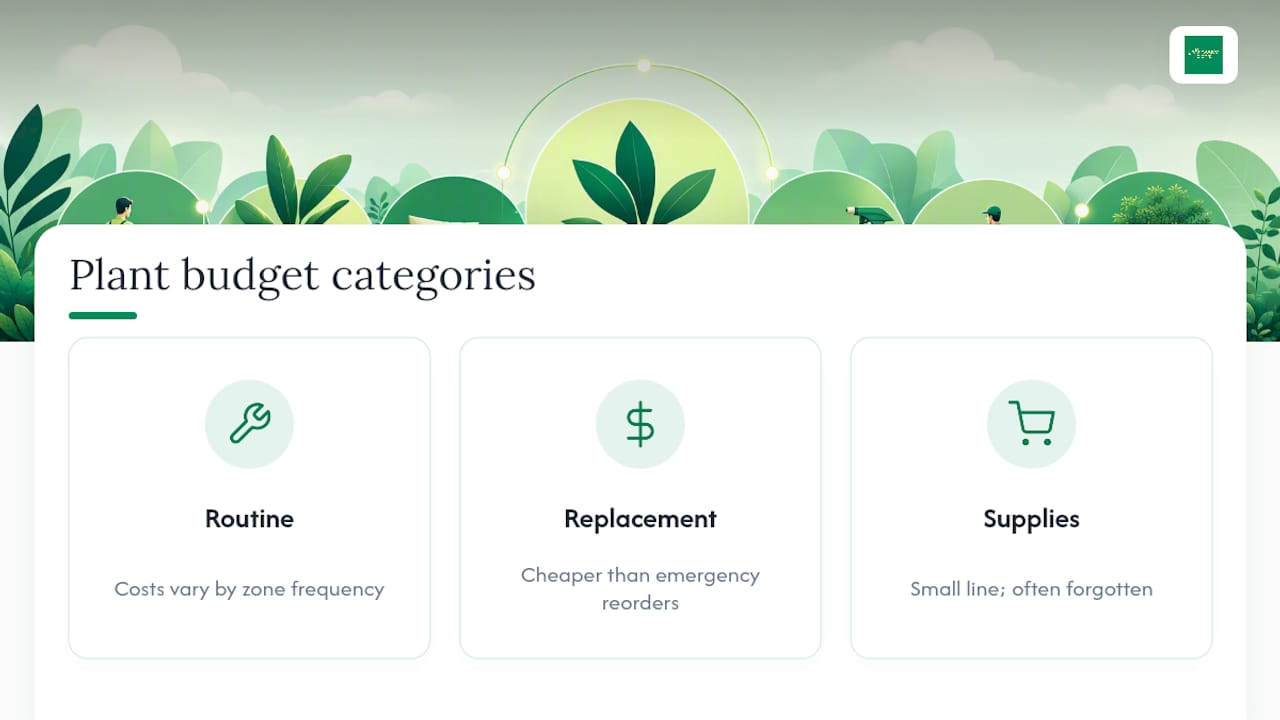
Plant budgets tend to get set once and forgotten, which is exactly how a facilities team ends up surprised by a wave of replacement costs in year two. Build the budget around three categories instead of one lump sum.
Routine maintenance covers your recurring visits, whether that's staff time or a contracted service, and should scale with the zone-based cadence you've set. A lobby getting weekly service costs more annually than a back corridor on a monthly rotation, and that gap should be visible in the budget, not buried.
Replacement reserve covers plants that decline despite good care. Even well-maintained interior plantscapes lose a percentage of stock each year to normal attrition. Setting aside a modest reserve for planned replacements is far cheaper than an emergency reorder when a client walkthrough is scheduled for next week.
Equipment and supplies covers the moisture meters, shears, fertilizer, and treatment products your team uses on rounds. This line is small compared to the other two, but it's the one most often forgotten entirely, leaving staff improvising with dollar-store tools.
If you're comparing outsourcing against an in-house program, reviewing how different service tiers are structured helps you see where a fixed monthly fee might actually cost less than piecemeal in-house replacement purchases.
What Training Do Facility Staff Need for Plant Care?
Nobody expects a facilities coordinator to become a horticulturist, but a short training investment prevents most of the costly mistakes we see repeated across client sites.
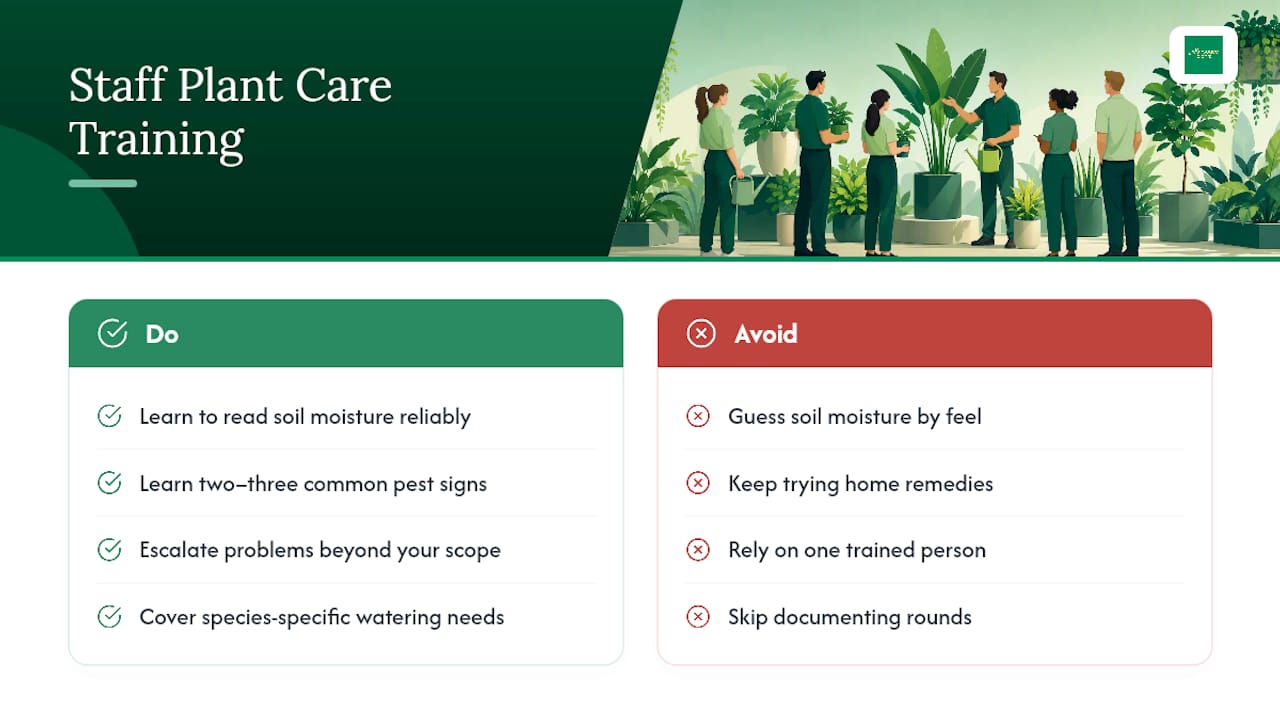
Staff running rounds need to know three things cold: how to read soil moisture without guessing, how to spot the early signs of the two or three pest issues most likely in an office environment, and when a problem is beyond their scope and needs escalation. That third point matters more than most training programs admit. Untrained staff often keep trying home remedies on a plant that needed professional intervention two weeks earlier.
A basic training session, whether run internally by an experienced team member or by an outside provider, should cover species-specific watering needs (a snake plant and a peace lily have almost opposite tolerances), proper pruning technique so cuts don't invite disease, and the documentation habit that makes the whole checklist worth running. Cross-train more than one staff member. Plant care that depends on a single trained person collapses the moment that person takes vacation.
For teams managing anything beyond basic potted plants, like a living wall installation, training needs to go further, covering irrigation flow, pump performance, and nutrient dosing that a standard rounds checklist doesn't touch.
The Practitioner's Take: Why the Inspection Habit Is Everything
The single biggest predictor of whether a commercial plantscape thrives or limps along isn't the species mix or the lighting. It's whether whoever's doing rounds actually stops to look before reaching for the watering can. On nearly every site we've walked into with declining plants, the root cause traces back to a watering schedule running on autopilot instead of an inspection.
The other pattern we see constantly: good intentions without documentation. Someone notices a plant looks off, means to follow up, and three weeks later can't remember if it's gotten worse or just always looked that way. A dated note with a photo solves that instantly.
For teams stretched thin or without in-house horticulture knowledge, that's exactly the gap a program like Greenspace+ is built to close, handling the inspection discipline and specialist judgment calls that a busy office manager shouldn't have to carry alone.
— Nicole
A Simpler Way to Guarantee Healthy Plants Year-Round
Running this checklist well every week takes real time, and most facilities teams are already stretched across a dozen other priorities. Greenspace Plants built Greenspace+ as the alternative: one fixed monthly fee covers plant design, installation, ongoing maintenance, and replacements, with a healthy-plant guarantee backing every visit.
It's the right call when your team has limited on-site staff, when you're managing high-visibility installations that can't afford a bad week, or when you're running a living wall that needs specialist attention beyond a standard rounds checklist. Instead of training staff, tracking supplies, and absorbing replacement costs when a plant declines, you get a team that already runs the inspect-first discipline this article just walked through, backed by a guarantee if something still goes wrong.
Take a look at how our indoor plant maintenance and care programs are structured, and see what a fixed monthly plan would look like for your space.
Sources
- Commercial Plant Maintenance Guide for Offices & Facilities – Trendy Gardener
- How Often Should Office Plants Be Serviced? (2026 Standards for Corporate Environments) – Natura