
Seasonal plants, when managed as a rotating building service rather than static decor, actively modulate indoor microclimate, support occupant wellbeing, and can reduce HVAC load — provided species, quantity, placement, and maintenance are matched to your building's actual conditions. The role of seasonal plants in buildings goes well beyond aesthetics: they are biological components that interact with your ventilation system, humidity balance, and occupant experience in measurable ways.
Three immediate actions to take now:
- Inspect your building's orientation and light levels (target zones with 500+ lux for biologically active species).
- Run a seasonal species selection checklist against your room volumes and ventilation rates before specifying any installation.
- Decide whether in-house staff or a managed-service vendor will handle quarterly rotations, replacements, and KPI tracking.
Track relative humidity (RH), CO2, and occupant satisfaction scores before and after installation to verify impact. These three data points are your proof of value.
Table of Contents
- What does seasonal planting actually do for your commercial building?
- How plants interact with your HVAC and building systems
- Choosing the right species and quantities for your seasonal strategy
- Where seasonal plantings work best — and where to be cautious
- How to operationalize a seasonal plant program
- What KPIs should you track for a seasonal plant program?
- What a managed-service model looks like in practice
- Key Takeaways
- Why seasonal refits are the highest-leverage move most managers overlook
- Greenspace Plants handles the seasonal program so your team doesn't have to
What does seasonal planting actually do for your commercial building?
The benefits of seasonal plants in a commercial context fall into four distinct roles, each with a measurable building-performance dimension.
Microclimate regulation is the most technically significant. Active plant walls have demonstrated temperature reductions of up to 4°C in study rooms compared to controls, while also lowering CO2 by roughly 42–47 ppm across seasons. In summer, green walls can reduce indoor air temperature by an average of approximately 2.5°C, with energy savings ranging from 5%–90% depending on climate and installation specifics.
Air quality co-benefits are real but context-dependent. Plants contribute to CO2 removal and can reduce ventilation requirements by about 6% when species and density are correctly specified alongside HVAC. High CO2 concentrations increase absenteeism and reduce cognitive performance, so even a modest plant-driven reduction has a business case.
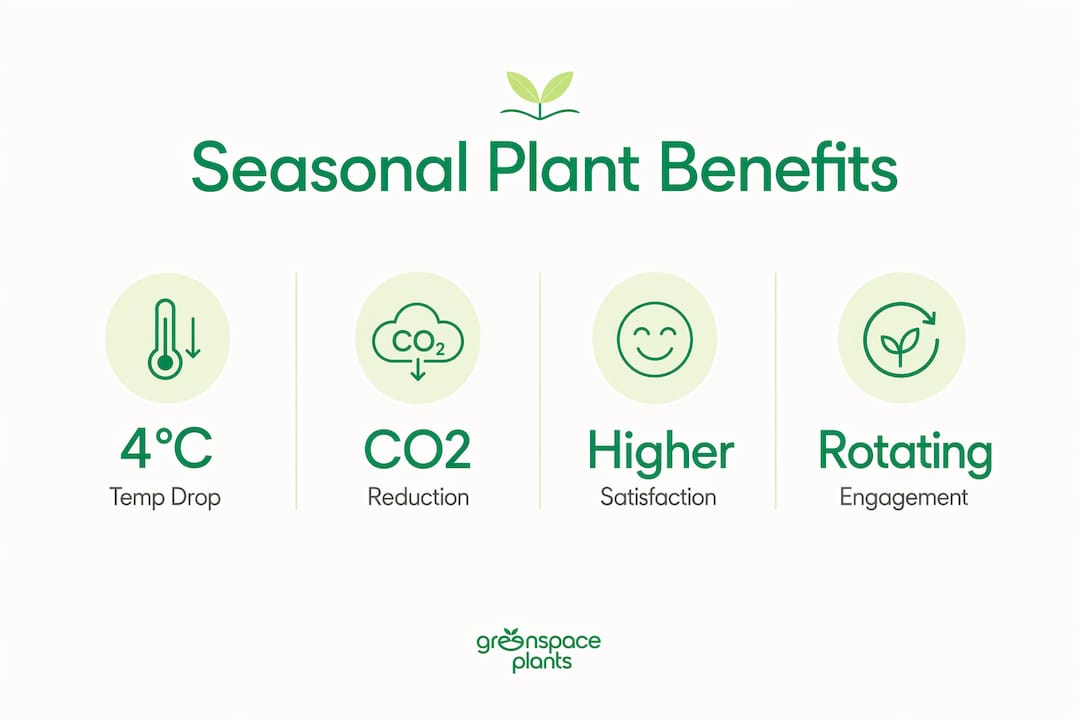
Occupant wellbeing and perceived space quality respond strongly to seasonal variety. Refitable, modular planting systems consistently outperform static displays on occupant engagement and perceived spatial quality — the rotation itself signals care and investment in the environment.
Seasonal brand and visitor engagement rounds out the business case. Lobbies and reception areas with rotating plantscapes reinforce brand identity and tenant-retention value in ways a permanent ficus installation simply cannot.
| Role | Measurable Outcome | Relevant KPI |
|---|---|---|
| Microclimate regulation | Up to 4°C temperature reduction (APW studies) | Zone temperature delta, HVAC setpoint log |
| CO2 uptake | ~42–47 ppm reduction vs. control rooms | Desk-level CO2 sensor |
| RH moderation | Seasonal RH increase of 11.6%–20.76% (transition/winter) | Zone RH sensor |
| Occupant wellbeing | Improved perceived space quality with seasonal rotations | Occupant satisfaction survey |
How plants interact with your HVAC and building systems
Plants interact with HVAC primarily through transpiration, shading, and airflow modification. These effects are species- and context-dependent, which is why treating them as a building service requires the same specification discipline you would apply to any mechanical system.
- Light availability (lux): Biologically active CO2 uptake requires adequate light. Raising light to high levels with supplemental LED can increase CO2 removal many-fold in some species. In low-light corridors, expect minimal air-quality contribution from potted plants.
- Transpiration rates: High-transpiration species like Spathiphyllum (peace lily) release significant water vapor. In small, poorly ventilated rooms, this pushes RH upward fast.
- Leaf area index (LAI): LAI drives both shading and evapotranspiration. Deciduous species like Parthenocissus tricuspidata reach peak LAI in summer — exactly when cooling benefit is most needed — while dropping to near-zero in winter.
- Substrate moisture strategy: Wet substrates amplify transpiration. Automated irrigation with moisture sensors prevents over-watering, which is the fastest route to RH problems.
- Ventilation rate impact: A higher air-change rate dilutes plant-driven humidity, making high-transpiration species safer. In low-ventilation zones, the same species can push RH above 60%, risking mold and material damage.
Pro Tip: Before specifying any high-density installation, calculate expected transpiration against room volume and ventilation rate. The target is to keep RH within the 40%–60% band that HVAC systems are designed to maintain. If your calculation shows risk of exceeding 60%, switch to lower-activity species or reduce plant count.

Choosing the right species and quantities for your seasonal strategy
Pick species based on the service you need — humidity moderation, CO2 uptake, visual seasonality, or low maintenance — then size quantity to room volume and ventilation rate. Getting this wrong in either direction wastes budget or creates building problems.
Species selection criteria:
- Transpiration rate: High for humidity-dry environments; low for small or poorly ventilated offices.
- Leaf density / LAI: Higher LAI means more shading and evapotranspiration; critical for green wall specifications.
- Light tolerance: Low-light-tolerant genera (Dracaena, Epipremnum) for interior corridors; higher-light species for glazed atria.
- Maintenance needs and pest resistance: Prioritize species with low pest susceptibility for managed programs where visit frequency is monthly.
- Native vs. non-native: Native or regionally adapted species generally require less supplemental irrigation and support local biodiversity goals.
CIBSE guidance is direct on quantity rules: less physiologically active species such as Dracaena fragrans and Zamioculcas zamiifolia can be used in larger numbers (10+) in small offices without raising RH above 60%. High-transpiration species like Spathiphyllum should be limited to five or fewer plants in small rooms, or deployed in large-volume spaces where their humidity effect is diluted across more air.
| Species / Genus | Transpiration Activity | Best Use Case | Count Guidance (small office) |
|---|---|---|---|
| Dracaena fragrans | Low | Green walls, corridors, dense installs | 10+ safe |
| Zamioculcas zamiifolia | Low | Low-light zones, high-density installs | 10+ safe |
| Epipremnum aureum | Moderate | Adaptable walls, shelving displays | 5–10 |
| Spathiphyllum (peace lily) | High | Large-volume atriums, lobbies | 5 or fewer |
| Succulents (various) | Very low | Dense small offices, accent groupings | Unrestricted |
For scaling across larger properties, zone your species selection by room volume and air-change rate rather than applying a single species mix building-wide.
Where seasonal plantings work best — and where to be cautious
Placement is as decisive as species choice. Sunlight exposure and airflow patterns change plant performance and building impact dramatically from zone to zone.
Glazed lobbies and atria are your highest-performance zones. High natural light supports biologically active species, maximizes CO2 uptake, and gives seasonal rotations maximum visual impact. Modular green walls here deliver the most consistent year-round thermal comfort benefit, with modular systems showing the highest proportion of livable thermal comfort values across seasons.
Interior corridors and meeting rooms require low-light-tolerant genera. Expect minimal air-quality contribution but strong wellbeing and aesthetic value. Keep plant counts conservative relative to room volume.
Near HVAC diffusers: Avoid placing plants directly in high-velocity airflow. Drafts desiccate foliage, increase maintenance calls, and disrupt the localized humidity contribution you are trying to achieve.
Outdoor patio plantscapes follow a different logic entirely. Weather-hardy seasonal rotations — cool-season annuals in spring and fall, heat-tolerant species in summer — keep exterior spaces productive year-round without the RH management concerns of interior zones.
Climate dependency is real. In hot, humid climates, green walls reduce cooling load reliably. In dry, low-airflow environments, low plant density with dry substrate can occasionally increase surface temperatures rather than reduce them. A pilot installation in one zone, measured over a full season, is the only reliable way to validate performance before committing to a building-wide program.
| Climate Type | Green Wall Cooling Effect | Key Risk | Mitigation |
|---|---|---|---|
| Hot/humid | Strong; reliable RH and temperature reduction | Over-humidification in winter | Seasonal irrigation adjustment |
| Hot/dry | Moderate; depends on irrigation and density | Dry substrate limits evapotranspiration | Automated irrigation, moisture sensors |
| Cold/temperate | Strongest in summer; winter effect reverses | Deciduous species lose LAI in winter | Pair with evergreen species for year-round coverage |
How to operationalize a seasonal plant program
A seasonal program needs a structured planning cycle. Here is a practical operational sequence:
- Site assessment (6–8 weeks before first install): Measure baseline CO2, RH, and lux levels by zone. Conduct an occupant satisfaction survey. This baseline is non-negotiable for proving ROI later.
- Species and quantity specification: Match species to zone conditions using the criteria above. Confirm room volumes and ventilation rates with your facilities team.
- Procurement and contracting: Decide your model. One-time purchase with optional paid maintenance gives you asset ownership. A subscription/managed service (design + install + quarterly rotation + replacement guarantee) transfers operational risk to the vendor. How commercial plant installation works varies significantly between these models.
- Seasonal install windows: Schedule installs during low-occupancy periods. Pre-stage plants off-site so the swap is a single, efficient operation rather than a multi-day disruption. Modular, refitable systems make this operationally feasible at scale.
- Routine maintenance cadence: Monthly visits for watering, pruning, pest inspection, and rotation. Coordinate access windows with your cleaning schedule — aligning plant servicing with office cleaning frequency reduces total disruption to occupants.
- Quarterly seasonal refit: Swap species for the incoming season. Dispose of or compost outgoing plants. Update the asset log.
Cost categories to budget: initial design and installation; plant materials and planters; recurring maintenance labor and consumables; irrigation or automation equipment; seasonal swap labor and disposal; and a contingency reserve for pest incidents or unexpected replacements.
What KPIs should you track for a seasonal plant program?
Measure occupant feedback alongside objective sensors. Either alone is insufficient to prove value to stakeholders.
| KPI | Measurement Method | Timing |
|---|---|---|
| Occupant satisfaction score | Anonymous survey (pre/post and seasonal) | Baseline, then each seasonal refit |
| Desk-level CO2 (ppm) | Fixed or portable CO2 sensor | Continuous; compare to pre-install baseline |
| Zone RH (%) | Humidity sensor per zone | Continuous; flag if >60% or <40% |
| Localized temperature delta | Temperature logger near green installation | Seasonal campaigns |
| Plant health metrics | Technician log (vigor, pest incidents, replacements) | Each maintenance visit |
| HVAC energy correlation | Compare HVAC energy use vs. setpoint logs | Quarterly, time-aligned with sensor data |
| Water use per m² | Irrigation meter or manual log | Monthly |
Collect your 4–8 week baseline of CO2, RH, and occupant surveys before installation, then run time-aligned sensor campaigns across seasonal transitions. This isolates plant-driven changes from HVAC schedule shifts. For sustainability reporting, also track native-plant percentage and composting or diversion of plant waste. How plants affect indoor air standards in your specific building type will shape which KPIs carry the most weight with your stakeholders.
What a managed-service model looks like in practice
A full-service vendor handles design, seasonal installs, monthly maintenance visits, guaranteed replacements, and seasonal design refreshes under a single contract. Here is what that contract should require:
- Service frequency: Minimum monthly maintenance visits with documented technician logs.
- Replacement SLA: Unhealthy or dead plants replaced within a defined window (typically 5–10 business days) at no additional charge.
- Plant health guarantee: Vendor assumes responsibility for plant vigor; you are not paying for dead specimens.
- Seasonal refit schedule: Quarterly or biannual rotations written into the contract, with species selections confirmed 4–6 weeks in advance.
- Disposal and composting terms: Vendor removes outgoing plants and documents disposal method.
- Metrics reporting cadence: Monthly or quarterly summary of plant health metrics, replacement counts, and any RH or pest incidents.
On the coordination side, a managed vendor should integrate with your facilities calendar for access windows, tie into existing irrigation infrastructure where available, and maintain an asset log that your team can audit. Aligning plant service visits with office maintenance schedules keeps disruption minimal and access windows predictable.
Key Takeaways
Seasonal plants deliver measurable building-performance benefits only when managed as a rotating, species-specified service with baseline KPIs, climate-matched placement, and a clear contracting model.
| Point | Details |
|---|---|
| Treat plants as a building service | Species-matched seasonal rotations reduce CO2 by ~42–47 ppm and temperature by up to 4°C in active plant wall studies. |
| Control RH with species choice | Use Dracaena fragrans or Zamioculcas (10+) in small offices; limit Spathiphyllum to 5 or fewer to stay below 60% RH. |
| Validate before scaling | Run a 4–8 week baseline of CO2, RH, and occupant surveys, then pilot one zone before committing building-wide. |
| Align operations with facilities | Schedule seasonal swaps during low-occupancy windows; coordinate with cleaning cadence to minimize disruption. |
| Greenspace Plants | Offers all-inclusive managed seasonal plantscaping with monthly maintenance, guaranteed replacements, and seasonal design refreshes for commercial spaces. |
Why seasonal refits are the highest-leverage move most managers overlook
Most facilities teams treat plants as a one-time purchase decision. They specify a species mix at installation and then manage decline for the next three years. That approach misses the entire performance argument.
The research is clear: static displays underperform on occupant engagement and perceived space quality compared to refitable systems. But the operational insight that rarely gets discussed is how to stage the swap without disrupting your building. Pre-stage incoming plants off-site for one to two weeks so they are acclimated and healthy on install day. Schedule the swap during a Friday afternoon or weekend low-occupancy window. Use modular planter frames so the physical exchange takes hours, not days. Done this way, a quarterly seasonal refit is a facilities event, not a construction project.
The single tip I would give any manager evaluating a seasonal program: write the refit schedule into the contract before you sign, not as an afterthought. Vendors who resist committing to a seasonal rotation calendar are telling you something important about how they intend to service the account.
Greenspace Plants handles the seasonal program so your team doesn't have to
For commercial property and business managers who want the performance benefits of seasonal planting without adding a new operational burden to their facilities team, Greenspace Plants delivers exactly that.
The Greenspace+ program covers plant design, installation, monthly maintenance visits, guaranteed plant replacements, and seasonal design refreshes under a single fixed monthly fee. No upfront capital cost, no long-term lock-in, and no internal expertise required. Whether you manage a single office floor or a multi-tenant property, the program scales to your footprint. Greenspace Plants serves commercial spaces across Toronto, Vancouver, and Calgary, with indoor plant rental programs and green wall installations designed specifically for the commercial environment. To see what a seasonal plantscape program looks like for your space, browse the client look-book or reach out for a site assessment and pilot estimate.