
Ongoing plant maintenance is the single decisive factor that preserves or destroys design integrity in commercial plantscapes. Without a structured care program, even the most thoughtfully specified installation will visually degrade within months. Three actions protect your investment right now: schedule quarterly design audits, enforce a documented plant replacement policy, and align every species to its actual light zone before installation. Greenspace Plants and the all-inclusive Greenspace+ service are built around exactly these principles.
- Schedule quarterly design audits to catch proportion drift, color shifts, and planter wear before they become visible to clients or guests.
- Enforce a replacement policy so that declining plants are swapped out on a defined timeline, not when someone finally complains.
- Match plants to light zones at the specification stage, because a species placed in the wrong light environment will require twice the corrective maintenance and still underperform.
Key Takeaways
Ongoing plant maintenance is the single most important factor in preserving design integrity for commercial plantscapes, and a structured care program is the only reliable way to protect that investment over time.
| Point | Details |
|---|---|
| Maintenance determines design integrity | Without structured care, commercial plantscapes enter visible decline within 6–12 months of installation. |
| Right-plant-right-place is the highest-return spec decision | Matching species to actual light zones reduces long-term maintenance costs more than increasing visit frequency. |
| Photo reporting converts aesthetics into a contract standard | Timestamped visit photos create a documented baseline that makes decline traceable and replacement terms enforceable. |
| Fixed-fee models reduce reactive replacement spend | Outsourced professional maintenance with a replacement guarantee converts unpredictable capital costs into a known monthly line item. |
| Greenspace Plants and Greenspace+ | An all-inclusive monthly service covering design, maintenance, and guaranteed replacements with no upfront costs or long-term commitment. |
Table of Contents
- Why maintenance is the foundation of design integrity for interior plantscapes
- The core maintenance tasks that directly protect your plantscape's appearance
- What a realistic maintenance schedule looks like for commercial interiors
- Design decisions that reduce maintenance risk and protect the intended look
- How maintenance choices change the lifecycle cost of your plantscape
- Red flags that tell you design integrity is already failing
- A practical handover checklist for property managers and designers
- A before-and-after example: restoring design integrity through structured maintenance
- How to evaluate and hire a commercial plantscaping and maintenance provider
- The case for designing with maintenance in mind from day one
- Greenspace Plants and Greenspace+ protect your design investment
- Sources
Why maintenance is the foundation of design integrity for interior plantscapes
Design integrity in a commercial plantscape means the installation still looks and performs the way it was specified: correct scale, consistent silhouette, healthy color, clean planter finishes, and no functional hazards. Maintenance is what keeps all of those qualities intact over time.
The visual impacts of neglect are obvious once you know what to look for. Plants grow phototropically toward available light, so without regular rotation, a specimen that was specified as a symmetrical focal point becomes a lopsided mass leaning toward the nearest window. Fertilizer gaps cause foliage to yellow and thin, shrinking the visual weight of a planting that was sized to anchor a reception area. Unpruned growth pushes beyond the intended silhouette, throwing off the proportional relationships the designer established.
Functional impacts are less visible but carry real liability. Overwatering without proper drainage creates standing moisture that promotes mold and fungal growth, introducing allergens into the air. Pest infestations, left unaddressed, spread across adjacent planters and can reach building finishes. Irrigation leaks create slip hazards on polished floors. Skipping scheduled maintenance converts predictable, budgeted care costs into unpredictable reactive expenses and brand-damage risk.
Illustrative signal: Industry professionals consistently observe that installations without active management enter visible decline within 6–12 months, at which point reactive replacement costs typically exceed what a structured maintenance program would have cost over the same period.
Professional maintenance reduces plant mortality, preserves the biophilic benefits of indoor greenery, and protects the brand perception your space is meant to project.
The core maintenance tasks that directly protect your plantscape's appearance
Scheduled visits covering watering, fertilizing, pruning, pest control, and replacement are what keep an installation visually coherent over time. Think of your maintenance technician as a plant clinician: each visit is a diagnostic check, not just a watering run.
- Moisture-calibrated watering: Technicians check soil moisture before adding water, preventing root rot and the overwatering that leads to mold and planter staining.
- Targeted pruning: Removing dead growth and shaping active growth preserves the silhouette and proportion the designer specified.
- Leaf cleaning: Dust accumulation dulls foliage and reduces photosynthetic efficiency; clean leaves maintain the luster that makes a plantscape read as "magazine-ready."
- Fertilization: Consistent nutrient delivery sustains foliage density and color, preventing the thinning and yellowing that visually erode a design.
- Integrated Pest Management (IPM): Proactive scouting and targeted treatment stop infestations before they spread to adjacent plants or building surfaces.
- Soil flushing and topdressing: Flushing removes salt buildup from fertilizers; fresh topdressing keeps planter surfaces clean and finished-looking.
- Rotation and relocation: Rotating phototropic species keeps growth symmetrical; relocating plants that are clearly struggling in their current light zone prevents long-term decline.
- Planned replacements: Replacing plants on a scheduled basis, rather than waiting for full decline, maintains visual continuity and prevents gaps in the design.
| Task | Frequency | Design benefit |
|---|---|---|
| Moisture check and watering | Weekly | Prevents root rot, planter staining, and mold |
| Leaf cleaning | Weekly | Maintains foliage luster and visual density |
| Pruning for silhouette | Monthly | Preserves proportion and intended shape |
| Fertilization | Monthly | Sustains color and foliage weight |
| IPM scouting | Monthly | Stops pest spread before it reaches finishes |
| Soil flushing and topdressing | Quarterly | Keeps planter surfaces clean and finished |
| Rotation and relocation | Quarterly | Corrects phototropic lean; rebalances composition |
| Planned plant replacement | As needed / quarterly review | Maintains visual continuity; eliminates gaps |
What a realistic maintenance schedule looks like for commercial interiors
A well-run commercial plantscape runs on three overlapping rhythms: weekly visits for basic health checks, monthly deep inspections, and quarterly refresh cycles that address design-level concerns.
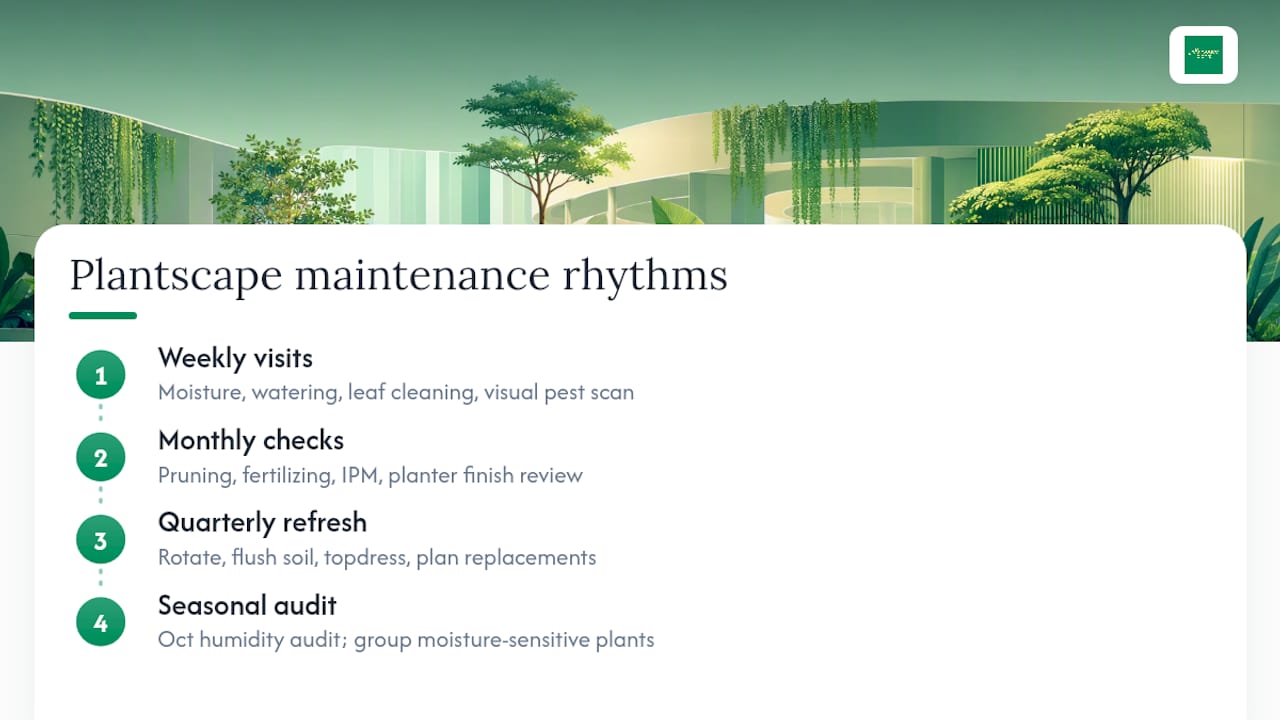
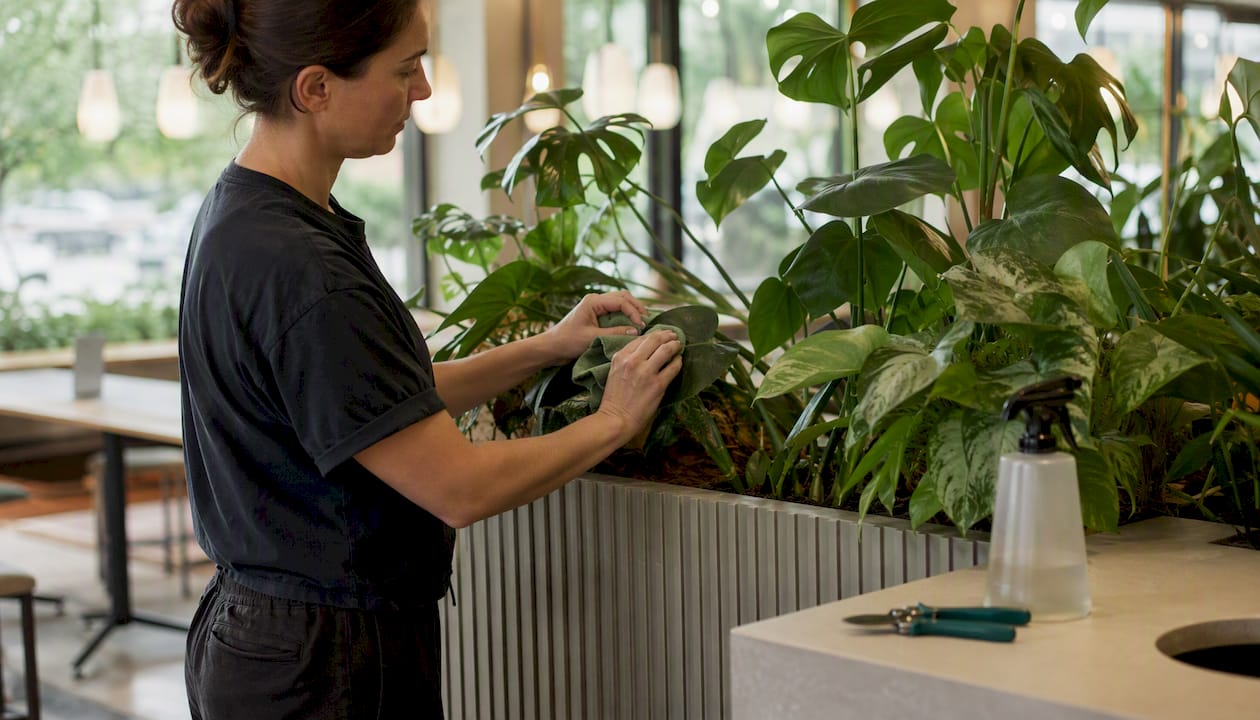
Weekly visits cover moisture checks, watering, leaf cleaning, and a quick visual scan for early pest activity or yellowing. These visits are brief but non-negotiable; skipping even two consecutive weeks in a warm, dry office environment can trigger visible decline.
Monthly deep checks add pruning, fertilization, IPM treatment if needed, and a review of planter finishes. This is also when a technician documents any plants approaching the replacement threshold and flags them for the property manager.
Quarterly refresh cycles address rotation, soil flushing, topdressing, and any planned replacements. This is the moment to step back and assess whether the installation still reads as the designer intended, or whether growth, light changes, or wear have shifted the composition.
Environmental cycles matter, too. HVAC systems in northern U.S. climates run heating from roughly October through March, dropping indoor humidity significantly and stressing tropical species that were specified for their lush, broad-leaf appearance. Seasonal light reduction in winter months means some plants receive far less photosynthetically active radiation than they did during the specification phase.
Pro Tip: In northern U.S. cities, add a humidity audit to your October service visit. Grouping moisture-sensitive species together and introducing a pebble-tray or supplemental humidifier near key focal plants can prevent the winter leaf drop that most dramatically disrupts a plantscape's visual weight.
Design decisions that reduce maintenance risk and protect the intended look
The most cost-effective maintenance strategy starts at the specification stage. Choosing plants unsuited to their light environment, specifying inaccessible planters, and neglecting planter finishes are among the most common errors that accelerate loss of design integrity.
Matching species to actual site conditions, what professionals call right-plant-right-place, reduces long-term maintenance costs more reliably than increasing visit frequency. A low-light-tolerant ZZ plant or cast-iron plant in a north-facing corridor will hold its form for years; a fiddle-leaf fig in the same spot will demand constant corrective care and still look stressed.
Planter selection matters beyond aesthetics. Planters without adequate drainage force technicians to guess at moisture levels, increasing both overwatering risk and planter staining. Planters that are too heavy to move without equipment make rotation impractical, which means phototropic lean goes uncorrected.
Two brief examples illustrate how specs differ by setting, with local expertise available from partners like Rojas Landscapes – Landscaping in Woodstock, IL. In a restaurant patio, where plants face direct sun, wind, and temperature swings, the right spec prioritizes drought-tolerant species with a compact growth habit, planters with drainage and UV-stable finishes, and modular groupings that can be individually swapped without disrupting the overall composition. Plant design for hospitality settings requires that durability and guest-facing visual impact work together. In an open-plan office, the priority shifts to species that tolerate fluorescent or LED lighting, planters positioned away from high-traffic corridors to reduce physical damage, and accessible servicing zones so technicians can work without disrupting staff. Greenspace Plants collaborates with interior designers to build these maintainability specs into the design brief from the start.
How maintenance choices change the lifecycle cost of your plantscape
The real cost of a commercial plantscape is not the installation fee. It is the cumulative cost of keeping it looking the way it was designed to look, year after year.
In-house care sounds economical until you account for the hidden costs: staff time diverted from core responsibilities, the absence of IPM expertise that lets a pest outbreak spread unchecked, and the reactive replacement spend that follows. A facilities team watering plants on a fixed schedule, regardless of actual soil moisture, will generate more plant losses in a year than a professional service running moisture-calibrated visits.
Outsourced professional maintenance shifts the cost structure from variable and reactive to fixed and predictable. Managed plant services with scheduled visits and documented replacement policies convert an unpredictable capital expense into a known monthly line item. The replacement guarantee built into a well-structured service contract means you are not absorbing the cost of a plant that declined because a visit was missed.
Greenspace+ takes this model further: a single fixed monthly fee covers design, installation, ongoing plant care and maintenance, and guaranteed replacements, with no upfront costs and no long-term commitment required. For property managers overseeing multiple floors or locations, that predictability is worth more than a lower nominal rate that comes with unpredictable add-on charges.
Red flags that tell you design integrity is already failing
These symptoms signal that the impact of maintenance gaps has moved from invisible to visible:
- Yellowing or leaf drop on previously healthy specimens, indicating watering irregularities or nutrient deficiency.
- Leggy, asymmetrical growth on focal plants, a sign that rotation has been skipped and phototropism has gone uncorrected.
- Soil runoff or topdressing loss on planter surfaces, which makes even expensive planters look neglected.
- Pest clusters on leaf undersides or at soil level, indicating IPM has lapsed.
- Inconsistent planter finishes, where some pots show water staining, algae, or physical damage while others remain clean.
- Irrigation leaks or pooling water near planters on hard-surface floors.
When you spot these, triage in this order:
- Isolate affected plants from healthy ones to prevent pest or disease spread.
- Document the condition with timestamped photos before any intervention.
- Pause automated irrigation on affected planters until a technician assesses moisture levels.
- Contact your maintenance provider for an IPM assessment and replacement evaluation.
Static plant programs that go without design-aware maintenance can unintentionally age a space, making updated finishes and furniture look mismatched against a plantscape that has drifted from its original specification. Remediation is possible for most plants caught early; full replacement is the right call when a specimen has lost more than roughly half its foliage density or when structural damage to roots is confirmed.
A practical handover checklist for property managers and designers
When a plantscape transfers from installation to ongoing operations, or from one service provider to another, a structured handover prevents the knowledge gaps that lead to early decline.
Plant inventory and care records:
- Species name and location for every plant in the installation.
- Watering regimen (frequency, volume, moisture threshold).
- Fertilizer schedule and product used.
- Pruning notes (target silhouette, last service date).
- Pest history and any active IPM treatments.
- Planter care instructions (cleaning products, drainage maintenance).
Operational handover fields:
- Site ID and floor/zone map.
- Access requirements (key codes, service elevator booking, restricted hours).
- Expected service cadence and escalation contact.
- Replacement policy terms (threshold, approval process, lead time).
- Emergency procedures for irrigation failures or pest outbreaks.
Pro Tip: Require photo-based reporting with timestamped visit notes as a contractual deliverable, not an optional add-on. A photo log converts subjective aesthetics into a documented record, making it straightforward to identify when decline began and which service interval was responsible.
Plant installation best practices recommend capturing a complete photo record at installation, which becomes the baseline against which all future condition reports are measured. For large buildings, preventing plant neglect at scale requires that this documentation system be centralized, not left to individual floor managers.
A before-and-after example: restoring design integrity through structured maintenance
A mid-size professional services firm had installed a reception plantscape featuring three large Ficus lyrata specimens as focal points, flanked by lower Aglaonema groupings in custom white ceramic planters. Eighteen months after installation, with only ad-hoc watering by office staff, the Ficus had grown asymmetrically toward the south-facing windows, the Aglaonema had thinned noticeably from inconsistent fertilization, and two of the white planters showed persistent brown water staining.
The intervention covered four actions: a full IPM assessment (minor fungus gnat activity was found and treated), a pruning session to restore the Ficus silhouette, a fertilization reset for the Aglaonema, and a planter cleaning protocol using a pH-neutral cleaner safe for ceramic finishes. Two Aglaonema plants that had lost more than half their foliage density were replaced.
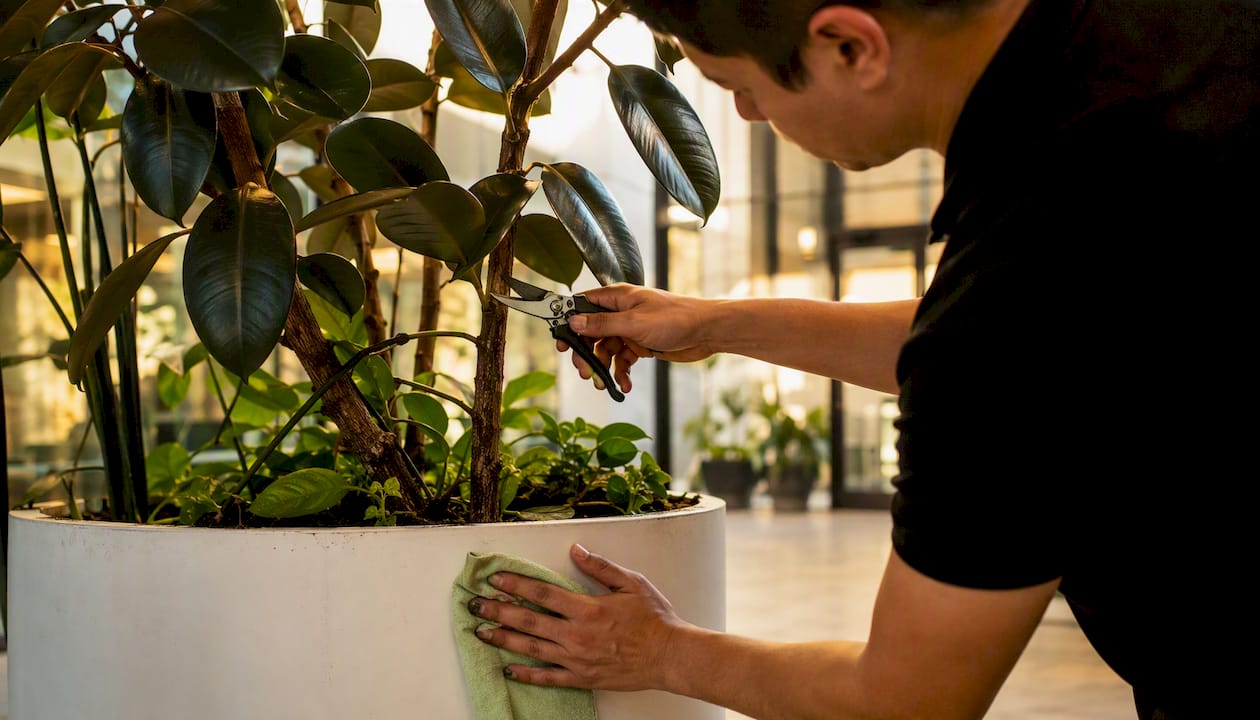
Within two monthly service cycles, the installation had returned to its specified appearance. The firm moved to a structured monthly maintenance program, and no further reactive replacements were needed in the following year. The lesson: earlier intervention would have prevented the replacement cost entirely.
How to evaluate and hire a commercial plantscaping and maintenance provider
Choosing the right provider is itself a design integrity decision. A provider who cannot document their maintenance process will not protect yours.
Selection criteria to apply:
- Portfolio of comparable commercial settings (offices, restaurants, retail, not just residential).
- Documented replacement guarantee with clear terms (threshold, timeline, no-cost swap).
- Written maintenance checklist shared with the client after every visit.
- Technician training in IPM and species-specific care.
- General liability insurance and proof of coverage.
- Photographic reporting as a standard deliverable.
- References from property managers or designers in similar building types.
Questions to ask every provider:
- What is your standard visit frequency, and what triggers an unscheduled visit?
- How do you approach IPM, and what products do you use in occupied commercial spaces?
- What are your replacement terms, and who approves a replacement?
- How do you document each visit, and how is that report shared with us?
- What happens if a plant declines between scheduled visits?
Contract red flags:
- Vague replacement language ("replaced as needed" with no defined threshold or timeline).
- No inspection reporting or photo documentation requirement.
- Long lock-in periods with minimal service detail in the scope of work.
- No named technician or account manager responsible for your installation.
Professional interior plant care begins with matching species to site conditions and continues with consistent, documented visits. A provider who cannot articulate both halves of that equation is unlikely to protect your design intent over time.
The case for designing with maintenance in mind from day one
There is a persistent gap between how commercial plantscapes are specified and how they are actually maintained, and it costs property managers and designers far more than they realize.
Most design briefs treat plants as static décor elements. The species, the planter, the placement: all specified with care. The maintenance plan: often an afterthought, delegated to whoever is available. The result is that a $15,000 installation looks tired within 18 months, not because the design was wrong, but because the living materials were never given a care framework to match the design ambition.
My suggestion for designers: specify maintainability alongside aesthetics. Document the target silhouette, the acceptable growth range, and the access requirements for every planting zone. That brief becomes the technician's reference and the client's contractual standard.
For property managers: set a documented replacement tolerance before the installation goes in. Decide in advance what percentage of foliage loss or what visual deviation triggers a replacement, and put it in the service contract. That single decision converts a subjective judgment call into a clear, enforceable standard.
Greenspace Plants and Greenspace+ protect your design investment
Watching a carefully designed plantscape decline because maintenance was inconsistent is a frustrating and avoidable outcome. Greenspace Plants offers a direct alternative: the Greenspace+ all-inclusive monthly program covers design, installation, scheduled maintenance visits, and guaranteed plant replacements for a fixed monthly fee, with no upfront costs and no long-term commitment required.
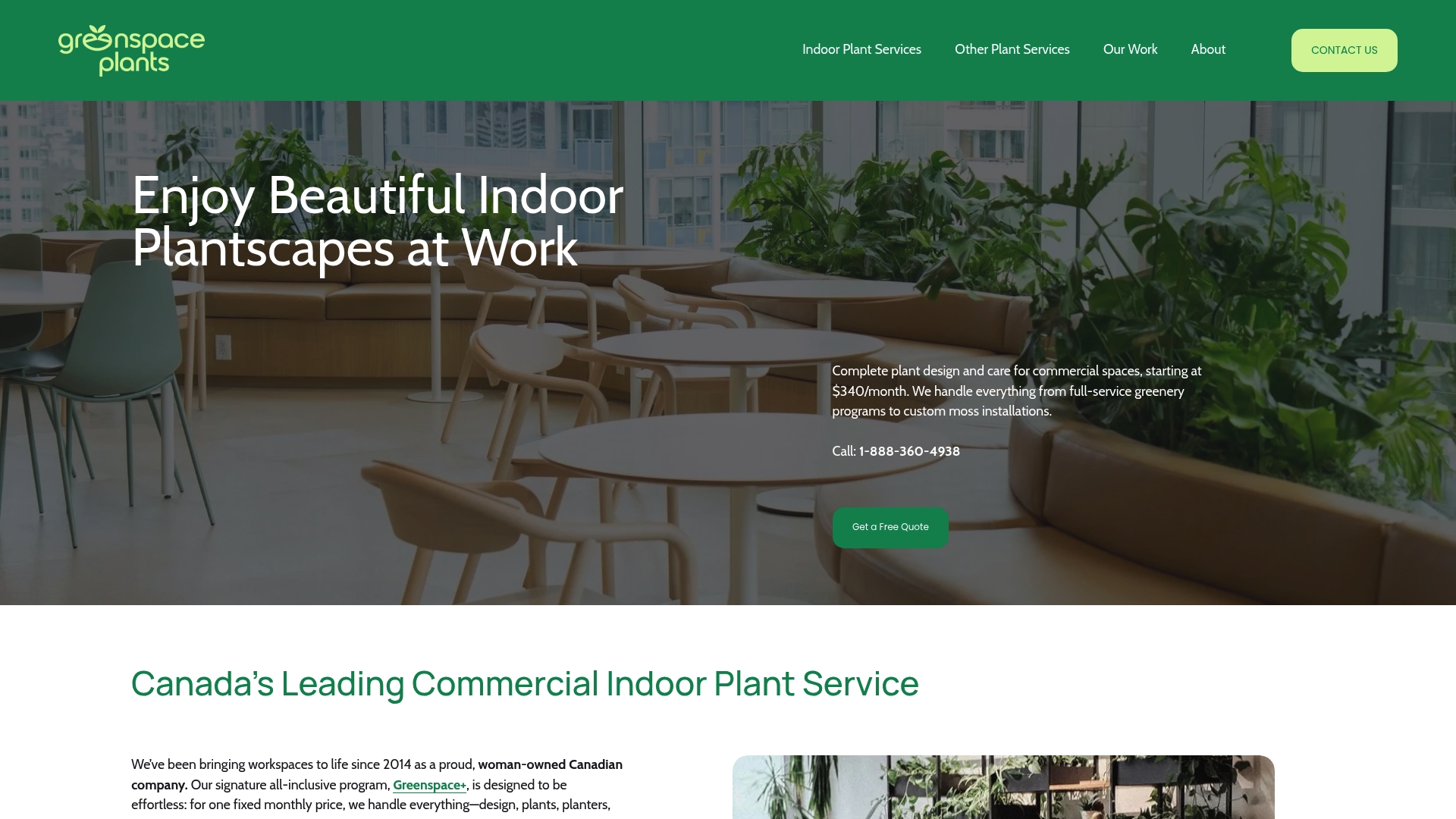
Every Greenspace+ client receives documented visit reports with photographic records, a guaranteed replacement policy with no surprise charges, and access to a design team that collaborates with interior designers to build maintainability into the specification from the start. Whether you manage a single-floor office or a multi-location restaurant group, the service scales to your footprint. To protect the design integrity of your commercial interior, request a site consultation with Greenspace Plants today.
Sources
- Indoor Plant Service Canada / Collaborating with Interior Designers