
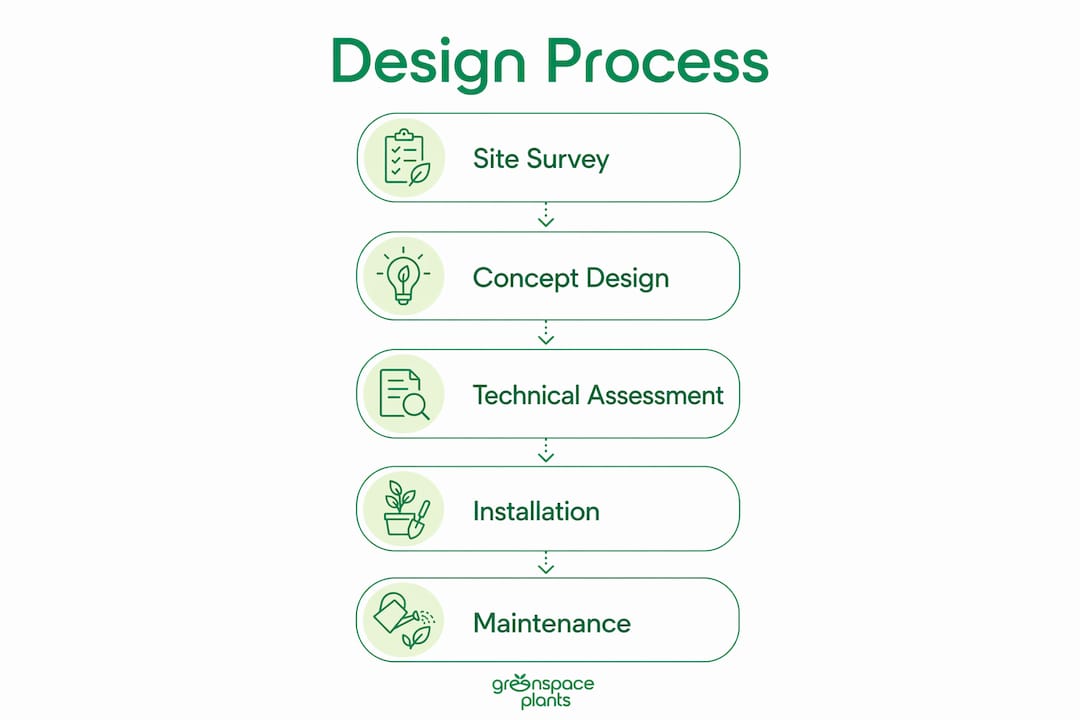
A restaurant plant design project runs through five staged phases: site survey, concept design and plant palette, technical assessment, installation, and ongoing maintenance. Done well, the result is a plantscape for restaurants that defines zones, supports guest circulation, and stays healthy under a guaranteed maintenance schedule. Greenspace Plants manages every one of those phases under its Greenspace+ subscription, so owners get a predictable monthly cost and zero plant-loss surprises.
The single most important number to know before you start: dining rooms typically read 50–300 lux during service. That range determines which species will survive, which will struggle, and whether high-quality preserved or replica plants are the smarter call for low-light corners.
Table of Contents
- How does the restaurant plant design process work, phase by phase?
- Plants are operational design tools, not just decoration
- Choosing plant species and planters that survive restaurant conditions
- What do restaurant plant programs typically cost, and how are contracts structured?
- What questions should you ask a plantscaping provider?
- How the Greenspace+ full-service model works in practice
- Before/after snapshots and the metrics worth tracking
- Key Takeaways
- Why a full-service approach makes more sense than you might think
- Greenspace Plants can handle every phase for you
- Useful sources
How does the restaurant plant design process work, phase by phase?
A well-run project moves through five clear phases. Each one has a defined deliverable so you always know what you're getting before the next phase begins.
-
Initial consultation and site survey. A designer visits your space, photographs the floor plan, measures light levels during service hours, and maps seating flow and traffic patterns. Commercial plant designers align plant aesthetics with your brand and interior layout at this stage. Deliverable: a site survey report with annotated floorplan and light readings.
-
Concept design and plant palette. Using the survey data, the designer builds a moodboard, selects species suited to your light and HVAC conditions, and proposes container styles. You see placement mockups before a single plant is ordered. Deliverable: concept mockups and a planting plan.
-
Technical assessment. This phase covers HVAC and heat-source proximity, irrigation and drainage requirements, food-safety clearances, and planter anchoring specs. It's the phase most owners skip when they DIY, and it's where most commercial programs fail. Deliverable: a technical memo and installation spec.
-
Installation. Delivery and installation workflows are scheduled around your service hours to avoid disruption. Planters are anchored, drainage is confirmed, and staff receive a brief on access points. Deliverable: a signed installation checklist with photos.
-
Ongoing maintenance. Maintenance logistics are planned during the design phase so crews can reach every planter without interrupting service. Deliverable: a maintenance schedule and contract with replacement terms.
| Phase | Typical Duration |
|---|---|
| Site survey | 1–2 days |
| Concept design | 1–2 weeks |
| Technical assessment | 3–5 days |
| Installation | 1–3 days |
| Maintenance setup | Ongoing from week 4 |
Plants are operational design tools, not just decoration
The biggest misconception in restaurant plant design is that greenery is purely decorative. In a working dining room, plants do real operational work.
- Zone definition. A row of tall floor planters separates a bar area from the main dining floor without a wall, preserving sightlines while reducing noise bleed.
- Traffic flow. Layered planter heights guide guests toward host stands and away from service corridors without a single sign.
- Privacy nooks. A pair of large-form plants flanking a banquette create a semi-private dining experience that commands a premium reservation.
- Acoustic dampening. Dense foliage absorbs mid-frequency sound, softening the echo that plagues hard-surface dining rooms.
- Kitchen screening. A green wall or tall planting column near an open kitchen pass hides back-of-house activity without blocking ventilation.
A single row of tall planters along a banquette wall typically adds two to four semi-private covers without reducing total seating. A full green wall in the same footprint delivers stronger visual impact but requires a drainage and irrigation plan. When reviewing a provider's proposal, ask for labeled floorplans and before/after mockups that show exactly how each plant element affects cover count and server paths. If a proposal lacks those, the design is guesswork.
Choosing plant species and planters that survive restaurant conditions
Species selection starts with your light reading. Below roughly 150 lux, live species choices narrow sharply to very low-light tolerants like ZZ plants, cast iron plants, and certain pothos varieties. Above 150 lux, you gain access to peace lilies, snake plants, and larger-form tropicals. Professional teams often mix live, preserved, and replica planting to achieve a consistent look in zones where maintenance or light makes fully live programs impractical.
Heat proximity matters just as much as light. Anywhere within about 2 meters of a hot pass or pizza oven runs 5–10°F warmer and drier than the rest of the dining room. Specify heat-tolerant species in those zones or plan for a higher replacement cadence.
| Condition | Threshold | Design Response |
|---|---|---|
| Light (dining service) | 50–300 lux | Below 150 lux: use low-light tolerants or quality replicas |
| Heat proximity | Within ~2 m of hot pass | Specify heat-tolerant species; increase replacement budget |
| Leaf cleaning frequency | Every 2–3 weeks | Large leaves accumulate grease; schedule microfiber wipe-downs |
Planter types to consider: freestanding floor planters for zone definition, banquette-top troughs for intimate dining rows, wall-mounted troughs for vertical interest, and built-in planters with integrated drainage for permanent installations. Material choices should prioritize washability and fire-safety compliance.
Pro Tip: Place planters where your maintenance crew can reach them during off-peak hours, typically before the first cover or after last call. A beautiful planter tucked behind a banquette that requires moving furniture to water will be neglected within a month.
What do restaurant plant programs typically cost, and how are contracts structured?
Three contract models cover most commercial restaurant programs.
-
One-time purchase with optional maintenance. You own the plants and planters outright. Maintenance is billed separately, either per visit or on a monthly retainer. Higher upfront cost; replacement risk sits with you.
-
All-inclusive monthly subscription (Greenspace+ model). A fixed monthly fee covers design, installation, scheduled maintenance, and plant replacements. No upfront plant cost, no surprise invoices when a plant declines. This model is what Greenspace Plants offers through Greenspace+.
-
Rental or seasonal refresh programs. Flexible rental programs combine installation and maintenance for short-term needs, pop-ups, or patio seasons, reducing upfront cost for operators who don't want a permanent commitment.
What's typically included versus extra:
- Included: design consultation, plant materials, standard planters, installation labor, scheduled maintenance visits, routine replacements
- Often extra: custom or luxury planters, green walls or moss walls, emergency call-outs outside scheduled windows, outdoor patio programs
Contract terms to review before signing:
- Maintenance visit frequency and access window (before or after service hours)
- Replacement guarantee language: does "healthy plant guarantee" mean same-day swap or next scheduled visit?
- Response time for a visibly sick plant
- Termination terms: month-to-month vs. annual lock-in
- Insurance and liability coverage for planter anchoring and water damage
- Invoicing cadence and what triggers an extra charge
What questions should you ask a plantscaping provider?
Not every provider who installs plants in restaurants has commercial hospitality experience. These questions separate the specialists from the generalists.
- Do you conduct an on-site light measurement during service hours, or do you estimate?
- Can you show me a sample planting plan with labeled species and lux requirements?
- How do you schedule maintenance visits around service hours?
- Where do you source your plants, and do you propagate replacements in-house?
- Do you carry commercial general liability insurance?
- Can you provide references from restaurant clients specifically?
Red flags to watch for: proposals without a floorplan or light data, vague guarantee language ("we'll replace as needed"), no scheduled maintenance calendar, and no mention of food-safety or anchoring considerations.
Pro Tip: Ask any provider for their indoor plant care protocol for kitchen-adjacent plants specifically. If they don't mention leaf cleaning or heat-zone species adjustments, they haven't worked in a real restaurant environment.
Deliverables to insist on before signing: a site survey report, species-specific planting plan mockups, an installation schedule with service-hour windows, a maintenance schedule showing access points, and written replacement/guarantee terms.
How the Greenspace+ full-service model works in practice
Greenspace+ is Greenspace Plants' all-inclusive monthly program designed for commercial spaces, including restaurants. Here's what it covers from day one.
- Design and installation: site survey, concept mockups, planting plan, and scheduled installation during off-peak hours
- Scheduled maintenance: regular technician visits timed around your service windows, covering watering, pruning, leaf cleaning, and soil amendments
- Plant replacements: any plant that declines is replaced at no extra charge under the healthy-plant guarantee
- Planter options: standard, premium, luxury, or custom planters included or available as an upgrade
- Simplified vendor management: one monthly invoice, one point of contact, no coordinating between a plant supplier and a separate maintenance crew
For a busy restaurant manager, the practical benefit is removing plant health from your weekly mental load entirely. You don't track watering schedules, you don't chase a supplier when a plant dies, and you don't brief new staff on care routines every time turnover happens.
Before/after snapshots and the metrics worth tracking
Two short examples show how functional planting translates to measurable outcomes.
A casual dining room with a noisy open floor plan added a row of tall ZZ plant columns along the central aisle. The result: a natural division between a quieter back section and a livelier front bar area, with guests in the back section reporting a noticeably calmer experience in post-visit surveys.
A fast-casual space near a busy street entrance used a dense planting column to screen the kitchen pass from the front door. Staff reported fewer guest complaints about kitchen noise and odors within the first month of installation.
Metrics worth tracking from your own baseline:
- Plant uptime rate (percentage of plants healthy at each maintenance visit)
- Customer dwell time in planted vs. non-planted zones
- Perceived ambiance score from a simple post-visit survey question
- Staff hours spent on plant-related tasks per week before and after a managed program
- Replacement frequency and cost under a self-managed vs. subscription model
A quick light reading with a phone light meter app and a rough footprint sketch are enough to establish your baseline before your first vendor call.
Key Takeaways
A restaurant plant design project succeeds when environmental data drives species selection, maintenance access is planned before installation, and contract terms put replacement risk on the provider.
| Point | Details |
|---|---|
| Measure light before selecting species | Dining rooms read 50–300 lux; below 150 lux restricts live species choices significantly. |
| Plan maintenance access during design | Crews need clear access to every planter without disrupting service hours. |
| Insist on written replacement guarantees | Vague guarantee language is the most common contract risk for restaurant owners. |
| Plants serve operational functions | Zone definition, traffic flow, and acoustic dampening are measurable outcomes, not just aesthetics. |
| Greenspace+ removes the management burden | Greenspace Plants' all-inclusive subscription covers design, installation, maintenance, and replacements under one monthly fee. |
Why a full-service approach makes more sense than you might think
Here's an opinion that tends to surprise restaurant owners: the plants themselves are rarely the problem in a failed commercial plant program. Poor maintenance planning is. Staff turnover, verbal handoffs, and no documented watering schedule are the most common causes of plant loss in hospitality settings. A beautiful planting plan executed by a skilled designer can be completely undone within three months if no one owns the ongoing care.
That's why we consistently recommend a full-service model for restaurants specifically. It's not about upselling. It's about the reality that a restaurant's core operational focus is food and service, not horticulture. When plant health depends on a staff member remembering to water between covers, it will eventually fail. When it's backed by a scheduled technician visit and a replacement guarantee, it won't.
The owners who get the most out of their plantscapes are the ones who treat the maintenance contract as seriously as the design brief. The design gets guests to notice. The maintenance keeps them coming back.
Greenspace Plants can handle every phase for you
Greenspace Plants takes restaurant owners from site survey to scheduled maintenance under one program. Greenspace+ covers indoor plant design, installation, regular technician visits, and guaranteed plant replacements for a fixed monthly fee. No upfront plant costs, no surprise invoices, and no long-term lock-in.
We schedule installations and maintenance visits around your service hours, so your dining room is never disrupted during a shift. If you want to see what a plantscape could look like in your specific space, our client look-book shows real commercial installations across restaurant, office, and retail environments.
Ready to start? Request a site survey and we'll bring light measurements, a concept mockup, and a clear proposal to your space.
Useful sources
- Plants for Restaurants: A Practical UK Guide (Growtropicals) — supports light-level thresholds (50–300 lux), heat-zone species guidance, and leaf-cleaning frequency recommendations.
- Restaurant Plant Design & Maintenance (Happy Trees) — supports Phase 1 site survey process, installation scheduling around service hours, and maintenance access planning.
- How To Use Plants In Restaurant Interior or Cafe Interior (Mindful Design Consulting) — supports functional use cases: zoning, traffic flow, and layered planter heights for circulation.
- Plants for Restaurants and Hospitality (Plant Plan) — supports replica/preserved planting options and flexible rental program models.