
Hire a full-service commercial plantscaping provider that bundles species selected for durability, heavy-duty planters, integrated irrigation, and a written maintenance SLA with a healthy-plant guarantee. That single decision removes the operational risk that kills most DIY greenery programs in busy commercial spaces.
The one-minute brief:
- Day one requirements: Insist on a documented site survey, species matched to each microclimate, shatterproof planters with sealed drainage, a scheduled maintenance cadence, and a written plant replacement policy before you sign.
- Signal metrics to request upfront: replacement response time (target: 72 hours), technician visit frequency (weekly for restaurants and high-traffic lobbies, bi-weekly minimum for offices), and a monthly plant health report.
- Subscription vs. one-time: For lobbies, restaurant dining rooms, and busy corridors, an all-inclusive monthly subscription transfers replacement risk to the vendor and keeps your plantscape looking its best without internal labor.
Table of Contents
- Why do indoor plants actually improve commercial spaces?
- What design principles protect circulation and plant health in busy spaces?
- How should vendors select plants for commercial, high-traffic installations?
- How do vendors price commercial plantscaping projects?
- What is a realistic timeline from site survey to handover?
- How do you measure whether the plantscape is working?
- What are the most common failure modes, and how do professionals prevent them?
- Key Takeaways
- A practitioner's perspective on what actually matters in busy-site projects
- Greenspace Plants: full-service plantscaping for busy commercial spaces
- Useful sources
Why do indoor plants actually improve commercial spaces?
The evidence here is stronger than most procurement teams realize. A field study across nine organizations using a Before-After-Control-Impact design found that plants reduced dry-air complaints, increased the sense of privacy, and improved perceived attractiveness and workspace satisfaction. Crucially, some of those benefits only appeared after multiple post-intervention measurements, which means a plantscape needs time to deliver its full return.
"Three longitudinal field experiments comparing green versus lean office spaces found improvements in perceived air quality, concentration, and in some cases objective productivity gains, measured at multiple points after installation." — Green vs. lean office field experiments
Plants also raise relative humidity locally, which directly addresses the dry-air complaints common in HVAC-heavy commercial buildings. For procurement teams building an internal business case, these peer-reviewed field experiments give you citable, real-world evidence to include in RFPs or budget memos. Our own office greenery productivity guide summarizes the practical implications for commercial settings.
What design principles protect circulation and plant health in busy spaces?
Professional designers working on high-footfall zones think about three things simultaneously: pedestrian safety, sightlines, and plant survival. Getting any one of them wrong creates either a liability or a dead plant within months.
The core placement rules:
- Keep all planting out of the primary pedestrian path. Corridors need sufficient clear egress width; plants should never narrow that.
- Avoid placing specimens on the central sightline of a lobby or dining room. Use plants as background or foreground framing elements instead.
- Use movable pots in areas where layout changes frequently (event spaces, restaurant dining rooms) so the plantscape adapts without a service call.
- In larger lobbies, vertical elements like green walls or tall specimen plants anchor the design without consuming floor space.
- Map HVAC diffusers and natural light zones during the site survey. A plant placed directly under a cold-air diffuser will decline regardless of species.
Pro Tip: Prioritize plant health over plant quantity. Research analyzing 200 indoor greenery images found that plant health status has a large negative effect on restorative experience — a few thriving specimens consistently outperform a crowded display of stressed plants.
How should vendors select plants for commercial, high-traffic installations?
Species selection for a busy lobby or restaurant is a professional discipline, not a catalog browse. The filters that matter in commercial settings go well beyond aesthetics.
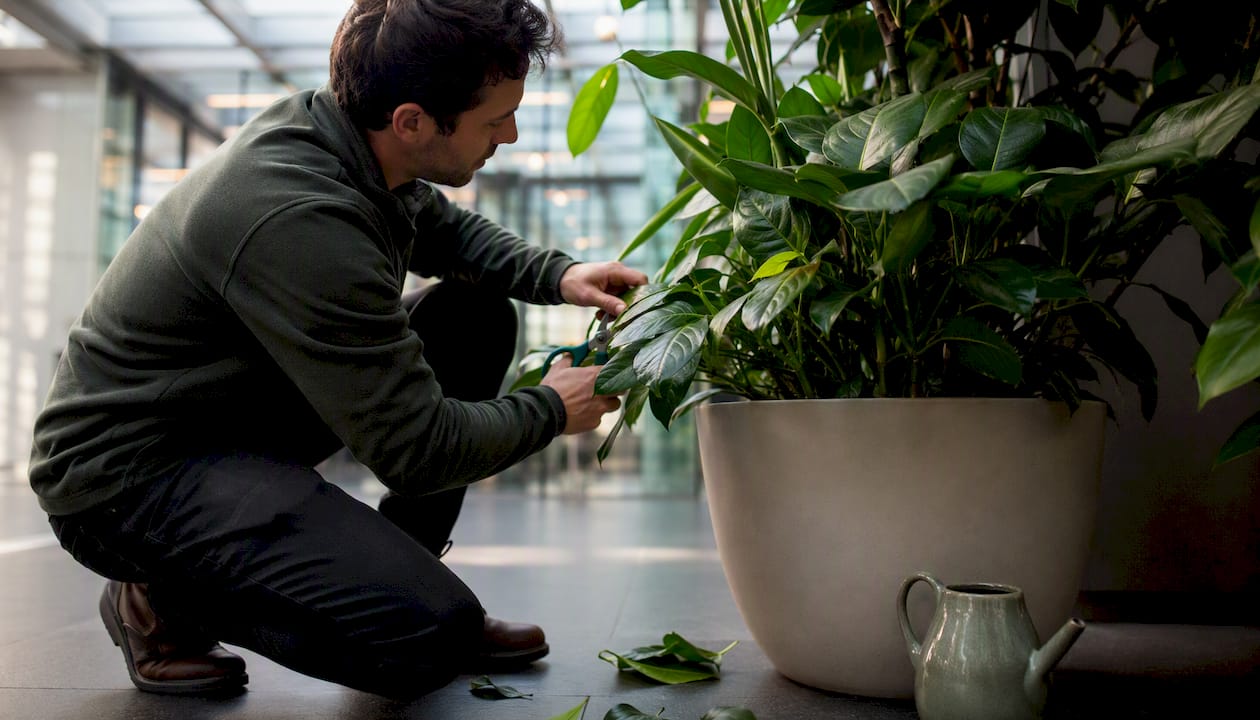
Durability traits are the first screen. Look for robust leaf structure that resists incidental contact, low leaf drop (fallen leaves create slip hazards and signal poor health to guests), and proven tolerance for the light levels your site survey documents. Pest resistance matters too: an infestation in a restaurant dining room is a reputational problem, not just a horticultural one.
Operational filters come next. Species with slow, controlled growth rates require less frequent pruning, which keeps per-visit labor predictable. Ease of grooming matters in tight corridors where technicians need to work quickly. The maintenance cadence your SLA specifies should drive species selection, not the other way around.
Visual performance is the third filter, and it is backed by data. Green View Index and species richness consistently predict restorative responses in occupants. A well-curated mix of two or three species in good health reads as more restorative than a monoculture, even at the same plant count.
For very high-traffic zones, fewer large specimen plants generally outperform many small ones. Fewer plants mean fewer failure points, easier monitoring, and faster replacement when needed.
How do vendors price commercial plantscaping projects?
Pricing follows two main structures, and understanding the difference helps you evaluate bids fairly.
All-inclusive monthly subscription covers plants, planters, installation, maintenance, and replacements for a fixed monthly fee. This model transfers replacement risk to the vendor and is the better fit for high-traffic areas where plant turnover is unpredictable.
One-time installation plus a recurring maintenance retainer suits spaces with stable layouts and lower footfall. The upfront cost is higher, and replacement costs are typically billed separately.
Primary cost drivers to clarify in every proposal:
- Plant quantity and specimen size (large specimen plants carry a significant premium)
- Specialty planters, custom finishes, or living wall infrastructure
- Irrigation infrastructure and automated drip system installation
- Travel and service frequency (weekly visits cost more than bi-weekly)
- Replacement allowance included in the base fee versus billed per event
When comparing bids, normalize them by per-visit coverage area and clarify exactly which consumables (substrate, fertilizer, pest treatments) are included. A lower monthly fee that excludes replacements is rarely the better value in a busy commercial setting.
What is a realistic timeline from site survey to handover?
Plan for six to twelve weeks from first contact to a fully installed and handed-over plantscape, depending on project scale.
Phase 1: Site survey (1–2 weeks). The vendor documents light levels, HVAC diffuser locations, traffic routes, and planter placement options. This phase should produce a written report, not just a verbal summary.
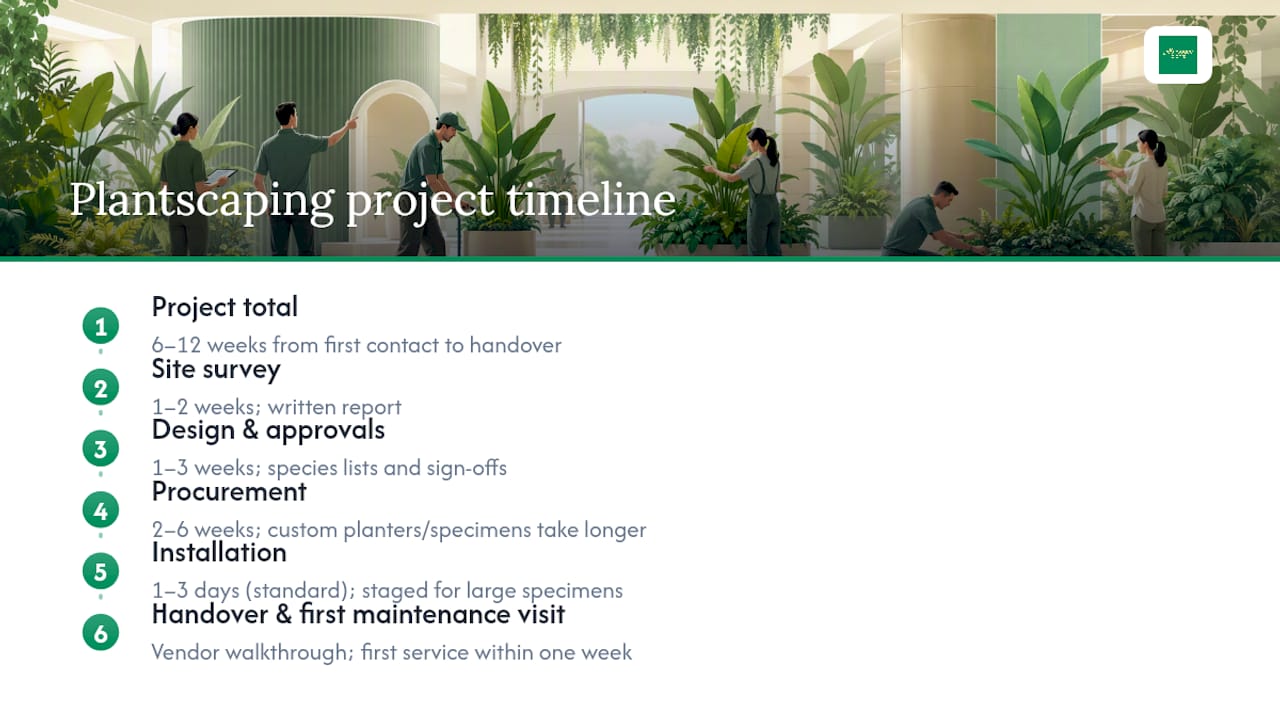
Phase 2: Design and approvals (1–3 weeks). Species lists, planter specifications, and layout drawings go to you for review. Budget approval and any building management sign-off happen here.
Phase 3: Procurement (2–6 weeks). Lead times vary by species and planter specification. Custom planters and large specimen plants take longer. Compressing this phase limits species availability.
Phase 4: Installation (1–3 days for standard installs; staged over multiple days for large specimens or living walls). Deliveries should be scheduled after hours or during low-occupancy periods. Tall specimens may require building permits or freight elevator coordination.
Phase 5: Handover and first maintenance visit. The vendor walks your team through the installation, confirms the maintenance schedule, and conducts the first service visit within one week of installation.
How do you measure whether the plantscape is working?
A compact KPI set keeps the program accountable without creating administrative overhead.
Plant health KPIs (tracked by the vendor): monthly health score per plant, replacement rate over rolling 90 days, and SLA response time for sick-plant notifications.
Occupant metrics (tracked by your team): run a short survey before installation, then again at one month and four months post-install. Ask about perceived air quality, attractiveness of the space, and dry-air discomfort. This mirrors the field-study cadence used in workplace plant research and gives you before/after data to share with leadership.
Environmental proxies: A basic humidity data logger in the lobby or dining room costs under $50 and gives you a continuous record of relative humidity trends. For spaces where air quality is a formal concern, periodic VOC and CO2 spot checks provide additional context. Our guide on how plants affect indoor air standards explains what to look for in those readings.
What are the most common failure modes, and how do professionals prevent them?
| Risk | Cause | Professional mitigation |
|---|---|---|
| Mold in living walls | Poor ventilation, high substrate moisture | Integrate with HVAC design; automated drip scheduling; substrate hygiene records |
| Irrigation leaks | Unsealed fittings, oversized drip trays | Sealed lines routed away from pedestrian areas; drip tray sizing to full irrigation volume |
| Plant damage from traffic | Poor placement, lightweight planters | Anchored or ballasted bases; placement outside primary pedestrian path |
| Pest outbreaks | Stressed plants, inadequate monitoring | IPM protocols at every visit; species selected for pest resistance |
| Dead plants on display | No replacement SLA | Written 72-hour replacement guarantee in contract |
Confined corridors with poor air renewal are the highest-risk environment for living wall systems. A 46-week case study on vertical greenery systems found the highest mold spore loads near VGS in exactly those conditions. If your corridor has limited air exchange, a well-maintained potted installation is the lower-risk choice.
Key Takeaways
Full-service commercial plantscaping with a written SLA and replacement guarantee is the only reliable model for indoor plants in high-traffic areas.
| Point | Details |
|---|---|
| Hire full-service, not DIY | Require design, installation, maintenance, and a healthy-plant guarantee in one contract. |
| SLA terms that matter | Demand 72-hour replacement response, weekly for restaurants and high-traffic lobbies, bi-weekly minimum for offices, and monthly health reports. |
| Plant health beats quantity | Research shows poorly maintained plants harm occupant experience more than no plants at all. |
| Measure before and after | Run occupant surveys at baseline, one month, and four months post-install to document ROI. |
| Greenspace Plants | Offers all-inclusive Greenspace+ subscriptions covering design, installation, maintenance, and replacements for commercial spaces. |
A practitioner's perspective on what actually matters in busy-site projects
The part of this process most managers underestimate is the site survey. Not the design, not the species list — the survey. We have walked into lobbies where a previous vendor installed beautiful plants directly under a cold-air diffuser blasting 58°F air eight hours a day. Every plant in that zone was in decline within six weeks. No species selection in the world fixes a bad microclimate assessment.
What we find in practice is that the difference between a plantscape that looks great at month one and one that still looks great at month eighteen comes down to two things: the quality of the initial environmental mapping and the discipline of the maintenance cadence. Restaurants are the hardest environment. Kitchen humidity, grease particulate, and the constant movement of staff and guests create conditions that stress even hardy species. We adapt by increasing visit frequency, selecting species with waxy or leathery leaf surfaces that clean easily, and building a faster replacement trigger into the SLA for those accounts.
The research on green versus lean office spaces confirms what we observe on the ground: the benefits compound over time. A plantscape that is well-maintained at month four delivers measurably more than one that looked good at install and was then neglected. That is the argument for a subscription model with teeth — not just a nice-to-have, but the mechanism that keeps the investment performing.
Greenspace Plants: full-service plantscaping for busy commercial spaces
Busy lobbies, restaurant dining rooms, and corporate corridors need a plantscaping partner who treats plant health as an operational commitment, not an afterthought. Greenspace Plants delivers exactly that through the Greenspace+ program: a fixed monthly fee covers plant design and installation, scheduled technician visits, and full plant replacements with no upfront costs and no long-term lock-in.
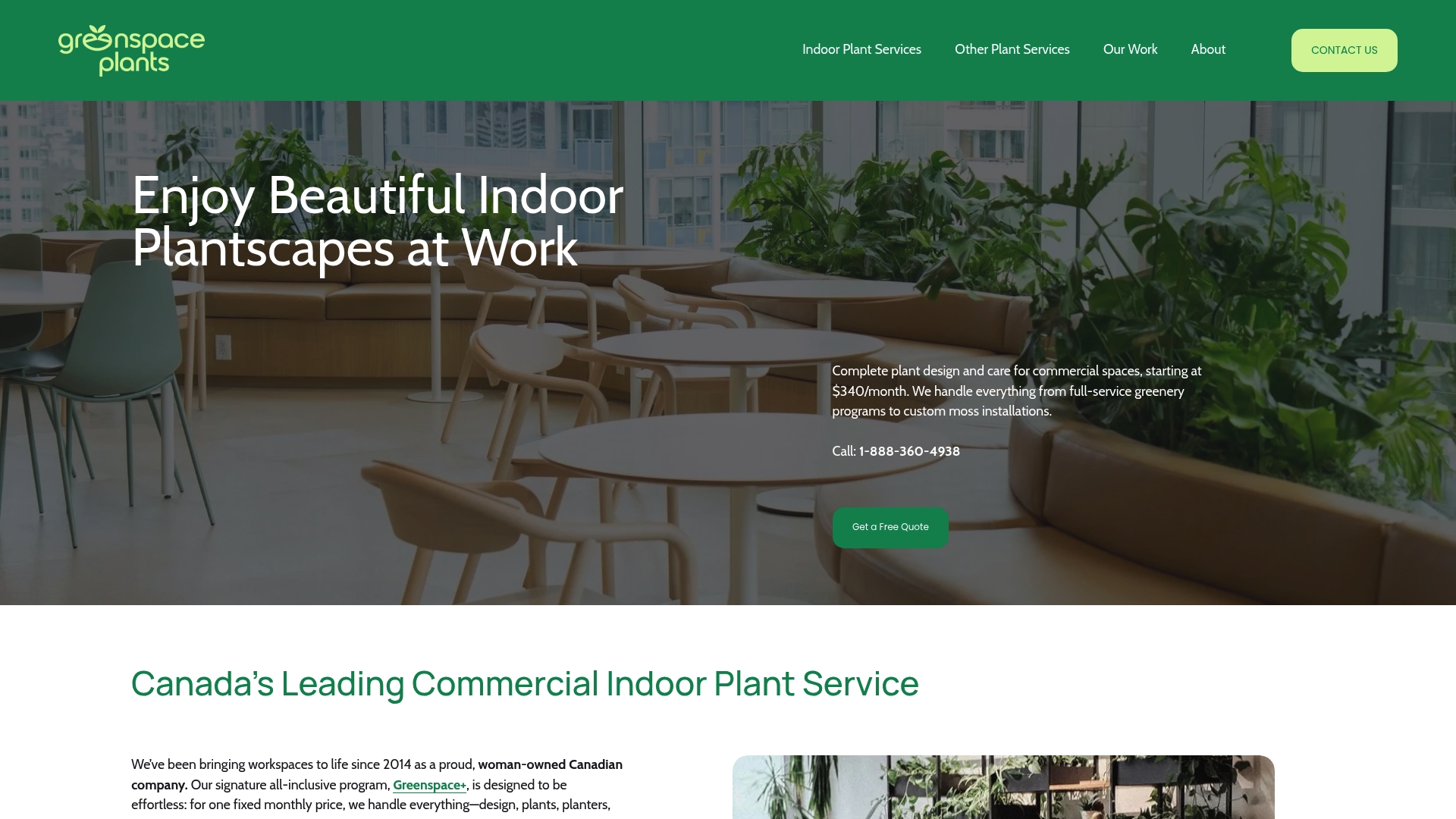
Every engagement starts with a documented site survey, species matched to your specific microclimates, and planters specified for the demands of your space. Whether you manage a single-floor office or a multi-location restaurant group, the program scales to your footprint. Browse the Greenspace client look-book to see installations in comparable commercial settings, then reach out to schedule your complimentary site survey.
Useful sources
-
Plants in the workplace: evidence from nine organizations (PMC) — A Before-After-Control-Impact field study across nine organizations documenting effects on dry-air complaints, privacy, attractiveness, and satisfaction. Essential reading for procurement teams building an internal business case.
-
Quantifying plant visual features and restorative experience in indoor greenery (MDPI, 2026) — Image-based analysis of 200 indoor greenery images showing that Green View Index, species richness, and plant health status drive restorative outcomes. Supports the case for quality over quantity.
-
Impact of vertical greenery systems on indoor air quality: Luxembourg case study — A 46-week study on five VGS installations documenting mold spore risks in poorly ventilated corridors. Required reading before specifying any living wall in a confined space.
-
Office Greenery Productivity Benefits: 2026 Guide (Greenspace Plants) — Practitioner-aligned summary of productivity and air quality evidence with commercial maintenance context.
-
Indoor Plant Design and Designer Collaboration (Greenspace Plants) — Documents the site survey to installation workflow and available service options, useful as a benchmark for evaluating vendor proposals.