
For busy office managers and property managers, the most practical approach to plants in shared tenant spaces is an all-inclusive plantscaping subscription: one fixed monthly fee covers design, installation, scheduled maintenance, and guaranteed plant replacements with zero upfront cost. This model removes the operational burden entirely and keeps your common areas looking their best without adding to your team's workload.
Get started in four steps:
- Select a pilot area — lobby, main corridor, or break room works well for a first install.
- Request a portfolio from a commercial plantscaping provider to confirm they have experience in spaces similar to yours.
- Schedule a site survey so a designer can assess light levels, traffic flow, and planter placement before any commitment.
- Set your maintenance SLA upfront: confirm visit frequency, replacement turnaround, and what "healthy plant guarantee" means in writing.
Greenspace Plants' Greenspace+ subscription covers all of the above with no long-term lock-in.
Table of Contents
- Why do plants matter in shared tenant areas?
- Which plants work best in shared commercial spaces?
- Where should you place plants to get the most impact?
- What maintenance model fits your team's capacity?
- What does a plantscaping program typically cost and how long does it take?
- What safety and compliance checks should you do first?
- How do you evaluate and hire a plantscaping provider?
- Key Takeaways
- The case for thinking bigger than a few potted plants
- Greenspace Plants makes commercial plantscaping straightforward
Why do plants matter in shared tenant areas?
Plants change the first impression of a space before a visitor reads a single sign or speaks to a single person. In lobbies and shared amenity areas, that effect is measurable: biophilic design elements in multifamily and commercial lobbies improve perceived welcome, leasing appeal, and tenant satisfaction. Greenery also softens acoustics, reduces perceived crowding, and gives tenants a tangible reason to linger in common areas rather than rush through them.
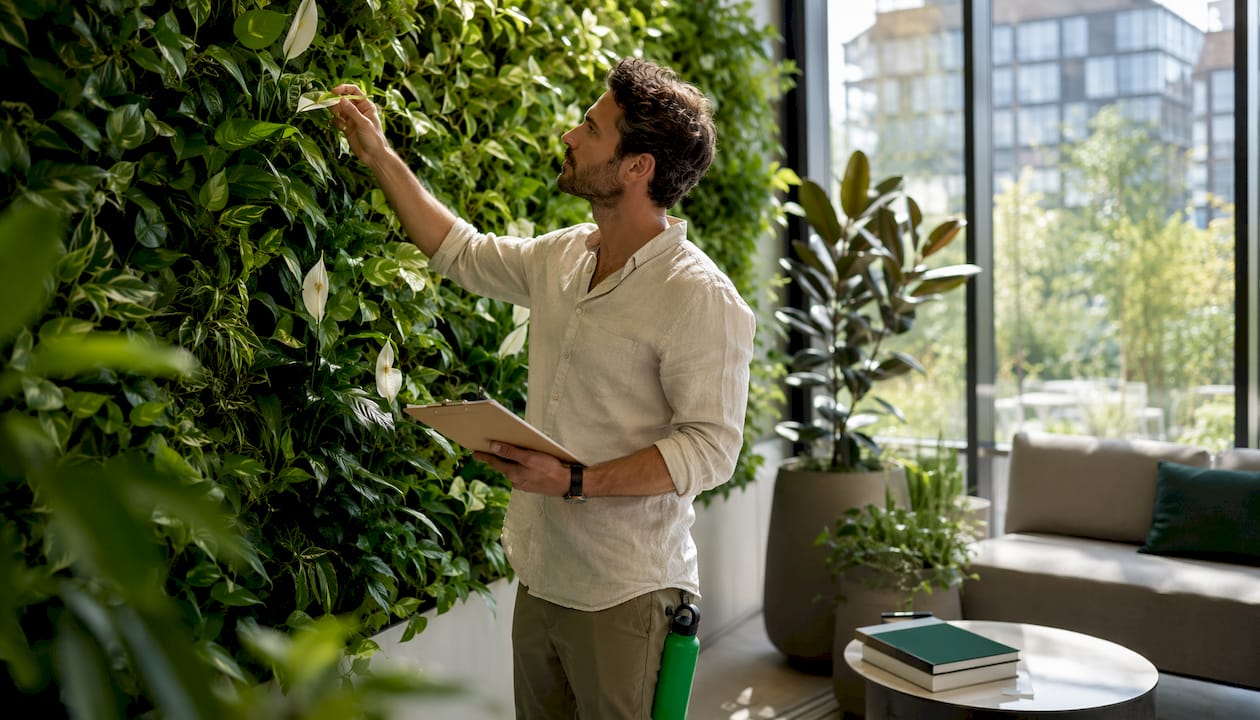
A well-placed statement tree or custom green wall does more than look impressive. Designers report it functions as a "center of gravity" in a lobby or amenity floor, orienting visitors toward reception, elevators, or amenity cores without a single additional sign.
One well-chosen statement piece can anchor circulation and wayfinding simultaneously. That is a practical return on a design investment that most managers underestimate. Where live plants are difficult to maintain due to low light or high foot traffic, preserved and artificial greenery removes irrigation, pest, and replacement risk while maintaining appearance year-round.
Which plants work best in shared commercial spaces?
The most reliable plants for shared tenant and commercial settings fall into four categories: architectural floor plants, large-leaf tolerant species, trailing or hanging species, and living or preserved wall options. Here is a practical catalog mapped to light, maintenance level, and typical placement:
- ZZ plant (Zamioculcas zamiifolia): low light, very low maintenance. Water only after the medium dries; keep above 60°F. Best for corridors, interior lobbies, and windowless breakrooms.
- Snake plant (Dracaena trifasciata): low to medium light, low maintenance. Tolerates missed waterings for up to a month. Ideal for narrow corridors and elevator landings.
- Pothos (Epipremnum aureum): low to medium light, low maintenance. Trails from shelves or hanging baskets; excellent for vertical space in breakrooms and reception areas.
- Spathiphyllum (peace lily): medium indirect light, low-to-medium maintenance. One of the top performers in vertical green walls for CO2 reduction and transpiration. Works in seating clusters and breakrooms.
- Chlorophytum (spider plant): medium light, low maintenance. Pet-safe, low-allergen, and highly effective in living wall systems. Good for breakrooms and family-friendly amenity spaces.
- Cast iron plant (Aspidistra elatior): very low light, very low maintenance. Handles drafty corridors and dim interior zones where most species fail.
- Chinese evergreen (Aglaonema): low to medium light, low maintenance. Available in multiple color variants; works well in seating clusters and reception areas.
- Parlor palm (Chamaedorea elegans): medium indirect light, low maintenance. Adds height and drama in lobbies with tall ceilings; pet-safe.
For living walls (vertical green walls), Chlorophytum and Spathiphyllum are the standout species under typical office light conditions of 50–100 μmol m⁻² s⁻¹ PPFD. Where live plants are impractical (very low light, high-traffic zones, or allergy-sensitive areas), preserved or high-quality artificial options maintain the visual effect without any care burden.
Pro Tip: In spaces with known allergen sensitivities or poor ventilation, specify low-pollen species like snake plant, ZZ plant, or cast iron plant, and avoid flowering species such as peace lily in enclosed corridors.
Where should you place plants to get the most impact?
Placement decisions should solve a spatial problem first: anchor a large open area, screen a service zone, soften a hard edge, or guide foot traffic. Aesthetics follow function.
Pro Tip: Use a single statement tree or green wall as a wayfinding anchor near your main entry or elevator bank. Designers confirm that a well-placed 20-foot natural-trunk tree or a custom green wall orients visitors toward amenity cores more effectively than additional signage.
| Design role | What it solves | Recommended scale | Typical planter type |
|---|---|---|---|
| Statement anchor | Orients visitors, creates focal point | Large floor tree or green wall | Premium or custom planter, moss wall panel |
| Screen / divider | Separates zones without hard walls | Mid-height planter row or trough | Standard or luxury trough planters |
| Seating cluster softener | Reduces acoustic harshness, adds comfort | Medium floor plants or hanging baskets | Standard or premium round planters |
| Corridor guide | Marks path, breaks long sightlines | Repeated small-to-medium floor plants | Standard planters at regular intervals |
| Patio / terrace amenity | Extends tenant experience outdoors | Large outdoor planters, seasonal color | Weather-resistant outdoor planters |
For scaling greenery across large lobbies or multi-building portfolios, consistent planter materials and plant species across floors create a coherent brand identity without requiring a custom design for every space.
What maintenance model fits your team's capacity?
For most property managers and office managers, an all-inclusive subscription with a fixed monthly fee and guaranteed replacements is the right default. It converts plant care from an unpredictable operational task into a predictable line item.
Three models compared:
- Buy and self-care: You purchase plants and planters outright and assign maintenance to your facilities team. Lowest monthly cost, but requires trained staff, a replacement budget, and a reliable watering and pest-check schedule. Works only if your team has genuine capacity and plant knowledge.
- One-time install with a maintenance contract: A provider installs plants and returns on a scheduled basis for care. Splits capital and operating costs; good for spaces with stable, well-lit conditions and low turnover risk.
- All-inclusive subscription (recommended): Fixed monthly fee covers site survey, design, installation, scheduled maintenance visits, pest checks, seasonal refreshes, dusting, and plant replacements. No upfront capital outlay. The provider carries the replacement risk.
For the self-care route, resilient species like pothos, snake plant, and ZZ plant are the most forgiving baseline. But even these require consistent attention that most facilities teams cannot reliably deliver alongside their primary responsibilities.
When evaluating a subscription provider, the healthy-plant guarantee is the single most important contract term. It should specify replacement turnaround time, appearance standards, and who bears the cost of a plant that declines between scheduled visits.
Trust signals to request during procurement:
- Portfolio of comparable commercial installs
- Written healthy-plant guarantee with defined appearance standards
- Confirmed visit frequency (weekly or biweekly for most commercial programs)
- Pest management protocol (Integrated Pest Management preferred)
- Insurance certificate and waste-handling policy
- References from property managers or office managers in similar spaces
What does a plantscaping program typically cost and how long does it take?
The cost structure shifts depending on the model you choose. A subscription converts what would be a capital expense (plants, planters, installation labor) into a predictable monthly operating expense. That shift matters for budget approval cycles and facilities planning.
Descriptive budget tiers:
- Basic refresh: A handful of low-maintenance floor plants in planters for one or two zones. Modest scope, fast install, minimal design work.
- Mid-range program: Multiple zones across a floor or building, mix of floor plants and hanging or wall-mounted options, standard or premium planters, biweekly maintenance visits.
- High-impact statement program: Lobby statement tree or living wall, custom planters, full-floor coverage, weekly maintenance, seasonal outdoor patio planting.
Living walls justify higher budget lines when sustainability or energy goals are present. A study of a hydroponic vertical green wall in an actual workplace showed measurable benefits in cooling, CO2 reduction, and energy savings.
| Benefit | Measured result |
|---|---|
| Cooling effect | Net reduction of approximately a few degrees Celsius in the test room |
| CO2 reduction | Measurable reduction in the test room, varying with conditions |
| Estimated energy saving | Significant energy savings estimated for the tested setup |
Typical project timeline:
- Site survey: 1–2 weeks from initial contact
- Design and procurement: 2–4 weeks
- Installation: 1–3 days for modest installs; 2–4 weeks for large green walls
- Maintenance onboarding: first 30–90 days to stabilize plant health and adjust care schedules
What safety and compliance checks should you do first?
Check fire egress, load-bearing capacity, water risk, and ADA accessibility before finalizing any plant placement. Catching these early prevents costly rework after installation.
Safety checklist:
- Egress clearance: No planter may reduce a corridor or exit path below the required clear width per your local fire code.
- Planter weight: Large planters filled with soil and water can exceed 200 lbs. Confirm floor load ratings with your building engineer before specifying large floor plants or troughs.
- Water containment: All planters should have sealed saucers or integrated drainage systems to prevent water damage to flooring and subfloor.
- Flame-retardant materials: Specify fire-rated planter materials in areas where your building code requires it, particularly near egress routes.
- Non-slip bases: Planter bases in high-traffic areas should include non-slip pads or be recessed to prevent tipping.
- Allergen and pest control: Prefer low-pollen species in enclosed or low-ventilation areas; confirm your provider uses an Integrated Pest Management protocol to prevent infestations from spreading between tenant spaces.
Check your building's insurance policy and landlord rules before installation, and integrate any fire-code requirements into the specification before the design phase begins. Coordinating plant maintenance with your office cleaning schedule also reduces pest risk and keeps shared areas consistently presentable.
How do you evaluate and hire a plantscaping provider?
A short, scored checklist removes subjectivity and speeds selection. Use these questions to brief and compare providers:
Provider questions:
- Can you show portfolio examples from lobbies, corridors, or amenity spaces similar to ours?
- What is your maintenance schedule and replacement policy in writing?
- Do you carry commercial liability insurance?
- Who are your references among property managers or office managers?
- What qualifications do your maintenance technicians hold?
- Is your pricing a flat monthly fee or per-visit billing?
- Can you scale across multiple buildings in our portfolio?
- Do you source custom planters, and can you match our brand palette?
- Do you have experience designing and maintaining living walls or moss walls?
Contract KPIs to specify:
- Plant survival and appearance rate (define the standard)
- Replacement turnaround time (48–72 hours is a reasonable benchmark)
- Maintenance visit frequency
- Reporting cadence (monthly condition reports)
- Termination and transition clause
Red flags to watch for:
- No portfolio or only residential examples
- Vague SLAs with no defined replacement policy
- No insurance certificate available on request
- Push for a multi-year contract with no trial period option
Pro Tip: Ask for a one-month pilot on your highest-visibility zone before committing to a full program. A provider confident in their work will agree; one who resists is telling you something.
Reviewing common plantscape design mistakes before your first vendor meeting will sharpen the questions you ask and help you spot weak proposals faster.
Key Takeaways
For shared tenant and commercial spaces, an all-inclusive plantscaping subscription delivers the best balance of visual impact, operational simplicity, and predictable cost for busy managers.
| Point | Details |
|---|---|
| Start with a pilot zone | Select your lobby or main corridor and run a one-month trial before committing to a full program. |
| Match plants to light conditions | ZZ plant, snake plant, and cast iron plant are the most reliable picks for low-light corridors and interior zones. |
| Living walls justify higher budgets | Living walls show measurable benefits in CO2 reduction and energy savings in actual workplace studies. |
| Demand a healthy-plant guarantee | Confirm replacement turnaround time and appearance standards in writing before signing any contract. |
| Greenspace Plants | Greenspace Plants' Greenspace+ subscription covers design, install, maintenance, and replacements for a fixed monthly fee with no upfront cost. |
The case for thinking bigger than a few potted plants
Most managers I speak with start by thinking about plants as decoration. A few pots near the elevator, maybe a small arrangement at reception. That framing undersells what greenery actually does in a shared space, and it leads to underinvestment that produces underwhelming results.
The spaces where plants genuinely change tenant behavior are the ones where a designer made a bold placement decision: a single large-canopy tree that makes a lobby feel like an arrival rather than a waiting room, or a green wall behind a leasing desk that signals care and quality before anyone opens their mouth. Those choices require a real brief, a real site survey, and a provider who thinks spatially, not just horticulturally.
My practical tip for day one of any site visit: stand at the main entry and ask what the first thing a visitor's eye lands on is. If the answer is a blank wall or a service desk, that is your placement opportunity. A well-chosen statement piece there will do more for tenant perception than a dozen small plants scattered across the floor.
Greenspace Plants makes commercial plantscaping straightforward
Greenspace Plants' Greenspace+ subscription is built specifically for property managers and office managers who want healthy, well-designed greenery in their shared spaces without adding plant care to their team's responsibilities. For a fixed monthly fee, you get a full site survey, professional plant design, installation, biweekly or weekly maintenance visits, pest checks, seasonal refreshes, and guaranteed plant replacements. No upfront capital. No surprise costs when a plant needs replacing.
Every program starts with a portfolio review so you can see comparable commercial installs before committing. Whether you need a statement lobby tree, a corridor refresh, or a full green wall installation, the process is the same: survey, design, install, maintain. Request your portfolio and site survey at greenspaceplants.ca.