
Yes, acoustic moss walls reduce echo and improve speech clarity in commercial interiors, but they are absorbers, not soundproofers. A properly engineered moss panel scatters and dissipates sound energy inside a room, softening the harsh reflections that make open offices and lobbies feel loud. It will not stop sound from passing through a wall into the next office. Built with the right thickness and backing, moss panels can reach Class A absorption ratings that rival premium fabric or foam systems, while adding a living, textured surface that those materials can't match.
TL;DR:
- Properly engineered moss panels with sufficient thickness and backing can achieve Class A absorption ratings comparable to premium fabric or foam systems.
- The backing layer is crucial; adding felt, mineral wool, or an air gap significantly improves sound absorption, especially at lower frequencies.
- Moss walls are most effective in reflective spaces like open offices, lobbies, and restaurants, where targeted placement reduces echo and improves speech clarity.
- Preserved moss typically offers NRC values between 0.60 and 0.85, while living moss walls generally fall between 0.40 and 0.70, often requiring larger coverage for noticeable impact.
- Costs vary based on material choice, thickness, backing, and customization, with preserved moss panels demanding higher upfront expenses but minimal ongoing maintenance.
Table of Contents
- Moss Wall Acoustics: How Preserved, Living, and Synthetic Panels Work
- Reading the Numbers: NRC, Class A, and What Backing Actually Does
- Where Moss Walls Earn Their Place in Commercial Spaces
- Design, Installation, and Upkeep: What to Ask Before You Sign Off
- What Moss Walls Cost, and Why Facilities Teams Still Choose Them
- How Greenspace Plants Approaches Moss Wall Projects
- A Scoping Checklist Before You Call Any Supplier
- Why Greenspace Plants Is the Practical Route to a Moss Wall That Performs
- Where the Performance Numbers in This Article Come From
- Sources
- FAQ
- A Straight Answer on Whether Moss Is Worth It
Moss Wall Acoustics: How Preserved, Living, and Synthetic Panels Work
"Moss wall acoustics" covers three distinct products, and the differences matter more than most buyers expect. Preserved moss panels use real moss treated with a glycerin-based solution that keeps it soft and green with zero watering or light. Living green walls use rooted plants in irrigated substrate, requiring lighting and horticultural upkeep. Synthetic plant panels mimic the look with foam or felt but carry no natural absorptive texture.
Acoustically, all three work the same way: sound waves hit a porous, irregular surface, and the panel's backing layer converts that energy into small amounts of heat instead of letting it bounce back into the room. That's the mechanism behind every soft acoustic material, from moss to mineral wool.
- A moss panel over a boardroom's hard drywall reduces the "boomy" ring after someone finishes speaking.
- The same panel does nothing to keep that conversation from carrying into the hallway. Sound transmission requires mass and sealed assemblies, not surface absorption.
Reading the Numbers: NRC, Class A, and What Backing Actually Does
The Noise Reduction Coefficient (NRC) measures how much sound energy a material absorbs versus reflects, on a scale from 0 (fully reflective) to 1 (fully absorptive). Class A, tied to the αw rating under ISO 354 test standards, is the top absorption tier architects specify for demanding spaces.
The backing layer decides the outcome. Thin moss glued directly to rigid board barely moves the needle. Moss over 25 to 50mm of felt or mineral wool, sometimes with an added air gap of the same depth, is what pushes a panel into Class A territory.
Test data backs this up. Aid Acoustics' Moss Wall 150 configurations, built at 50 to 150mm total thickness, hit αw = 1.00 and NRC = 1.00 under ISO 354 and ASTM C423 testing. AcuSorb Vita's octave-band tables show a similar pattern: adding an air gap behind a direct-to-wall install measurably lifts absorption, especially at lower frequencies.
Rules of thumb worth remembering:
- Preserved moss typically lands between NRC 0.60 and 0.85, depending on substrate depth.
- Living walls usually run lower, around NRC 0.40 to 0.70, per AcousPlan's breakdown.
- Covering a moderate portion of a room's total surface area with a well-backed panel is generally enough to produce a noticeable, room-level improvement.
Where Moss Walls Earn Their Place in Commercial Spaces
Moss panels perform best where reflective surfaces and high foot traffic collide. Placement matters as much as panel choice.
- Open-plan offices. Target the ceiling-to-wall junctions and any glass-heavy meeting pods, where sound bounces hardest.
- Lobbies and reception areas. A branded moss feature wall softens hard-surface echo while doubling as a design statement.
- Restaurants. Partial walls or hanging moss islands between tables cut the din without closing off sightlines.
- Schools and healthcare waiting rooms. Low, dense placement near seating areas reduces the fatigue that comes from constant background noise.
- Meeting rooms. A single accent wall opposite a whiteboard tames flutter echo during video calls.
A small decorative moss accent looks great in a mood board but does almost nothing acoustically. Coverage and placement at reflection points drive performance, not square footage for its own sake. Pairing moss with upholstered seating or curtains often rounds out the frequency range, since moss tends to shine at mid and high frequencies rather than the low end.
Design, Installation, and Upkeep: What to Ask Before You Sign Off
Specifying a moss wall means coordinating structural, safety, and maintenance details early, not after the panels arrive.
- Confirm wall load capacity and framing; larger installations need proper anchoring, not adhesive alone.
- Check fire ratings for the substrate and moss treatment, especially in schools and healthcare facilities.
- Ask about moisture exposure near kitchens or humid restaurant zones, and whether an acrylic cover or sealed frame is available.
- Decide if backlighting or edge trim needs to integrate with existing millwork and finish schedules.
- Preserved moss needs no watering or light, just occasional dusting. Living walls need irrigation, grow lighting, and a maintenance schedule, with individual plants replaced as they decline.
Pro Tip: Ask your supplier for the backing spec, not just the finished NRC number. A panel tested at 100mm with mineral wool won't perform the same at 50mm with none. The number on a spec sheet only holds if your installed build matches the tested configuration.
What Moss Walls Cost, and Why Facilities Teams Still Choose Them
Cost swings widely based on a handful of variables: preserved versus living moss, panel thickness and backing, custom shapes or branding, and fire or moisture upgrades. Installation complexity, structural framing, electrical for backlighting, adds up fast on larger walls.
Expect preserved moss panels to sit well above standard fabric-wrapped acoustic panels per square foot, largely because of material sourcing and the felt or mineral wool backing needed to hit Class A performance. Facilities teams often justify the premium through fewer noise complaints, better speech clarity in client-facing spaces, and a visual asset that doesn't need repainting or replacement every few years the way fabric panels do.
- Preserved moss: higher upfront cost, near-zero ongoing maintenance spend.
- Living walls: lower material cost, ongoing irrigation and plant replacement expenses.
- For a full breakdown of long-term savings, Greenspace Plants' moss wall ROI analysis walks through the ten-year math for facilities budgets.
How Greenspace Plants Approaches Moss Wall Projects
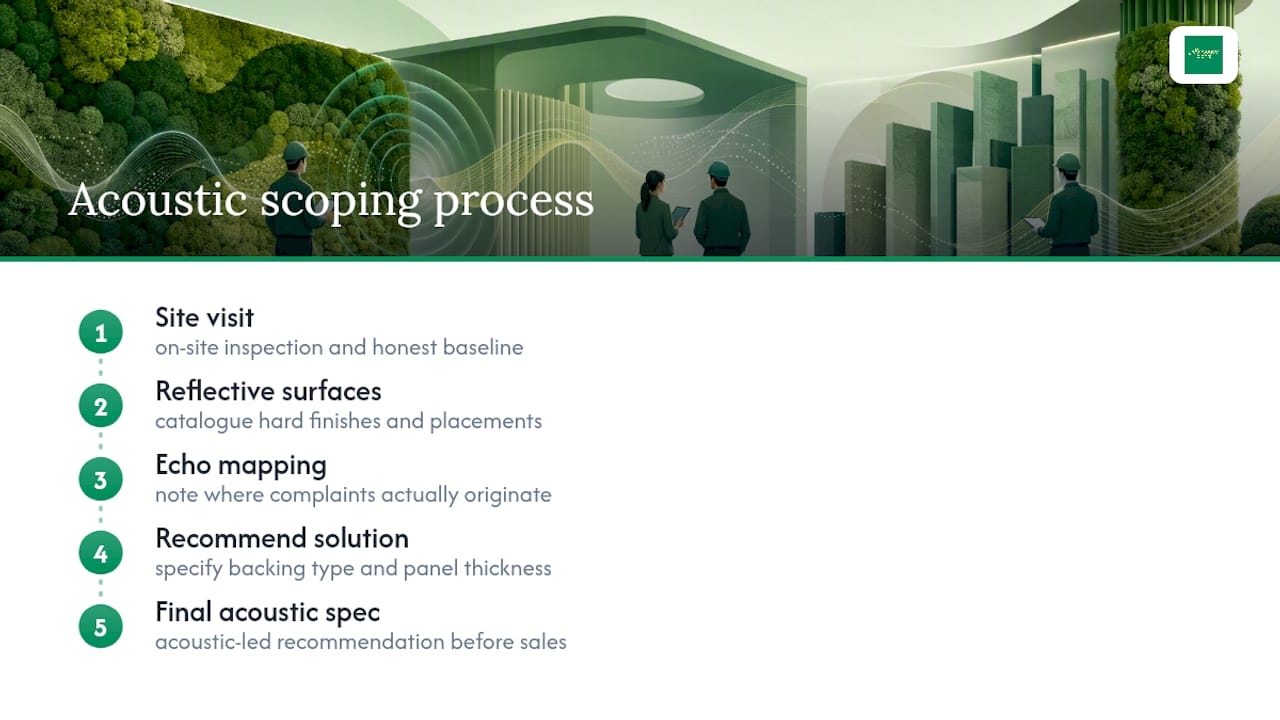
Every moss wall project we scope starts with a site visit and an honest acoustic baseline, not a catalog pitch. We assess the room's reflective surfaces, note where echo complaints actually originate, and recommend the backing and thickness that will realistically fix it rather than the biggest panel that fits the budget.
From there, installation and ongoing care can run through a fixed monthly service covering design, install, and plant replacements with no upfront cost. It's a natural fit for businesses that want the wellbeing benefits of biophilic design without adding a maintenance task to someone's job description. Clients who prefer a one-time purchase with optional ongoing care can choose that option instead. Either way, the acoustic spec comes first.
A Scoping Checklist Before You Call Any Supplier
Before a single quote comes in, get three things settled internally. Walk the space and note where the noise complaints actually happen, not just where a feature wall would look nice, then decide what you're targeting: a rough sense of reverberation, or a specific NRC/αw number tied to a design brief.
Next, pick your model. A managed service like Greenspace+ removes the maintenance question entirely; a one-time purchase means budgeting separately for care, especially if you're going with living moss.
Finally, confirm fire code and moisture exposure for the room, and insist on a physical sample panel before committing to a full wall. Color and texture photograph differently than they read in person, and a supplier confident in their build will always let you touch the material first.

Why Greenspace Plants Is the Practical Route to a Moss Wall That Performs
Foam panels are cheap and easy to spec, fabric panels come in more colors, and wood baffles look sharp in a lobby. None of them give you a living surface that improves air quality while it quiets a room, and few suppliers in that category also handle year-round upkeep without a separate maintenance contract.
Greenspace Plants designs and installs moss walls as part of a broader plantscaping practice, which means the acoustic spec, the plant health, and the visual integration all come from one team instead of three vendors pointing fingers.
A consultation starts with a site visit, an honest look at your current acoustics, and a recommended panel build with a realistic budget range, no guesswork, no oversized quote to pad a project. If ongoing care matters to you, ask about folding the wall into Greenspace+ so replacements and upkeep are handled without another line item on your plate. Browse examples on our Green Plant Walls page, or reach out to schedule a walkthrough of your space.
Where the Performance Numbers in This Article Come From
The absorption figures cited throughout come from manufacturer test data rather than marketing copy. Aid Acoustics publishes ISO 354 and ASTM C423 results for its Moss Wall 150 line, while AcuSorb Vita and AcoustiNature offer comparable octave-band tables for their own systems. For readers who want a plain-language primer on reflection points and room modeling, The Connected Dwelling's acoustic guide is a solid starting point.
Sources
- Aid Acoustics Moss Wall 150 product/specification (Aid Acoustics, 2024)
- AcuSorb® Vita product page (acuphon)
- What are green acoustic walls? (AcousPlan)
FAQ
What are the disadvantages of moss walls?
Moss walls don't block sound transfer between rooms, cost more upfront than standard fabric panels, and living versions need ongoing irrigation and lighting. Preserved moss also needs UV-controlled lighting to avoid fading over time.
Do acoustic wall panels actually work?
Yes, when built with the right thickness and backing. Aid Acoustics' tested configurations reach NRC 1.00, meaning the panel absorbs essentially all the sound energy that hits it under lab conditions.
Why are moss walls so expensive?
The material sourcing, preservation process, and the mineral wool or felt backing required to hit Class A performance all add cost compared with standard fabric-wrapped panels. Custom shapes, fire-rated substrates, and backlighting push the price higher still.
How expensive is a moss wall?
Pricing depends heavily on panel thickness, backing type, and customization, so costs vary significantly project to project. Greenspace Plants' moss wall ROI breakdown walks through the long-term cost comparison against cheaper acoustic alternatives for facilities teams budgeting a project.
A Straight Answer on Whether Moss Is Worth It
Most acoustic guidance treats moss walls as either a gimmick or a miracle, and both framings miss the point. The honest read is that moss is a genuinely strong absorber, backed by test data showing Class A performance, but only when the backing and thickness are specified correctly. Skip that step and you've bought an expensive decoration.
What gets underestimated is how much the decision comes down to timing, not material. Waiting until after drywall and finishes are locked in to add moss panels almost guarantees a compromise, because the coverage and placement that actually fix a room's echo get sacrificed for whatever wall space is left. The buyers who get the best results are the ones who bring acoustic goals into the design conversation early, alongside lighting and layout, not after the fact.
I'd also push back gently on the idea that living walls are always the "greener" or better choice because they're literally alive. For pure acoustic performance, preserved moss often wins, and it does so with a fraction of the maintenance burden. Living walls have their place for humidity and air quality goals, but treating them as interchangeable with preserved moss for noise control sets up unrealistic expectations. Match the material to the actual problem you're solving, not the one that sounds most impressive in a pitch deck.
— Nicole