
Plants reduce mid and high frequency office noise through absorption, diffusion, and masking, but they cannot replace heavy structural soundproofing. Research using impedance-tube testing on ferns and baby tears confirms real gains near speech frequencies. The substrate behind the leaves does most of that work, so a dense living wall beats a scattering of desk plants, and A full-service program is available to help offices install that density correctly.
TL;DR:
- Dense fern walls backed by at least 20 centimeters of substrate provide significantly better noise absorption than scattered desk plants, especially in the 800 to 1600 Hz range.
- Plants like Boston ferns, baby tears, and dense palms perform best when their light and placement conditions match their growth needs, maximizing acoustic benefits.
- Positioning plants along reflective surfaces, near high-traffic zones, and across open-plan areas enhances their ability to intercept sound paths effectively.
- Living green walls require ongoing irrigation and care to maintain density and absorption levels, with maintenance costs impacting their long-term viability.
- Proper acoustic strategies should prioritize structural treatments first, with plants serving as a supplementary diffusion, masking, or finishing layer for optimal results.
Table of Contents
- What Acoustic Plants Do for Office Noise, Exactly
- Which Plants Work Best for Office Sound Absorption
- How to Place Plants to Actually Cut Noise
- Green Walls, Preserved Moss, or Planter Clusters: Which One Fits?
- Building a Layered Acoustic Plan Around Plants
- What Ongoing Maintenance Actually Costs You
- Why Most Offices Get Plant Acoustics Backwards
- Let Greenspace Plants Handle the Installation
- Sources
- FAQ
What Acoustic Plants Do for Office Noise, Exactly
Three mechanisms explain why a wall of ferns changes how a room sounds. Absorption happens when sound energy hits leaves and growing medium and gets converted to heat instead of bouncing back. Diffusion scatters sound waves in multiple directions rather than letting them reflect cleanly off a hard surface, which is why an open-plan office with glass and drywall sounds harsher than one broken up by foliage. Masking is psychological: the soft, irregular texture of rustling leaves and moving water gives the brain a pleasant sound to focus on instead of a coworker's phone call.
None of these mechanisms touch low-frequency rumble, which is why plants won't quiet a building's HVAC system or traffic noise leaking through a window. They excel instead at the 800 to 1600 Hz range, which happens to be where human speech and keyboard clatter live. Testing on ferns and baby tears mounted with a porous substrate showed some of the strongest absorption in that exact band, and the substrate, not the leaves alone, supplied most of the effect.
Where this matters most:
- Meeting rooms with hard tables and glass walls, where speech bounces and creates a distracting echo
- Open-plan workstation clusters, where overheard calls and typing accumulate into constant background noise
- Reflective lobbies and reception areas with tile floors and high ceilings
One set of reverberation-chamber tests found fern and baby tears installations produced some of the highest absorption coefficients among tested indoor species specifically near 800 to 1600 Hz, the exact range that makes open offices feel loud even when nothing is technically "noisy."
Which Plants Work Best for Office Sound Absorption
Not every plant on a corporate expense report earns its keep acoustically. Leaf density, surface texture, and how the plant is mounted all decide whether it's decoration or a working sound-absorbing plant.
- Boston fern and other Nephrolepis varieties. Dense, layered fronds create enormous surface area in a small footprint, and lab testing consistently ranks ferns among the top performers near 1600 Hz. They need bright, indirect light and consistent humidity, so they suit atriums and well-lit lobbies better than dim interior corridors.
- Baby tears (Soleirolia soleirolii). This creeping, moss-like groundcover packs thousands of tiny leaves into a single planter, and it pairs naturally with substrate-backed wall systems. It's shade-tolerant and low-growing, which makes it a strong choice for the base of a living wall.
- Dense palms (Kentia, Areca). Broad, layered fronds add mid-frequency diffusion at a larger scale than tabletop plants, useful for breaking up sound in tall, open atriums.
- Rubber plant (Ficus elastica). Large, waxy leaves diffuse rather than absorb heavily, but the plant's size and durability make it a practical floor-standing option near hard walls.
- Tradescantia Zebrina (inch plant). Conference testing found its noise reduction coefficient rose with planting thickness, moving from 0.23 to 0.35 to 0.52 as density increased, which confirms that coverage matters as much as species choice.
- English ivy on living facades. Ivy performs well as a visual and diffusive layer, but without a substrate backing it contributes far less absorption than a true green wall.
Pro Tip: Match light needs to your floor plan before you fall in love with a species. A fern that thrives under skylights will decline fast in an interior conference room, and a dying installation undercuts the acoustic benefit you installed it for.
How to Place Plants to Actually Cut Noise
Placement decides whether an acoustic plant investment works or just looks nice. The goal is intercepting sound paths, not scattering pots wherever there's floor space.
- Use linear planters as soft dividers between desk clusters instead of hard partitions, breaking sightlines and sound paths at the same time.
- Cluster tall plants near high-traffic hubs like coffee stations and printer bays, where foot traffic and conversation naturally spike.
- Install green walls or moss panels along long, flat, reflective surfaces, since those walls are usually where echo builds fastest.
- Layer height: floor-level plants handle seated conversation, planter-topped storage adds a mid layer, and vertical walls catch sound at standing height.
- Keep fire egress and accessibility paths completely clear when planning any cluster or wall footprint.
- Loop in your cleaning crew and HVAC technicians early, since vents and duct returns near a planned green wall can dry out substrate faster than expected.
Design guidance from the Whole Building Design Guide backs this layered thinking: plants work best as one piece of a coordinated acoustic plan, not a standalone fix.
Green Walls, Preserved Moss, or Planter Clusters: Which One Fits?
The right choice depends on how much maintenance budget you have and whether air quality matters to the project.
Living green walls built with roughly 20 centimeters of substrate plus a 10 centimeter air gap outperform plant facades or felt-backed systems in impedance-tube testing, because that substrate depth is where most of the absorption actually happens. The trade-off is real: living walls need irrigation, horticultural care, and structural support to hold that soil weight.
- Living green walls: Highest acoustic ceiling when substrate is deep enough; requires ongoing irrigation and horticultural upkeep; best where air quality and biophilic design goals justify the maintenance.
- Preserved moss walls: NRC values between roughly 0.60 and 0.85, comparable to mid-range acoustic panels, with near-zero maintenance since there's no watering or pruning. The trade-off is no air-purifying benefit, since the moss is no longer living.
- Planter clusters: Lower cost, flexible to move as teams reorganize, and useful for zoning, though acoustic impact is more modest than a full wall system.
For a deeper look at how preserved moss compares to living walls specifically, our breakdown of moss wall acoustics for facilities teams covers the maintenance math in more detail.
Building a Layered Acoustic Plan Around Plants
Plants work best as one layer in a coordinated strategy, not the whole solution. Here's a simple sequence to follow before buying anything.
- Diagnose the dominant problem. Is it reverberation bouncing around a room, or a single loud source like a printer bay? Reverberation calls for ceiling and wall treatment first; a single source often just needs distance or a barrier.
- Choose the primary engineered treatment. Ceiling baffles and mass-loaded wall panels handle the bulk of reverberation and any low-frequency issue. NIOSH guidance is explicit that engineering controls, not decor, are the front line against hazardous noise.
- Add plants for diffusion, masking, and comfort. Once the structural work is in place, plants handle the mid and high frequency polish and give the space a warmer, less clinical feel.
For window-heavy offices, complementary soft-surface treatments matter too. Acoustic glazing cuts exterior noise transmission at the source, while heavier drapery like acoustic curtains softens reflective glass surfaces indoors.
Pro Tip: Don't expect plants to close more than a modest slice of the gap in a genuinely loud room. Budget engineered treatment for the heavy lifting, and let plants finish the job.
What Ongoing Maintenance Actually Costs You
A living wall or dense planter cluster is a commitment, not a one-time purchase. Watering schedules, pruning cycles, and substrate refreshes all affect whether the acoustic benefit holds up a year later.
- Living walls typically need weekly irrigation checks, monthly pruning, and periodic substrate top-ups to keep density (and absorption) consistent.
- Preserved moss panels need almost no upkeep beyond occasional dusting, but they can't be refreshed once the material fades.
- Planter clusters need standard watering and rotation for light exposure, plus pest checks every few weeks.
Some services bundle plant design, installation, scheduled maintenance, and replacement under a healthy-plant guarantee, which matters because a struggling living wall loses both its looks and its acoustic performance at the same time. Before signing with any provider, ask about their health guarantee terms, irrigation integration, emergency response time, and how they handle multi-site coordination if you're managing more than one office.
Why Most Offices Get Plant Acoustics Backwards
The biggest mistake we see is treating plants as a replacement for real acoustic engineering instead of a finishing layer on top of it. A handful of desk ferns scattered across an open floor plan will not fix a room with a 15-foot ceiling and glass on three sides. That takes ceiling baffles or wall panels first, and the NIOSH guidance on engineering controls backs that up directly.
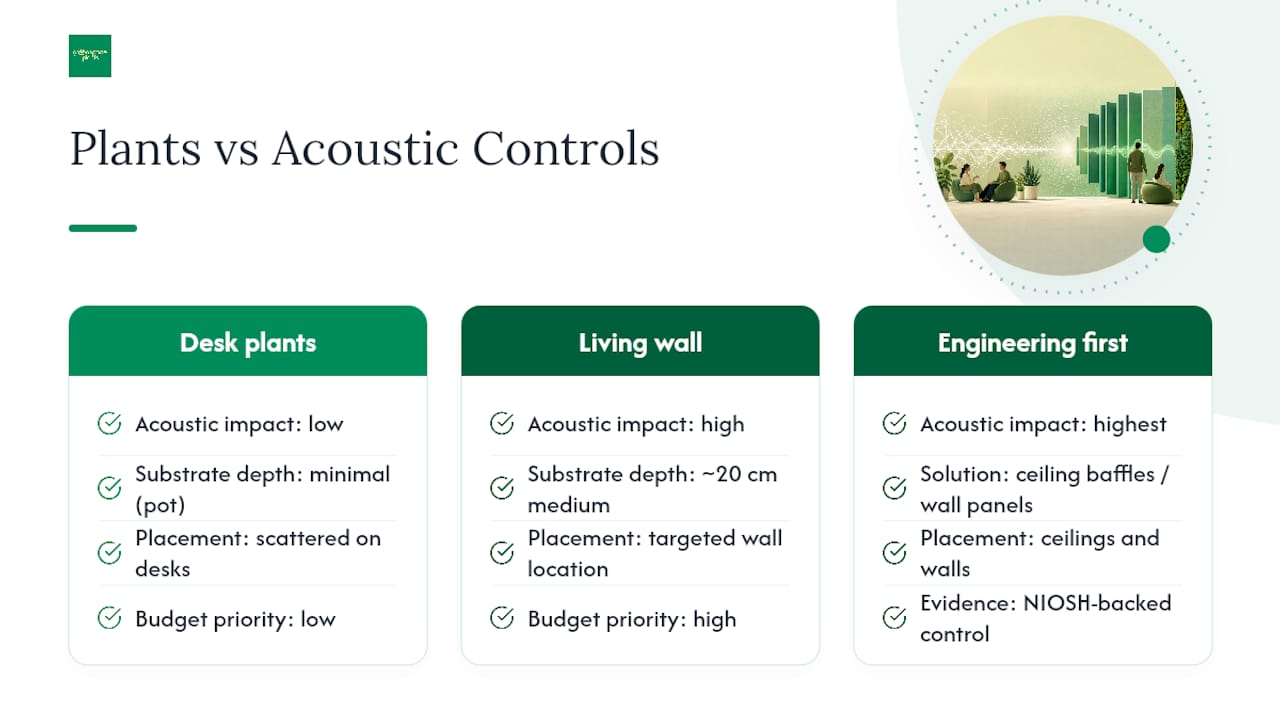
Where conventional advice falls short is specificity. Most lists of "quiet office plants" name species without mentioning that the substrate behind those leaves is doing most of the acoustic work. A single potted fern on a desk does very little; a wall of ferns backed by 20 centimeters of growing medium does a lot. That distinction should drive the entire budget conversation, not an afterthought.
If you're prioritizing one thing, prioritize density and substrate depth over species diversity. A well-built moss or living wall in the right location will outperform a dozen scattered plants every time, and it will look far more intentional doing it.
— Nicole
Let Greenspace Plants Handle the Installation
Greenspace Plants is the alternative to piecing together plant sourcing, irrigation, and structural support on your own. Where a DIY green wall means sourcing substrate, coordinating a contractor for structural support, and hoping the ferns survive your office's light levels, Greenspace+ bundles design, installation, and ongoing maintenance into one plan starting from $299 per month, with no upfront cost.
That all-inclusive structure matters most for acoustic installations specifically, because a green wall that isn't properly irrigated or pruned loses density fast, and density is what drives sound absorption in the first place. A healthy-plant guarantee can ensure that a fading plant gets replaced before it turns the acoustic investment into an eyesore. Whether you're weighing a living wall against a moss wall option for a lobby or open-plan floor, a site assessment is the fastest way to see what substrate depth and layout your space actually needs. Start with a design consultation to get a plan built around your actual noise problem, not a generic plant list.
Sources
- Sound absorption properties of tropical plants for indoor applications (Green Plants for Green Buildings)
- Tradescantia Zebrina as New Creeping Plant for Good Sound Absorption Performance (IOPscience)
- Acoustic comfort (Whole Building Design Guide)
- Noise and Hearing Loss Prevention (NIOSH/CDC)
FAQ
What plants are good for acoustics?
Ferns, especially Boston fern varieties, and baby tears rank among the top performers for mid and high frequency absorption when mounted with a porous substrate. Dense palms and Tradescantia Zebrina also contribute measurably, with absorption increasing as planting thickness increases.
How do I soundproof my office at work?
Start by identifying whether the problem is reverberation or a specific loud source, then address it with engineering controls like ceiling baffles or acoustic glazing before adding plants. Plants add diffusion and masking on top of that structural work; they don't substitute for it, according to NIOSH's noise prevention guidance.
What are the best plants for soundproofing?
No plant fully soundproofs a room, since soundproofing blocks transmission while plants absorb and diffuse sound already inside the space. Ferns, baby tears, and dense living walls with deep substrate deliver the strongest measurable absorption, particularly near 800 to 1600 Hz.
How can I soundproof my office?
Combine mass and sealing (heavier doors, acoustic glazing, sealed gaps) with absorptive interior treatment (ceiling tiles, wall panels, and dense plant walls). A full-service provider like Greenspace Plants can assess your space and recommend where a living wall or moss panel will do the most good; current Greenspace+ pricing starts from $299 per month.
Do preserved moss walls work as well as living plants for noise?
Preserved moss walls can reach NRC values between roughly 0.60 and 0.85, which rivals many living wall setups for mid and high frequency absorption. They require far less maintenance than living walls but don't offer air-quality benefits since the moss is no longer alive.