
Most businesses pay a moderate monthly amount that increases with office size and plant count, ranging from small offices with a handful of plants to large offices or lobbies with feature installations. The single biggest lever is plant count, followed by whether you lease the plants or own them outright. Get your headcount of plants right, and the rest of the quote falls into place.
TL;DR:
- Plant count and specific access logistics are the primary factors that influence monthly costs more than office size or square footage.
- Bi-weekly visits with environmental management, including moisture checks and pest control, are standard and crucial for maintaining plant health.
- Prices for small offices with 10-20 plants typically range from $150 to $350 per month, depending on ownership and service model.
- Higher costs in upscale or feature-heavy offices reflect additional care needs for items like living walls or large statement plants.
- Opting for fixed monthly plans like Greenspace+ simplifies budgeting by bundling design, installation, maintenance, and replacements into a single fee.
Table of Contents
- What Are the Typical Monthly Cost Ranges for Office Plants?
- What Does a Monthly Maintenance Program Actually Include?
- What Drives the Price Up or Down?
- Sample Budgets: What Three Real Offices Might Pay
- How Do You Get an Accurate Quote?
- Why Professional Maintenance Often Beats DIY Long-Term
- What Contract Length and Payment Terms Should You Expect?
- What I'd Tell Any Office Manager Before Signing
- How Greenspace+ Simplifies Your Plant Budget
- Sources
- FAQ
What Are the Typical Monthly Cost Ranges for Office Plants?
Pricing scales almost linearly with how many plants a technician has to touch on each visit, which is why every credible quote starts with a plant count, not a square footage number.
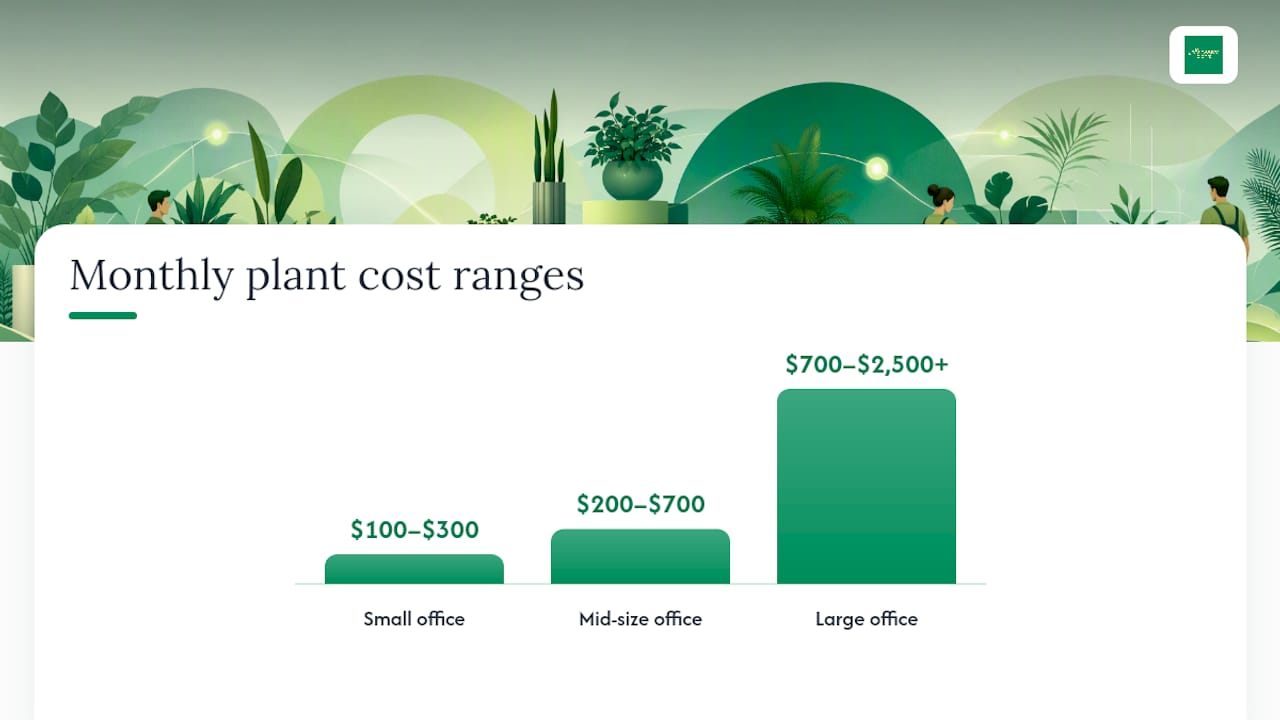
A small office running 10 to 20 plants on a bi-weekly maintenance schedule typically lands between $150 and $350 per month for care alone. If you'd rather not own the plants and want a provider to bundle replacements into the fee, that same 10 to 20 plant footprint often runs $200 to $500 monthly under a leasing arrangement. Mid-size offices tend to see per-plant charges in the $3 to $12 range, with total monthly bills settling in the low hundreds once you multiply that rate across 20 to 40 plants and factor in visit frequency.
Here's how the bands typically break down:
| Office size | Plant count | Typical monthly cost | Common billing model |
|---|---|---|---|
| Small | 5–15 plants | $100–$300 | Maintenance-only or basic lease |
| Mid-size | 15–40 plants | $200–$700 | Lease or hybrid contract |
| Large / feature-heavy | 40+ plants or living walls | $700–$2,500+ | All-inclusive lease |
Regional labor costs shift these numbers too. A downtown high-rise with strict security check-in and limited elevator access will usually see a higher quote than a suburban office park, even with an identical plant count, simply because the technician's time per visit goes up.
What Does a Monthly Maintenance Program Actually Include?
A recurring fee isn't just paying someone to top off a watering can. Professional care is closer to environmental management: technicians use moisture meters rather than guesswork, which is exactly what prevents the slow decline many offices mistake for "bad luck with plants."
A standard monthly program typically covers:
- Moisture-based watering on each visit, checked with a meter rather than a fixed schedule
- Pruning and grooming to remove dead growth and maintain shape
- Leaf dusting so plants can actually photosynthesize under office lighting
- Pest checks using Integrated Pest Management principles to catch infestations early
- Fertilizing on a seasonal cycle tied to each species' growth pattern
- Rotation of plants that lean toward light sources, a natural response called phototropism
Visit cadence matters more than most office managers assume. Bi-weekly visits throughout the year are common in the industry and help maintain plant health. Less frequent visits cost less upfront but may increase replacement frequency due to declining plant health. That's the core trade-off between leasing, where the provider owns the plants and absorbs replacement cost, and maintenance-only contracts, where you own the plants and pay for a dead one out of pocket.
What Drives the Price Up or Down?
Four variables move a quote more than anything else, and understanding them lets you negotiate instead of just accepting a number.
- Species and size. A six-foot fiddle leaf fig or a mature tropical costs more to source and maintain than a desktop succulent. Statement trees in lobbies often carry their own line item.
- Visit frequency and guarantee level. More visits mean higher labor cost, but a strong plant health guarantee reduces your contingency risk if something dies between visits.
- Access and logistics. Freight elevators, after-hours security clearance, and where the nearest water source sits all affect how long a visit takes, and time is what you're billed for.
- Feature installations. Living walls, moss walls, and premium or custom planters require specialized, higher-intensity care, and that intensity shows up directly in the invoice.
Pro Tip: Ask any prospective vendor to separate "labor" from "plant materials" on the quote. If a provider can't break those two numbers apart, they probably haven't priced the job carefully either.
Sample Budgets: What Three Real Offices Might Pay
Numbers land better with a scenario attached. Here are three common setups and how the math typically works out.
Scenario A: The small office. Twelve plants across a 3,000 square foot suite, bi-weekly visits, maintenance-only contract. At roughly $10 to $15 per plant per month, that lands near $150 to $180 monthly, consistent with the small-office range documented by industry sources.
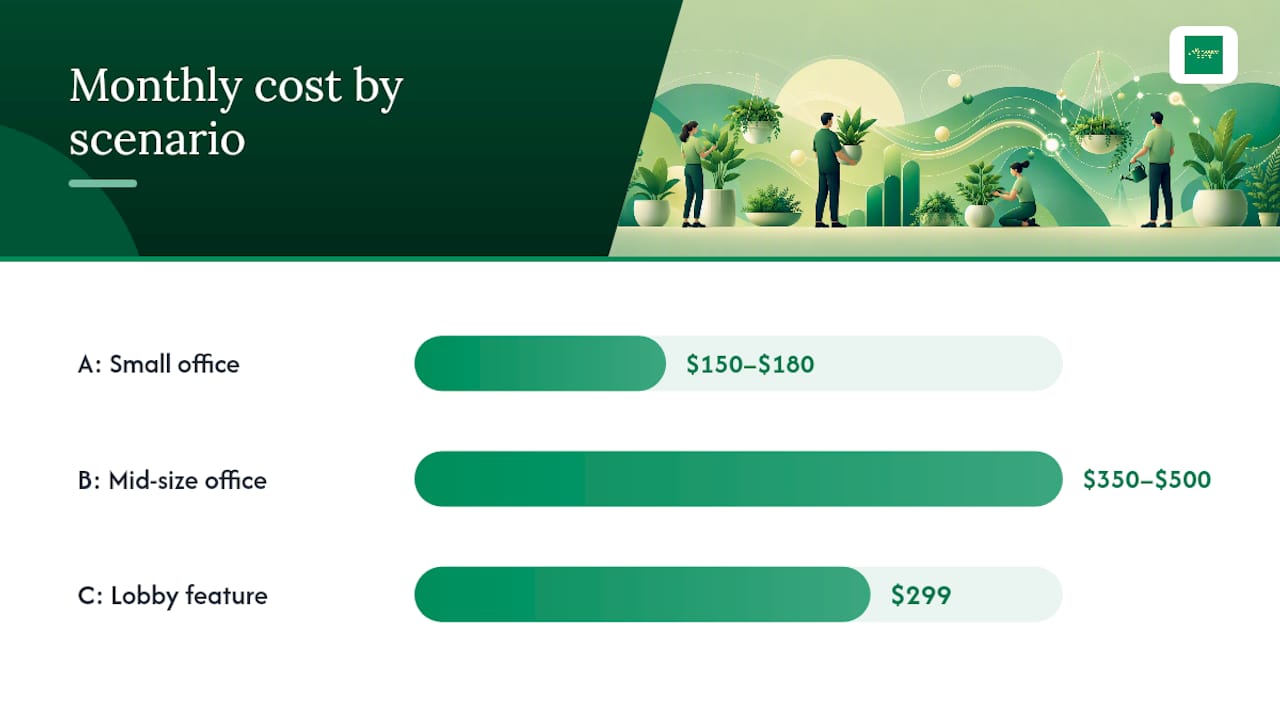
Scenario B: The mid-size office. Thirty plants spread across two floors, leasing model, monthly visits with a quarterly deep-clean. Expect somewhere around $350 to $500 a month, with replacement costs folded into the fee.
Scenario C: The lobby feature. A reception area with a living wall plus 15 supporting plants. The wall alone can push monthly maintenance into four figures given the specialized irrigation and lighting most walls require.
| Scenario | Plant count | Model | Estimated monthly cost |
|---|---|---|---|
| A: Small office | 12 | Maintenance-only | $150–$180 |
| B: Mid-size office | 30 | Lease with replacements | $350–$500 |
| C: Lobby feature | 15 + living wall | All-inclusive lease | $299 |
Initial setup is a separate line. Design, sourcing, and installation typically run from a few hundred to several thousand dollars depending on scope, though many providers roll that cost into the first invoice or waive it entirely under an all-inclusive lease.
How Do You Get an Accurate Quote?
Vague requests get vague quotes. Give a vendor these specifics up front and you'll get numbers you can actually compare:
- Share a floor plan with plant locations marked, or let the vendor walk the space in person.
- State your exact plant count and note any priority zones like a reception area or executive suite.
- Disclose access details early: elevator size, security check-in requirements, and where water sources are located.
- Request an itemized quote that separates labor, plant materials, and replacement contingency into distinct lines.
- Ask about the guarantee specifically: how fast a dead plant gets replaced, and whether emergency visits carry extra fees.
- Request a light and moisture assessment as a deliverable, not an afterthought. It's what determines which species will actually survive in your space.
Pro Tip: Building logistics like elevator access and after-hours security clearance create hidden line items more often than plant species does. Disclose them in your first email, not after the walkthrough.
Why Professional Maintenance Often Beats DIY Long-Term
DIY watering schedules tend to fail for a predictable reason: someone waters on a fixed calendar instead of checking actual soil moisture, and plants either drown or dry out in a cycle that ends in replacement. Professional technicians use moisture meters specifically to break that cycle.
The economics favor contracting once you count staff time and replacement frequency honestly:
- DIY care shifts unbudgeted hours onto whoever "has a green thumb" on staff, and dead plants get replaced at retail cost with no guarantee.
- Leasing programs shift replacement risk to the provider, so a plant that struggles gets swapped at no extra charge instead of becoming a surprise expense.
- Biophilic design research links workplace greenery to employee engagement, which is part of why facilities managers justify the line item as more than decor.
For a deeper look at how offices calculate that return, see our breakdown of eco friendly office catering and how sustainable office programs can boost workplace wellness alongside live plants.
What Contract Length and Payment Terms Should You Expect?
Most commercial plant service agreements run month-to-month or on a one-year term, with month-to-month becoming more common as providers compete on flexibility rather than lock-in. A one-year term sometimes earns a modest discount, but you should be wary of any contract that penalizes you heavily for canceling early. That's a red flag for a service category where your needs might change with office headcount.
Payment terms are almost always monthly invoicing, either by check, ACH transfer, or credit card, billed in advance of the service period rather than after. Setup or installation fees, when they apply, are typically billed separately as a one-time charge on the first invoice rather than spread across the contract term.
Ask specifically whether the agreement auto-renews and what notice period is required to cancel or downsize. A 30-day notice window is standard and reasonable. Anything longer, especially 90 days or more, limits your ability to adjust the program if your office relocates or downsizes, which happens more often than most office managers plan for when they sign.
If a vendor requires a multi-year commitment with no early-exit option, treat that as a negotiating point, not a fixed rule. Flexible terms are increasingly the norm in this category, and a provider unwilling to offer them is worth a second look before you sign.
What I'd Tell Any Office Manager Before Signing
When we walk a new space for the first time, we're checking three things: light readings at each proposed plant location, moisture levels in any existing soil, and physical access logistics like elevator size and after-hours entry. Skip that audit and you get a quote based on guesswork, not your actual space.
The hidden fees to watch for are emergency-visit charges, after-hours access surcharges, and vague "materials" lines that don't specify plant replacement value. Paste this into any RFP: plant count by area, desired visit frequency, guarantee terms requested, and a requirement for itemized labor versus materials pricing. Vendors who balk at itemizing rarely price fairly.
— Nicole
How Greenspace+ Simplifies Your Plant Budget
If you'd rather skip line-item math altogether, Greenspace+ is built for exactly that. For a fixed $299 per month, Greenspace Plants handles design, installation, ongoing maintenance, and plant replacements under a single price, with no upfront costs and no long-term lock-in.
That fixed structure matters more than it sounds like on paper. Every scenario in this guide shows how quotes swing based on plant count, access logistics, and replacement risk, variables you don't control once a contract is signed. An all-inclusive monthly plan moves that risk onto the provider instead of onto your budget, so a struggling plant becomes our problem to fix, not a surprise line item on your invoice.
Browse our indoor plant selection to see what a Greenspace+ program could look like in your space, or request a custom assessment and we'll walk your office the same way we'd walk any new client's, checking light, moisture, and access before we ever send a number.
Sources
- Can you hire professional plant maintenance service for your office? Costs, Contracts, and Benefits — PlantSolve (Hire Office Plant Maintenance Service)
- Office Plant Service Cost, Price Ranges, and How to Budget Smartly 2026 — Current Cost
- Human Spaces / Biophilic design impact report — Green Plants for Green Buildings
- Office Plant Service Pricing and Cost Guide 2026 — Design Transition Studio
FAQ
What's a good low-maintenance plant for an office?
Snake plants, ZZ plants, and pothos tolerate inconsistent light and irregular watering better than most species, making them common picks for offices without a dedicated care budget. See our full list of low-maintenance office plants for more options by light condition.
Should I cut the brown tips off my plants?
Yes, trimming brown or dead tips with clean scissors improves appearance and redirects the plant's energy toward healthy growth, but cut along the natural leaf shape rather than straight across. This is a standard part of the pruning technicians perform on every maintenance visit.
How do you actually take care of office plants?
Consistent care means checking soil moisture before watering rather than following a fixed schedule, dusting leaves so they can photosynthesize, rotating pots toward light sources, and watching for pests early. This is exactly the routine a bi-weekly professional maintenance visit is built to cover.
How much does Greenspace+ cost?
Greenspace+ starts from $299 per month and includes plant design, installation, maintenance, and guaranteed replacements with no upfront cost.
Is leasing plants cheaper than buying them outright?
Leasing usually costs more per month than owning the same plants outright, but it shifts replacement risk to the provider, which often makes it the better deal once you account for the cost of a dead statement plant under a maintenance-only contract.