
Creepers are plants that spread horizontally along the ground or trail from containers, while climbers ascend vertical surfaces using specialized attachment mechanisms. The two terms overlap in casual use, but the distinction matters practically: the attachment method your plant uses determines the support it needs, and choosing the wrong one leads to structural damage, poor growth, or a maintenance headache that compounds every season.
Before you buy anything, take three quick steps:
- Check your site. Note the light level (full sun, partial shade, or shade), wall material (masonry, timber, wire fence), and available height and width. These three factors narrow your species list faster than any other filter.
- Identify the climbing mechanism. Read the plant tag or ask at the nursery whether the plant twines, grips with tendrils, clings with adhesive roots, or hooks with thorns. Each mechanism needs a different support.
- Choose a compatible support before you plant. A trellis, wire system, pergola, or moss pole installed before planting saves you from retrofitting around an established root system.
Species recommendations organized by landscape role, including flowering show-stoppers, fast foliage cover, and indoor trailing options, appear in the section below.
Key Takeaways
Matching a plant's climbing mechanism to the correct support, and installing that support away from the wall surface, prevents the structural damage that makes climbing plants a liability rather than an asset.
| Point | Details |
|---|---|
| Mechanism determines support | Identify whether your plant twines, grips with tendrils, clings with adhesive roots, or hooks before buying a support. |
| Detach supports from walls | Set trellises and wire grids at least 5 cm (2 in.) from masonry to protect mortar and allow maintenance access. |
| Prune by flowering group | Prune old-wood bloomers after flowering; prune new-wood bloomers hard in late winter to preserve the following season's flowers. |
| Rain-shadow watering | Wall-grown climbers need supplemental watering and mulch because the wall deflects rainfall away from the root zone. |
| Greenspace Plants | Provides commercial climbing plant and green wall installation with scheduled maintenance and a healthy plant guarantee across Toronto, Vancouver, and Calgary. |
Table of Contents
- What are creeper plants, and how do they differ from climbers?
- How do climbers attach, and why does that decide the support you need?
- Which creepers and climbers suit your garden goals?
- Where should you grow climbers, and which support fits each plant?
- How do you keep climbing plants healthy year-round?
- How do you propagate creepers and climbers at home?
- What's going wrong with your climber? Common problems diagnosed
- When does a climbing plant project need a professional?
- A practical perspective on growing creepers and climbers
- Professional plantscaping for climbing plants and green walls
- Sources
What are creeper plants, and how do they differ from climbers?
The terms "creeper," "climber," and "trailing plant" describe three distinct growth habits, though nurseries and gardeners use them interchangeably. Knowing the difference helps you pick the right plant for the right spot.
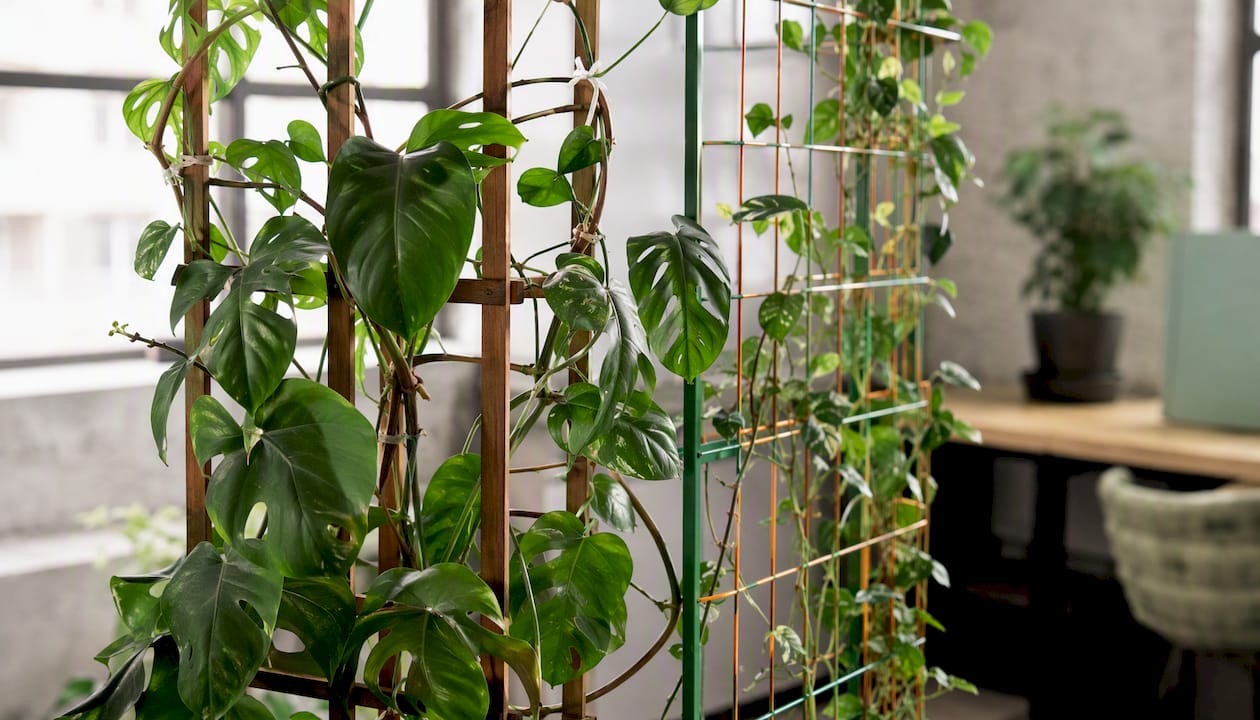
A creeper spreads horizontally, rooting at nodes as it goes. Think of it as a ground-level colonizer: it covers soil, suppresses weeds, and cascades over retaining walls. A climber grows upward, using one of five attachment mechanisms to ascend a vertical support. A trailing plant hangs downward from a container or shelf, neither rooting along its stems nor gripping a support.
| Growth habit | Attachment method | Common uses |
|---|---|---|
| Creeper | Rooting nodes along stems | Groundcover, erosion control, wall cascades |
| Climber | Twining, tendrils, adhesive roots, hooks | Wall cover, pergolas, fences, arches |
| Trailing houseplant | None (gravity-dependent) | Hanging baskets, shelf displays, moss pole training |
Quick identification checklist for the nursery:
- Does the stem wrap around supports on its own? → Twining climber.
- Does it produce thin, curling growths that grip wire or mesh? → Tendril climber.
- Are there small, sticky pads or aerial roots on the stem? → Adhesive/root climber.
- Does it spread along the ground and root where it touches? → Creeper.
- Does it simply hang without gripping? → Trailing plant.
How do climbers attach, and why does that decide the support you need?
Botanists classify climbing plants into five main ascent categories: twining stems, tendril bearers, leaf climbers, root/adhesive climbers, and hook climbers. The category your plant falls into is not a botanical curiosity; it is the single most important piece of information for choosing a support system.
- Twining stems wrap the entire stem around a support. Wisteria and Honeysuckle are classic examples. They need open structures with something to wrap around: vertical wires, timber posts, or open lattice. Solid flat panels give them nothing to grip.
- Tendril bearers produce thin, curling growths that coil around thin supports. Clematis and Passionflower fall here. They perform best on wire grids, trellis panels, or open fencing where tendrils can find purchase on something narrow.
- Leaf climbers grip with modified leaf stalks (petioles) rather than dedicated tendrils. Some Clematis species use this mechanism too, wrapping their petioles around wires or thin branches.
- Root/adhesive climbers produce aerial roots or adhesive pads that bond directly to surfaces. English ivy, Climbing hydrangea, Boston ivy, and Virginia creeper all fall here. They can scale a bare brick wall with no additional support, but that convenience comes with a cost: adhesive rootlets can penetrate mortar joints and damage paint. For masonry and painted surfaces, a detached trellis or wire grid set a few inches from the wall is strongly recommended.
- Hook/thorn climbers lean and scramble, using thorns or hooked stems to catch on neighboring plants or rough surfaces. Rambling roses are the prime example. They need tying in regularly because they do not self-attach to smooth supports.
Pro Tip: The most common installation error we see is placing an adhesive climber directly against a rendered or painted wall. The plant thrives, but removal years later strips the surface. Install a timber batten frame or galvanized wire system at least 5 cm (2 in.) from the wall surface from day one, and you protect the structure while still getting full coverage.
According to the RHS, improper species selection and direct wall attachment are leading causes of structural damage in older buildings. Matching mechanism to support is not optional; it is the foundation of responsible planting.
Which creepers and climbers suit your garden goals?
For privacy and fast foliage cover, choose vigorous adhesive or twining species. For seasonal flowering drama, go with Clematis, Wisteria, or Climbing Roses. For indoor display, Pothos and Creeping fig are forgiving and flexible. Here is a practical breakdown by landscape role.
Flowering show-stoppers
Popular flowering climbers for landscape display include Wisteria, Clematis, Honeysuckle, Climbing Hydrangea, and Climbing Roses, each with distinct bloom windows and support needs.
- Clematis (Clematis spp.): Blooms range from early spring to fall depending on the group (Group 1, 2, or 3). Tendril/leaf-stem climber; needs wire or trellis. Pros: extraordinary variety, long season. Cons: pruning rules differ by group, which confuses beginners.
- Wisteria (Wisteria spp.): Spectacular hanging flower clusters in late spring. Twining; needs very sturdy supports (masonry anchors, heavy timber pergola). Pros: dramatic impact. Cons: vigorous enough to lift gutters and damage lightweight structures if left unpruned.
- Honeysuckle (Lonicera spp.): Fragrant, wildlife-friendly, and relatively fast. Twining; train on wires spaced about 45 cm (18 in.) apart with a 5 cm (2 in.) gap from the wall for airflow, as the RHS recommends. Pros: tolerates partial shade. Cons: deciduous types can look bare in winter.
- Climbing hydrangea (Hydrangea anomala subsp. petiolaris): Self-clinging with aerial rootlets; large white lacecap flowers in summer. Pros: shade-tolerant, spectacular on north-facing walls. Cons: slow to establish (often three years before significant flowering).
- Climbing/rambling roses (Rosa spp.): Hook climbers that need tying in. Pros: unmatched fragrance and color range. Cons: thorns make maintenance physically demanding; susceptible to blackspot.
- Morning glory (Ipomoea spp.): Fast-growing annual twiner with vivid trumpet flowers. Pros: cheap, quick, and colorful. Cons: annual, so replanting is needed each year; self-seeds prolifically.
- Passionflower (Passiflora spp.): Tendril climber with exotic, intricate flowers. Pros: attracts pollinators; some species produce edible fruit. Cons: can be tender in colder climates; check hardiness before planting.
Foliage and cover plants
- Boston ivy (Parthenocissus tricuspidata): Adhesive-pad climber; brilliant red fall color. Pros: covers large walls rapidly, no support needed on masonry. Cons: vigorous woody vines like Boston ivy need very sturdy supports and careful pruning when trained on structures rather than bare walls.
- Virginia creeper (Parthenocissus quinquefolia): Adhesive-tipped tendrils; can reach 20–30 m (70–100 ft.) in the wild and tolerates a wide range of light conditions. Pros: native species, strong fall color, wildlife value. Cons: vigorous enough to overwhelm smaller structures; monitor and prune annually.
- English ivy (Hedera helix): Self-clinging aerial roots; evergreen. Pros: dense cover, shade-tolerant, year-round interest. Cons: can become invasive outside its native range; aerial roots damage mortar over time.
Indoor trailing and climbing plants
- Pothos (Epipremnum spp.): One of the most forgiving indoor creepers available. Train on a moss pole for a climbing display or let it trail from a shelf. Tolerates low light and irregular watering. Pros: near-indestructible. Cons: toxic to pets.
- Creeping fig (Ficus pumila): Adhesive aerial roots; clings to walls and moss poles. Pros: fine-textured foliage, good for living walls. Cons: once established on a surface, removal damages the substrate.
Hardy and low-maintenance picks
For gardeners who want coverage without constant intervention, vine selection based on intended use, location, and soil adaptability narrows the field quickly. Dense-foliage species like Boston ivy and Virginia creeper suit screening; fine-textured, slower growers suit decorative wall patterns on stone or brick.
Where should you grow climbers, and which support fits each plant?
The main rule: match the climbing mechanism to the support, and match the plant's ultimate vigor to the strength of the structure holding it. A Wisteria on a lightweight timber trellis screwed to a fence is a structural problem waiting to happen.
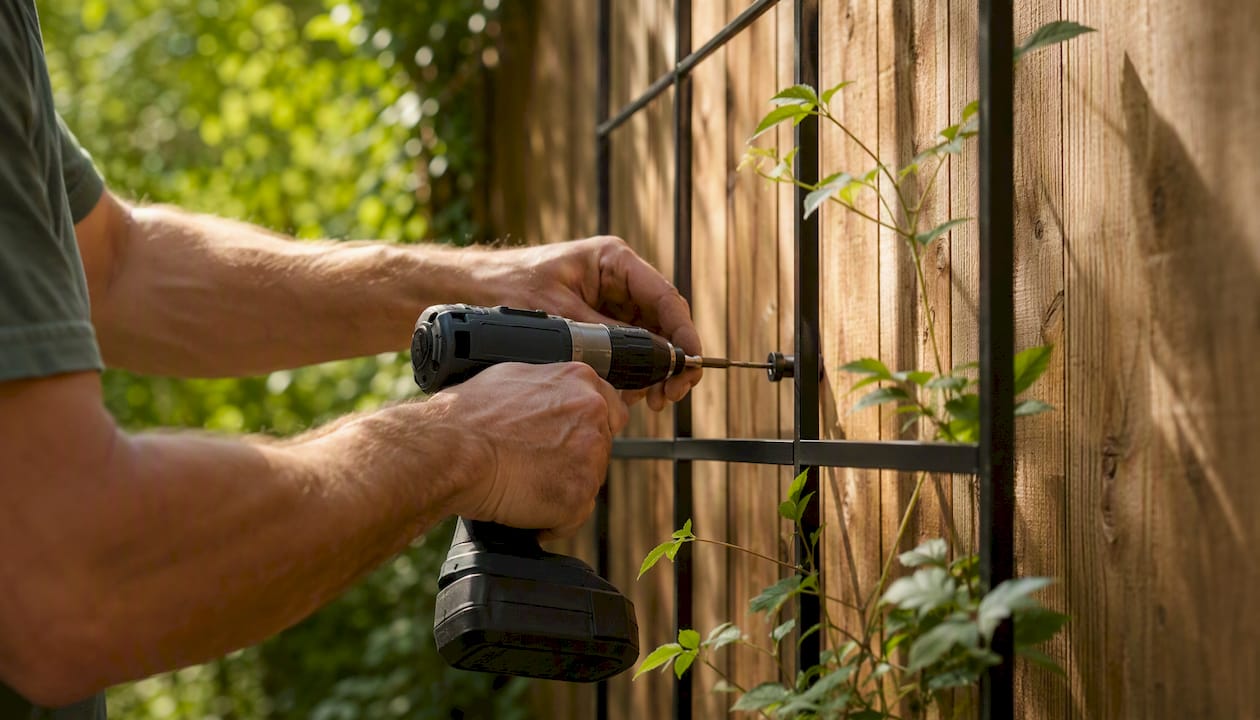
Selecting the right support also depends on whether you want to avoid permanent attachment to the wall surface. For masonry, brick, or painted surfaces, a detached system is almost always the better long-term choice.
| Support type | Best ascent types | Key installation tip |
|---|---|---|
| Timber or metal trellis panel | Twining, tendril, hook/thorn | Mount on battens 5 cm (2 in.) from wall; allows airflow and maintenance access |
| Horizontal wire system | Twining, tendril, hook/thorn | Space wires 30–45 cm (12–18 in.) apart; use vine eyes or standoffs to keep wires off the wall |
| Pergola or arch | Twining, hook/thorn | Use pressure-treated timber or powder-coated steel rated for the plant's mature weight |
| Bare masonry wall | Root/adhesive climbers only | Inspect mortar condition first; damaged mortar accelerates with adhesive rootlets |
| Moss pole (indoor) | Root climbers, trailing plants | Keep pole moist; aerial roots need humidity to attach |
| Open fence or post-and-rail | Tendril, twining | Ideal for grape, Clematis, and annual twiners |
Practical planting checklist:
- Dig a planting hole at least 30 cm (12 in.) from the base of the wall or support to avoid the rain-shadow zone.
- Amend heavy clay or sandy soil with compost before backfilling.
- Plant at the same depth as the nursery pot, except for Clematis (plant 5–8 cm deeper to protect against wilt).
- Angle the root ball slightly toward the support so new growth heads in the right direction.
- Water thoroughly at planting and apply a 5–8 cm (2–3 in.) mulch layer, keeping mulch clear of the stem.
- Anchor freestanding supports (arches, obelisks) before planting, not after.
How do you keep climbing plants healthy year-round?
Three priorities drive healthy climbers: correct support from the start, seasonal pruning timed to the plant's flowering habit, and consistent root-zone moisture management. Climbers grown near walls face a rain-shadow effect, where the wall deflects rainfall and the soil stays drier than open ground. Supplemental watering and mulch are not optional extras; they are part of the maintenance contract.
Seasonal checklist:
- Spring: Check ties and replace any that have cut into stems. Apply a balanced slow-release fertilizer. Begin training new shoots onto supports before they tangle. Prune Group 3 Clematis hard (back to 30 cm/12 in.) in late winter or early spring.
- Summer: Water deeply during dry spells, especially wall-grown plants. Deadhead repeat-flowering climbers (roses, some Clematis). Tie in new growth on hook climbers (roses) every few weeks to prevent wind rock.
- Autumn: Apply a second mulch layer (5–8 cm) after the first frost to insulate roots. Prune rambling roses after flowering. Collect and dispose of diseased leaves rather than composting them.
- Winter: Inspect support fixings for rust or rot. Protect tender climbers (Passionflower in colder zones) with horticultural fleece. Prune Wisteria side shoots back to 2–3 buds in late winter.
Pruning decision flow:
- Does the plant flower on growth made the previous year (old wood)? → Prune immediately after flowering, not in spring. Examples: Wisteria, Group 1 Clematis, rambling roses.
- Does it flower on growth made in the current season (new wood)? → Prune hard in late winter or early spring. Examples: Group 3 Clematis, some Honeysuckle.
- Does it flower on both old and new wood? → Light tidy after the first flush, then deadhead through summer. Examples: Group 2 Clematis, repeat-flowering climbing roses.
Getting the pruning timing wrong does not kill the plant, but it reliably eliminates a full season of flowers.
How do you propagate creepers and climbers at home?
The three fastest home-friendly propagation methods are layering, softwood cuttings, and semi-ripe or hardwood cuttings. Seeds work but produce variable results and take significantly longer to reach a flowering or covering size.
1. Layering (best for Honeysuckle, Climbing Hydrangea, Wisteria)
- Select a long, flexible stem from the current or previous season's growth.
- Wound the underside of the stem lightly with a knife (a shallow nick, not a full cut).
- Bury the wounded section 8–10 cm (3–4 in.) deep in a pot of moist compost placed beside the parent plant, leaving the growing tip exposed.
- Secure the buried section with a U-pin or bent wire.
- Keep the compost moist. Roots typically form within 8–16 weeks.
- Sever the new plant from the parent once it shows active new growth.
Layering is a reliable, low-tech method that professionals use to establish firm anchors for heavy vines without specialized equipment.
2. Softwood cuttings (best for Clematis, Passionflower, Honeysuckle)
- Take 8–10 cm (3–4 in.) cuttings from soft, non-flowering shoot tips in late spring or early summer.
- Remove the lower leaves, leaving one or two pairs at the tip.
- Dip the cut end in rooting hormone powder or gel.
- Insert into a tray of perlite-and-compost mix (50/50).
- Cover with a clear plastic bag or propagator lid to maintain humidity.
- Place in bright, indirect light at 18–22°C (65–72°F). Roots form in 4–8 weeks.
3. Semi-ripe and hardwood cuttings (best for English ivy, Climbing Roses, Virginia Creeper)
- Take semi-ripe cuttings in midsummer (stems that are firm at the base but still green at the tip) or hardwood cuttings in late autumn after leaf drop.
- Cut sections 15–20 cm (6–8 in.) long, just below a node.
- Remove lower leaves; leave two or three at the top.
- Insert into gritty compost in a cold frame or unheated greenhouse.
- Hardwood cuttings can overwinter in situ and root by spring.
| Propagation method | Best time of year | Typical success note |
|---|---|---|
| Layering | Spring through early summer | High success; plant stays connected to parent until rooted |
| Softwood cuttings | Late spring to early summer | Moderate to high; humidity control is critical |
| Semi-ripe cuttings | Midsummer | Moderate; firmer stem reduces rot risk vs. softwood |
| Hardwood cuttings | Late autumn to early winter | Lower but reliable; minimal attention needed over winter |
| Seed | Spring (after stratification if needed) | Variable; slow to reach mature size |
What's going wrong with your climber? Common problems diagnosed
The most common, high-impact problems with climbing plants are no flowers, yellowing leaves, pest infestations, and structural damage from unchecked growth. Most have a clear cause and a straightforward first action.
- No flowers: Likely causes are over-pruning at the wrong time (removing flower buds on old wood), too much nitrogen fertilizer (promotes foliage at the expense of blooms), or insufficient light. First action: check pruning timing against the plant's flowering group and move to a higher-light position if possible.
- Yellow leaves: On wall-grown plants, the most common cause is drought stress from the rain-shadow effect. Check soil moisture 10 cm (4 in.) below the surface. Secondary causes include nutrient deficiency (apply a balanced feed) or waterlogged roots (improve drainage).
- Powdery mildew: White, powdery coating on leaves, common on Clematis and roses in dry summers. Improve airflow by thinning crowded stems. Remove affected leaves and apply a sulfur-based fungicide if the infection is widespread.
- Aphids and scale insects: Cluster on soft new growth. For light infestations, blast with water or apply insecticidal soap. For persistent scale on woody stems, use a horticultural oil in late winter before growth begins.
- Structural damage: Adhesive climbers on old masonry, or twiners that have grown into gutters and under roof tiles, require careful removal. Pulling stems off a wall strips mortar; cutting the plant at the base and allowing it to dry before peeling is less damaging.
- Invasive spread: Virginia creeper and English ivy can spread into neighboring gardens or natural areas if not contained. Prune hard each autumn and remove any rooted stems that have spread beyond the intended area.
When to call a professional: If a climber has grown into structural elements (gutters, roof tiles, window frames), if root systems are lifting paving or penetrating foundations, or if a disease like honey fungus is suspected, a professional assessment protects both the structure and surrounding plants. Large-scale removal of established adhesive climbers from historic masonry is also a job for specialists.
When does a climbing plant project need a professional?
Three clear signals indicate a project has moved beyond DIY territory: the installation involves load-bearing structures or historic masonry, the scale requires irrigation integration, or ongoing maintenance commitments exceed what a single gardener can reliably deliver.
Professional plantscaping services typically cover:
- Structural assessment and detached trellis or wire-grid installation, set correctly off the wall to protect masonry and allow maintenance access.
- Irrigation system integration for large wall plantings or green walls, where hand-watering is impractical.
- Scheduled pruning and training visits, timed to each species' flowering group and growth rate.
- Plant health monitoring and replacement guarantees, so a failing specimen is swapped before it leaves a gap in coverage.
- Responsible species selection that avoids invasive choices for the specific site and region.
For commercial spaces, the calculus is straightforward: a climbing plant or green wall installation that enhances a lobby, restaurant, or office facade needs to look good every day, not just at installation. That requires a maintenance plan, not a one-time plant purchase. Greenspace Plants provides commercial plant installation and care across Toronto, Vancouver, and Calgary, handling everything from support design to scheduled maintenance visits, with a healthy plant guarantee built into the service.
For home gardeners, the threshold is simpler: if the project involves a wall you cannot afford to damage, a structure you cannot safely climb to maintain, or a plant with a history of aggressive growth on your site, a professional consultation before planting costs far less than remediation after.
A practical perspective on growing creepers and climbers
The single most underestimated factor in growing climbing plants is not species selection or pruning timing. It is the support system, and specifically, the gap between the support and the wall behind it.
Every season, we see beautiful climbers that have been planted with care and maintained with attention, but attached directly to a rendered or painted surface. The plants look fine for years. Then removal or renovation reveals mortar damage, paint stripped to bare render, or adhesive rootlets that have worked into hairline cracks. The fix is expensive and avoidable.
A practical checklist worth applying before you plant anything:
- Site first. Confirm light levels, wall material, and available space before choosing a species.
- Support before plant. Install the trellis, wire system, or moss pole before the root ball goes in the ground.
- Maintenance cadence. Decide now how often you can realistically prune and tie in. If the honest answer is "once a year," choose a species that tolerates that schedule rather than one that needs monthly attention.
Climbing plants reward patience and preparation. The gardeners who struggle are almost always the ones who planted first and planned second.
Professional plantscaping for climbing plants and green walls
Greenspace Plants offers a concrete alternative to managing large climbing plant installations on your own. For commercial spaces in Toronto, Vancouver, and Calgary, the Greenspace+ program covers plant design, support installation, scheduled maintenance, and plant replacements under a fixed monthly fee with no upfront costs or long-term lock-in.
For businesses where a living wall, green facade, or indoor vining display needs to perform reliably, the all-inclusive model removes the guesswork from maintenance scheduling, pruning timing, and plant health monitoring. Our team handles indoor plant care and outdoor patio planting with the same scheduled, proactive approach, so your installation looks intentional every day, not just at launch.
To discuss a commercial climbing plant or green wall project, request a consultation with Greenspace Plants and we will assess your site, recommend species suited to your structure, and outline a maintenance plan that protects both the plants and the building.
Sources
- Climbing plants / RHS
- Vine
- Vines | Chicago Botanic Garden
- Selecting Landscape Plants: Ornamental Vines | MU Extension
- Common flowering creepers and climbers (Garden Design)
- Best climbing plants (Martha Stewart)