
A top plant care contract for a commercial building must specify the scope of work, visit frequency, measurable SLA metrics and remedies, a replacement/warranty window, the pricing model and what triggers extra charges, insurance certificates, access and security rules, reporting requirements, and termination terms — all in writing, before work begins.
Quick procurement checklist for your RFP or bid evaluation:
- Detailed scope of work (SOW) listing every plant, planter, and location
- Visit frequency and guaranteed minimum service time per visit
- SLA metrics with defined thresholds and remedies for missed standards
- Replacement/warranty window (industry-recommended at 7–14 days)
- Pricing model with explicit list of what triggers extra charges
- Certificate of Insurance (COI) naming your building, with coverage limits
- Access, badging, and after-hours procedures
- Reporting cadence (visit logs, photo reports, escalation contacts)
- Termination notice period and exit logistics (plant ownership, removal)
All-inclusive subscription vs. à la carte: Choose a subscription when you want predictable monthly costs and guaranteed replacements with no surprise invoices. Go à la carte only when your plant footprint is small, static, and rarely needs intervention.
Table of Contents
- Why does a written plant-care contract matter for commercial buildings?
- What should every commercial plant maintenance contract include?
- What SLA metrics should you specify in a plant-care agreement?
- How do plant-care pricing models work, and what inflates a low bid?
- What insurance and liability protections should you require?
- What contract terms, renewal mechanics, and exit rights should you negotiate?
- How do you evaluate bids and negotiate a defensible contract?
- Why do managed subscription services often deliver better outcomes?
- What qualifications should plant-care technicians have?
- How should dispute resolution be structured in a plant-care contract?
- What confidentiality provisions belong in a plant-care contract?
- What sustainability commitments should you ask for?
- How should plant selection be customized for your building?
- What chemical-use and allergen protocols should the contract require?
- Key Takeaways
- The real cost of a cheap plant-care contract
- Greenspace Plants offers a fully managed alternative
- Useful sources and sample contract templates
Why does a written plant-care contract matter for commercial buildings?
A written contract converts subjective aesthetics into measurable deliverables and budget certainty. Without one, "healthy plants" means whatever the technician decides it means on any given Tuesday.
The operational risks are real. Plant decline, pest spread through centralized HVAC systems, and inconsistent appearance in client-facing spaces all become budget problems when there is no documented standard to enforce. A well-defined contract improves budget predictability and reduces operational risk by formalizing scope and SLAs — which means you stop paying for surprises and start paying for outcomes.
Statistic callout: Industry practitioners consistently identify clear contract language as the primary tool for facilities managers to maintain interior greenery under commercial HVAC and lighting conditions, where plants decline faster than in residential settings and inconsistent maintenance compounds the problem quickly.
Access schedules matter too. A contract that specifies when technicians can enter, which floors require escort, and how chemical applications are communicated protects both the building owner and the service provider from liability disputes.

What should every commercial plant maintenance contract include?
A comprehensive SOW lists what's included, what's excluded, and who supplies the plants, planters, and irrigation — nothing is assumed.
Plant and planter inventory
- Complete plant inventory by location: species, pot size, quantity per floor or zone
- Planter inventory: standard, premium, luxury, or custom; who owns them
- Irrigation systems, self-watering inserts, or hydroponic setups
- Seasonal displays, living walls, moss walls, and outdoor patio areas
- Tenant-specific areas and any zones excluded from service
Maintenance tasks to list explicitly
Every task that a technician performs should be named. Vague language like "general care" is the single most common source of service disputes.
- Watering schedule and method (hand-watering, irrigation check, moisture monitoring)
- Pruning, trimming, and grooming (foliage cleaning, leaf dusting)
- Fertilization schedule and soil health checks
- Pest monitoring and treatment as a standalone clause — centralized air systems in commercial buildings can spread infestations rapidly if not caught during structured inspections
- Plant rotations for phototropic species
- Emergency response procedures and response time commitments
Reporting and communication
- On-site visit logs signed or timestamped by the technician
- Photo reports documenting plant condition before and after service
- Digital service notes accessible to the facilities manager
- Named points of contact and an escalation path for urgent issues
- Quarterly review cadence with a written summary
Installation vs. ongoing maintenance boundaries
Spell out who installs, who pays for shipping and installation labor, what the acceptance criteria are at handover, and what a completed handover checklist looks like. This prevents billing disputes when the first maintenance visit reveals a plant that arrived damaged.
Replacement and warranty language
Replacement windows of 7–14 days are the industry-recommended standard — declining plants should be swapped before they become an aesthetic liability. Your contract should also define the conditions that trigger replacement, how specialty varieties (such as high-maintenance species like gardenias) are handled, and what exclusions apply (intentional damage, extreme weather events, tenant interference).
Pro Tip: Add two non-obvious clauses: (1) a guaranteed minimum service time per visit (e.g., "no less than 45 minutes for a 20-plant installation") to prevent drive-by maintenance; and (2) defined moisture and visual thresholds that constitute "decline" — for example, "any plant exhibiting more than 20% yellowing or wilting for more than 48 hours triggers a replacement request."
Sample clause language (generic): "Provider shall replace any plant exhibiting visible decline, as defined in Exhibit A, within [7/14] calendar days of written notification by the Client or Provider's own inspection log. Specialty varieties listed in Exhibit B carry a [30]-day replacement window due to sourcing lead times."
What SLA metrics should you specify in a plant-care agreement?
Specify measurable SLA metrics or you get subjective service. A provider who agrees to "maintain healthy plants" with no defined threshold has agreed to nothing enforceable.
| SLA Metric | Suggested Standard | Remedy for Breach |
|---|---|---|
| Plant health threshold | No more than 10% of plants in visible decline at any inspection | Written notice; replacement within 7–14 days |
| Guaranteed minimum service time per visit | Named minimum (e.g., 45 min for 20 plants) | Service credit for that visit |
| Visit completion confirmation | Signed log or digital timestamp within 2 hours of visit | Documented as a missed visit |
| Emergency response (pest outbreak, major decline) | On-site response within 24 hours of notification | Service credit; escalation to account manager |
| Scheduled visit adherence | Visits completed within the contracted window | Credit or makeup visit within 5 business days |
| Replacement window | 7–14 calendar days from identification | Prorated credit for each day beyond the window |
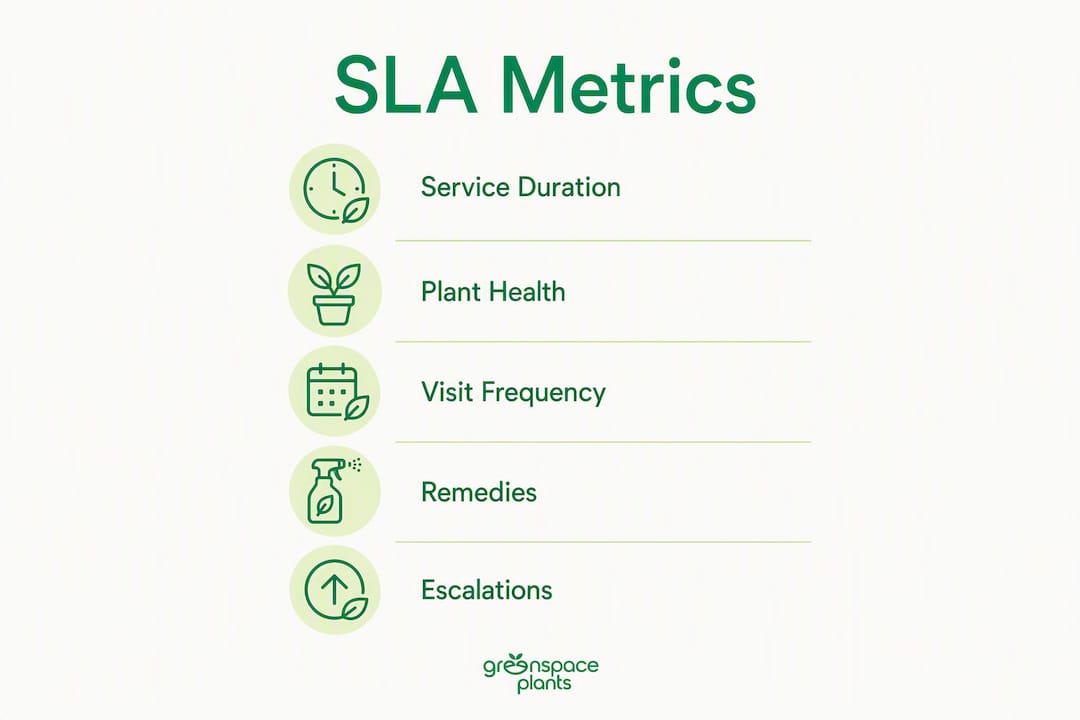
Remedies should escalate. A single missed visit warrants a service credit. Repeated SLA failures — say, three in a 90-day period — should trigger a right to terminate for cause without an early-termination penalty. Build that language in before you sign.
Sample SLA phrasing: "Provider guarantees a minimum on-site service duration of [X] minutes per scheduled visit. Visits confirmed at less than the minimum duration shall be logged as partial visits and credited at 50% of the per-visit rate."
For living walls and large atrium installations, weekly service visits are the standard because plants need time to acclimatize to commercial HVAC and lighting conditions. Build that frequency into the SLA for complex installs, not just the SOW.
How do plant-care pricing models work, and what inflates a low bid?
Pricing typically comes as a flat monthly subscription, per-visit fees, or a hybrid tiered model. Understanding what each covers — and what triggers extra charges — is how you compare bids accurately.

| Pricing Model | What's Typically Included | Common Extras |
|---|---|---|
| All-inclusive monthly subscription | All labor, routine maintenance, replacements, reporting | Specialty plant upgrades, custom planters, large-scale installs |
| Base monthly + consumables | Labor and visits; plants/soil billed separately | Every replacement, fertilizer, pest treatment |
| Per-visit fee | Labor for that visit only | Travel, materials, replacements, emergency calls |
| Installation + maintenance add-on | One-time install cost; ongoing care billed monthly | Seasonal refreshes, living wall service, outdoor patios |
| Living wall / large-install special pricing | Custom scope; often weekly visits included | Irrigation system maintenance, structural repairs |
The extras that inflate a low bid most often: plant replacements outside the warranty window, specialty planter upgrades, after-hours service, emergency pest treatments, seasonal refreshes, and shipping for replacement stock. A bid that looks 30% cheaper than competitors may carry all of those as unbundled line items.
For budgeting, calculate your expected monthly total by adding an estimated replacement rate to the base fee, factoring in at least one seasonal refresh per year, and building a contingency of 15–20% for living walls and outdoor patios, which carry higher replacement and labor costs. Public-sector contracts for large installations — such as multi-year municipal awards covering terminals and public spaces — demonstrate how scope and cost scale with installation complexity.
An all-inclusive subscription typically reduces total cost of ownership when your plant footprint is large enough that replacements and emergency calls would otherwise generate unpredictable monthly invoices. For a single-site office with 15 plants, per-visit pricing may be adequate. For a multi-floor headquarters with a living wall, the subscription model almost always wins on predictability.
What insurance and liability protections should you require?
Insist on a Certificate of Insurance naming your building and verifying appropriate coverage limits before any technician sets foot on your property. This is non-negotiable.
Minimum insurance requirements:
- General liability: At least $1 million per occurrence / $2 million aggregate is a common commercial baseline; verify with your own risk manager
- Workers' compensation: Required in every U.S. state; confirm it covers all technicians, including subcontractors
- Professional liability (errors and omissions): Required if the contract includes design services or horticultural consulting
- Commercial auto: If the provider transports plants or equipment to your site
- Pollution/environmental liability: Required wherever pesticides or chemical treatments are used on your property
Safety and chemical-use clauses to include:
- Require Safety Data Sheets (SDS) for all chemicals used on-site
- OSHA-compliant handling and disposal procedures
- Advance written notification (minimum 24–48 hours) before any pesticide application
- Allergen and tenant-notification protocols, especially in food-service or healthcare-adjacent spaces
- Subcontractor COI requirements: any subcontractor must carry equivalent coverage
Sample COI clause: "Provider shall maintain and deliver to Client a current Certificate of Insurance prior to commencement of services and upon each annual renewal. The certificate shall name [Building Owner/Manager] as an additional insured on the general liability policy."
Verify COI renewals annually. A lapsed policy discovered after an incident is a budget problem, not just a paperwork one.
What contract terms, renewal mechanics, and exit rights should you negotiate?
Define the term length and a clear notice period so neither party gets locked into an unexpected renewal. Automatic renewals without adequate notice windows are the most common source of contract disputes in commercial plant services.
Common term structures:
- Month-to-month: Maximum flexibility; typically carries a higher per-visit or monthly rate
- 12/24/36-month agreements: Lower monthly cost in exchange for commitment; include renewal options with defined notice windows
- Project-based: Used for installation-only or seasonal display contracts; define a clear end date and acceptance criteria
Notice and termination provisions:
- Standard notice windows run 30–90 days; 60 days is the most common commercial standard
- Termination for cause tied to SLA breaches (e.g., three missed SLA thresholds in 90 days) should carry no early-termination penalty
- Termination for convenience should specify whether prepaid fees are pro-rated or forfeited
- Early-termination fees, when present, should be capped and clearly stated (e.g., two months' remaining fees, not the full contract value)
Exit logistics:
- Who owns the plants at contract end? Ownership should be stated explicitly — especially under rental/subscription models
- Options for the client to purchase plants at fair market value
- Provider's responsibility to remove plants and planters within a defined window
- A condition report at handover documenting plant health and planter condition
Government procurement examples illustrate how long-term structures work at scale: a five-year sole-source award for interior plant maintenance at a healthcare campus shows that long-duration contracts are viable when scope and performance standards are tightly defined from the start.
How do you evaluate bids and negotiate a defensible contract?
Evaluate proposals against the same SOW and SLA metrics to make apples-to-apples comparisons. A bid that doesn't address your SOW in full is not a complete bid.
Vendor evaluation scoring criteria (numbered for RFP use):
- SOW completeness: does the proposal address every line item in your scope?
- SLA metrics included: are visit frequency, response times, and replacement windows specified?
- Insurance limits: does the COI meet your building's minimum requirements?
- Replacement guarantee window: is it 7–14 days or longer?
- Staff qualifications and training: are technicians certified or trained in Integrated Pest Management (IPM)?
- Local account management: is there a named account manager and escalation contact?
- Reporting cadence: are visit logs, photo reports, and quarterly reviews included?
- References and case studies: can the provider demonstrate experience with comparable installations?
Questions to ask during the RFP stage:
- Who performs installations — in-house staff or subcontractors?
- What is your turnaround time on plant replacements?
- What is the guaranteed minimum service time per visit for our installation size?
- What is your escalation path for a pest outbreak discovered on a Friday afternoon?
- Do subcontractors carry their own insurance?
Red flags to watch for:
- Vague SOW with no plant inventory or task list
- No SLA metrics or response time commitments
- Missing or expired COI
- Open-ended "extra charges" with no defined triggers
- "Drive-by" service descriptions (e.g., "regular care as needed")
- No replacement guarantee or a window longer than 30 days
Negotiation tips: Convert every vague promise into a performance metric. "We'll take care of it" becomes "Provider will respond on-site within 48 hours of written notification." Ask for a 30–60 day pilot period with defined acceptance criteria before committing to a multi-year term, especially for large or complex installations. Managed plant service programs that bundle design, installation, and maintenance under one contract simplify this evaluation considerably.
Why do managed subscription services often deliver better outcomes?
Premium services pair higher-quality plant material, purpose-selected planters, and genuine horticultural expertise with stronger SLA and replacement commitments — which reduces both visual risk and operational unpredictability.
The difference between average and premium isn't just plant selection. Designer-level offerings combine top-tier plant material, premium planters, and personalized horticultural assessments that match species to a building's specific light levels, HVAC airflow, and humidity. A plant chosen for the right microclimate needs far fewer emergency replacements than one dropped in because it was available.
For complex installs, the service frequency difference is significant. Living walls and large atriums typically require weekly visits to stay healthy under commercial conditions. Consider a scenario where a living wall in a corporate lobby receives only biweekly service: by week three of a dry HVAC season, moisture stress creates entry points for spider mites. A weekly service cadence — with structured IPM inspections — catches that before it spreads. Reactive treatment after a visible infestation costs far more than the incremental cost of an extra visit per month.
Value comparison for managed subscriptions:
- Fewer replacements over a 12-month period due to proactive monitoring
- Predictable monthly budgeting versus unpredictable per-incident billing
- Fewer tenant complaints from consistent plant appearance
- Single point of accountability for design, installation, and ongoing care
- Documented horticultural evaluations that inform plant selection for large commercial spaces
What qualifications should plant-care technicians have?
Your contract should specify minimum qualifications for the people performing the work, not just the company holding the contract. A technician who can identify early-stage root rot or a thrips infestation before it spreads is worth more than one who waters and leaves.
Qualifications worth requiring in writing include: training in Integrated Pest Management (IPM) principles, familiarity with commercial-grade plant species and their care requirements, OSHA 10 or equivalent safety training where chemical applications are involved, and documented experience with the specific installation type (living walls, moss walls, and outdoor patios each carry distinct technical demands). For larger accounts, require that the lead technician have a minimum number of years of commercial horticultural experience and that any substitution of the lead technician be communicated in advance.
Ongoing training matters too. Ask whether the provider has a formal training program or relies on informal on-the-job learning. Providers who invest in continuing education — through organizations like the Certified Biological Laboratory Professionals or university extension programs — tend to bring more consistent, evidence-based care to each visit.
How should dispute resolution be structured in a plant-care contract?
Require mediation before arbitration. That sequence gives both parties a lower-cost path to resolution before committing to a binding arbitration process, which can be expensive and time-consuming even for relatively small contract disputes.
A well-structured dispute resolution clause should name the governing law (specify the U.S. state), define what constitutes a formal dispute (typically a written notice with a 15–30 day cure period), require good-faith negotiation first, then mediation through a named or agreed-upon mediator, and only then escalate to binding arbitration. Litigation as a first resort is rarely in either party's interest for a commercial plant-care contract.
What confidentiality provisions belong in a plant-care contract?
Plant-care technicians have regular, often unsupervised access to your building. A confidentiality clause protects proprietary information they may encounter during service visits.
At minimum, the contract should require the provider and all technicians to keep confidential any business information, personnel details, security procedures, or proprietary materials observed during service. This includes floor plans, access codes, tenant names, and any information visible on workstations or in meeting rooms. The clause should survive contract termination — confidentiality obligations don't end when the service does. For buildings with heightened security requirements (financial services, healthcare, government), consider requiring background checks for all technicians as a condition of the contract.
What sustainability commitments should you ask for?
Sustainability provisions are increasingly standard in commercial plant-care contracts, and they protect both your ESG reporting and your building's occupant health.
Ask providers to specify their approach to plant sourcing: do they prioritize regionally appropriate species that require less intervention under local climate conditions? For outdoor patios, native plant selections reduce water use, support local pollinators, and typically carry lower replacement rates than non-native ornamentals. Indoors, low-VOC soil amendments and organic fertilizers reduce chemical exposure for building occupants.
Waste handling is another area worth specifying. How does the provider dispose of replaced plant material, spent soil, and chemical containers? A contract that requires documented disposal practices signals a provider who takes environmental compliance seriously, not just aesthetics.
How should plant selection be customized for your building?
Customization provisions protect you from receiving whatever the provider has in stock. Your contract should require that plant selection be approved by the facilities manager or interior designer before installation and that any substitutions be pre-approved in writing.
Specify the criteria for selection: light levels by zone (low, medium, bright indirect), planter style and finish to match building aesthetics, any tenant preferences or restrictions (allergies, cultural considerations, fragrance-free requirements), and seasonal rotation schedules for lobby or reception areas. For multi-tenant buildings, include a process for incorporating individual tenant requests without disrupting the overall design scheme. Indoor plant design programs that pair a horticultural consultant with your interior designer at the specification stage tend to produce selections that hold up far better over the contract term.
What chemical-use and allergen protocols should the contract require?
Chemical applications in occupied commercial buildings require more than OSHA compliance. Your contract should require advance written notification to building management at least 24–48 hours before any pesticide, fungicide, or chemical fertilizer application.
The notification should name the product, its active ingredients, the application method, the affected zones, and the re-entry interval (the time occupants should avoid the treated area). For buildings with food-service tenants, healthcare providers, or childcare facilities, require that only products approved for use in those environments be applied, and that the provider carry documentation of that approval. Fragrance-sensitive or allergy-prone occupants should be identified in the contract's allergen-management annex, with a defined notification process for those individuals or their HR contacts.
Key Takeaways
A defensible commercial plant-care contract requires a detailed SOW, measurable SLAs with defined remedies, and a written replacement window — without all three, you are paying for effort, not outcomes.
| Point | Details |
|---|---|
| Detailed SOW is non-negotiable | List every plant, planter, task, and excluded zone before signing — vague language creates service disputes. |
| SLAs need numbers, not promises | Specify response times (24 hours for emergencies), replacement windows (7–14 days), and visit minimums in writing. |
| Insurance must be verified upfront | Require a COI naming your building before work begins and verify it annually at renewal. |
| Pilot before committing long-term | A 30–60 day pilot with defined acceptance criteria protects you on large or complex installs. |
| Greenspace Plants Greenspace+ | Greenspace Plants' all-inclusive Greenspace+ subscription covers design, installation, maintenance, and guaranteed replacements under one predictable monthly fee. |
The real cost of a cheap plant-care contract
The most common mistake facilities managers make isn't choosing the wrong provider. It's signing a contract that doesn't define what "good" looks like.
A low monthly fee that excludes replacements, emergency pest treatments, and seasonal refreshes often costs more over a 12-month period than a higher all-inclusive subscription. The math is straightforward: three emergency replacement calls at $150–$300 each, plus a pest treatment, plus a seasonal refresh, and the "affordable" contract has already exceeded the subscription price — with none of the predictability.
What I find underappreciated is the SLA minimum service time clause. Most facilities managers focus on visit frequency and replacement windows, which are important. But a provider who shows up for 10 minutes on a 30-plant installation isn't maintaining those plants — they're visiting them. Requiring a guaranteed minimum service time per visit, with a service credit remedy for violations, is the single clause that most reliably separates serious providers from drive-by operators.
For large installs — living walls, multi-floor atriums, outdoor patios — pilot before you commit. A 30–60 day trial with defined acceptance criteria costs almost nothing relative to the risk of a 36-month contract with a provider who can't deliver at scale. The contract detail that protects you most isn't the termination clause. It's the SLA language you negotiate before you sign.
Greenspace Plants offers a fully managed alternative
If negotiating every clause above sounds like a project in itself, there's a simpler path. Greenspace Plants' Greenspace+ program delivers exactly what the contract checklist above describes — plant design, installation, ongoing maintenance, and guaranteed healthy-plant replacements — under a single fixed monthly fee, with no upfront costs and no long-term lock-in.
Every Greenspace+ account includes a dedicated account manager, documented visit logs, proactive plant health monitoring, and replacements handled before you notice a problem. For facilities managers who want predictable budgeting and consistent results without managing a multi-clause SLA negotiation, it's a practical alternative to building a contract from scratch. Greenspace Plants serves commercial spaces including offices, restaurants, retail environments, and property-managed buildings, with indoor plant care and green wall programs available depending on your installation type.
Ready to skip the RFP and get a proposal built around your space? Request a proposal and a Greenspace Plants consultant will walk through your building's requirements and put together a scope and monthly fee within a few business days.
Useful sources and sample contract templates
These resources are useful starting points for drafting or benchmarking a commercial plant-care contract.
- Corporate Plant Services: What to Include in Your Contract — Covers SOW structure, SLA language, and replacement window standards. Best starting point for single-site office contracts.
- Sample Maintenance Contract — Plant NoVA Natives — A publicly available maintenance contract template with clause-level detail on scope, reporting, and termination. Useful for outdoor and native-plant installations.
- Indoor Plant Maintenance Contracts: What Businesses Should Expect — Covers service frequency expectations and living-wall requirements.
- Houston Municipal Contract Award (Interior Plants) — A public-sector contract example showing multi-year scope, weekly service requirements, and procurement rigor for large installations. Useful as a benchmark for multi-site or large-building contracts.
- Government Purchase Order: Five-Year Interior Plant Maintenance — Illustrates long-duration contract structures and sole-source procurement for healthcare campuses.
For single-site offices, start with the Plant NoVA Natives template and layer in the SLA metrics and replacement-window language from the corporate plant services guide. For multi-location or large-scale installations, use the municipal contract examples as a scope and compliance benchmark before drafting your own RFP.