
In commercial interiors, phytoremediation means using plantscaping as living biofilters, positioned and maintained to reduce some indoor pollutants, support occupant wellbeing, and improve the look of a space. That's it. No lab coats, no contaminated soil, no industrial cleanup. For an office manager or restaurant owner, the practical version of this concept comes down to a few things:
- Plants absorb certain airborne compounds and particulates through their leaves and root systems.
- The visible payoff is nicer interiors; the invisible payoff is a modest, measurable air-quality supplement.
- Employees and customers report feeling better in green spaces, even when they can't say why.
Greenspace Plants builds commercial plantscapes around this exact idea, treating greenery as infrastructure rather than decoration.
Key Takeaways
Phytoremediation in commercial interiors works when plantscaping is treated as an engineered biofilter, ventilation stays primary, and maintenance is consistent.
| Point | Details |
|---|---|
| Definition | Phytoremediation here means plants acting as living biofilters that supplement air quality and boost occupant wellbeing indoors. |
| Mechanism drives results | Leaf uptake, transpiration, and rhizosphere microbes do the biological work, and surface area controls how much. |
| Wellbeing gains are well documented | Employees in green offices report higher satisfaction and fewer health complaints than those in plant-free spaces. |
| Plants supplement, not replace, ventilation | Sealed, high-activity rooms need ventilation first, with plants adding a measurable but secondary effect. |
| Maintenance determines performance | Greenspace+ pairs professional design with scheduled care, plant replacement, and a healthy-plant guarantee. |
Table of Contents
- How Does Phytoremediation Work Indoors?
- What Are the Real Benefits of Phytoremediation for a Commercial Space?
- Where Does Phytoremediation Fall Short?
- Which Plants and Design Choices Work Best for Offices?
- Why Maintenance Determines Whether the System Keeps Working
- How Do You Plan and Pilot a Plantscaping Program?
- What Ten Years of Plant Proposals Taught Me About This Question
- Get a Working Biofilter, Not Just Decoration
- Frequently Asked Questions
- Sources
How Does Phytoremediation Work Indoors?
A plant's leaves are covered in tiny pores called stomata, which draw in air, and some airborne particulates and volatile organic compounds get absorbed or deposited on the leaf surface in the process, as illustrated by expert landscaping considerations. That's step one. Step two happens underground, where rhizosphere microbes, the community of bacteria living in the root zone and potting mix, break down VOCs the plant has drawn in through transpiration. The potting medium isn't just a plant holder. It's an active biological component of the system.
Here's the mechanism in sequence:
- Air moves across the leaf surface, and stomata take in gases along with normal respiration.
- Some particulates settle on leaf surfaces (which is why clean leaves matter more than people assume).
- Water pulled up through the plant evaporates from leaf pores, creating airflow that draws more air across the plant.
- Root-zone microbes metabolize absorbed compounds, a process botanical biofilters and engineered green walls are specifically designed to accelerate by increasing contact area between air and root systems.
A single potted plant on a passive schedule does a little of this work. An engineered green wall or botanical biofilter, which forces air mechanically across a larger root surface, does considerably more, because contact area and airflow, not just plant count, drive the effect. Light and airflow both matter here too; a plant in a dim corner with no air movement is mostly decorative.
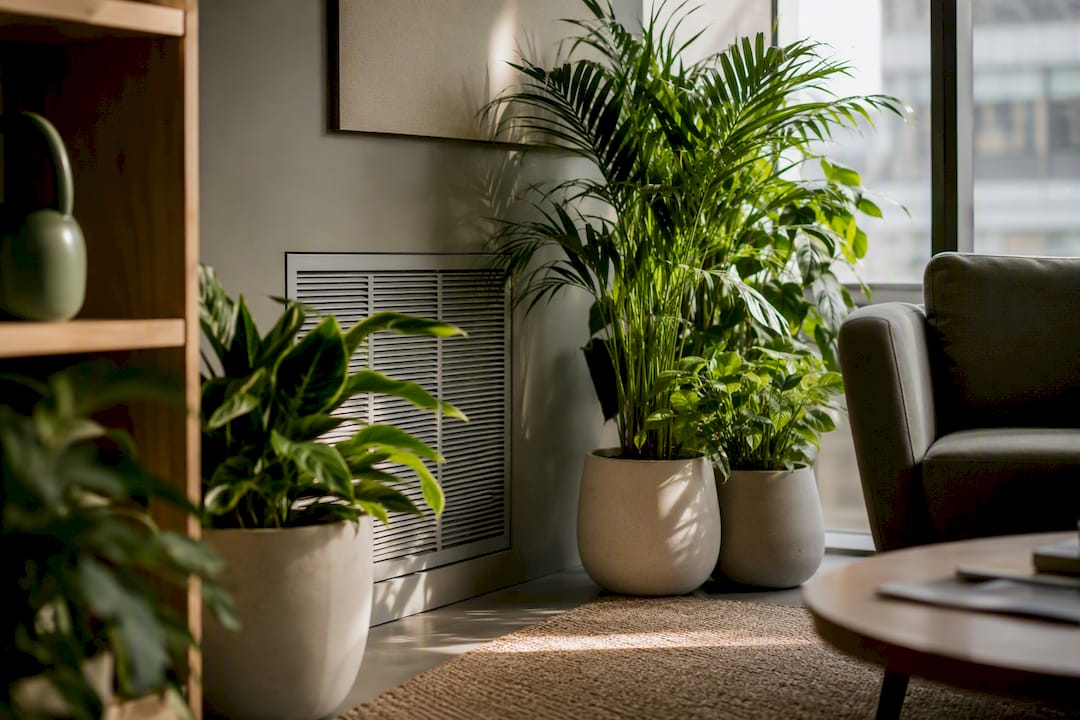
Pro Tip: If you want the biological engine to actually run, place plants where air circulates naturally, near vents or foot traffic, not tucked into dead corners where the air barely moves.
What Are the Real Benefits of Phytoremediation for a Commercial Space?
The clearest, best-documented benefit isn't a pollutant chart. It's people. Field experiments on office greenery consistently find that employees in planted spaces report higher satisfaction, better concentration, and fewer health complaints compared to plant-free offices, and that pattern shows up in studies on office greenery and workplace productivity as well.
On the pollutant side, the picture is more specific than "plants clean the air." Office studies using potted-plant microcosms found:
- TVOC reductions of 50 to 75 percent once the plant system was "induced," meaning concentrations exceeded a threshold that triggered a stronger biological response.
- Real-world results that vary with plant density, species, and how well the system is maintained.
There's a third benefit that gets underrated: the managerial-care signal. Visible, well-tended greenery tells employees and customers that someone cares about the space they're in, and that perception alone moves satisfaction scores independent of any pollutant measurement.
Where Does Phytoremediation Fall Short?
Plants are a supplement, not a substitute for ventilation. That's the single most important limitation to understand before you build a proposal or a budget around greenery. Comparisons of sealed versus naturally ventilated rooms show that ventilation reduces PM2.5 and TVOCs far more dramatically than any plant density realistically achievable indoors. Plants help at the margins; they don't outrun pollutant generation in a sealed, high-activity room.
A few dependencies determine whether you'll see any effect at all:
- Ventilation quality. Plants layered onto poor airflow underperform no matter how many you add.
- Plant-to-space ratio. A handful of desk plants in an open floor plan won't move measurable air chemistry.
- Pollutant load. Rooms with heavy printer use, new furniture off-gassing, or high occupancy generate faster than a passive plant system can process.
- Maintenance consistency. Neglected plants with dusty leaves and dry soil biology stop functioning as biofilters.
Set your expectations and your pilot metrics accordingly. A useful pilot runs long enough for biological induction to occur, generally four to eight weeks, and tracks TVOC, PM2.5, and CO2 alongside a simple staff survey on perceived air quality.
Which Plants and Design Choices Work Best for Offices?
Design decisions determine whether you get a wall of decoration or a functioning biofilter. Start with the format question:
- Choose green walls for high-impact, high-traffic zones where air can be moved mechanically across a dense root system, maximizing the contact area that drives VOC biodegradation.
- Choose floor specimens for flexible, lower-density coverage, especially in spaces where a wall system isn't structurally or budget feasible.
- Prioritize leaf area and root health over species novelty. A plant with dense, broad foliage and an active root zone outperforms a sparse, exotic option that looks better in a catalog than it functions in a lobby.
- Pick durable, low-drama species for commercial settings: pothos, snake plant, and peace lily show up repeatedly in office plantscaping because they tolerate inconsistent light and irregular watering without collapsing.
- Place for airflow and daylight, near return-air vents or circulation paths, and away from corners where staff will bump or ignore them.
Institutional green wall projects, including the Smith Campus Center case study, reinforce this: species selection and system engineering matter as much as raw plant count.
Why Maintenance Determines Whether the System Keeps Working
A biofilter that isn't maintained stops being a biofilter. Dusty leaves block stomatal uptake. Compacted, dry potting mix kills off the microbial community doing the actual VOC breakdown. This is where design and rhizosphere health intersect with upkeep: the system only performs as designed when someone is actively tending it.
A realistic maintenance cadence looks like this:
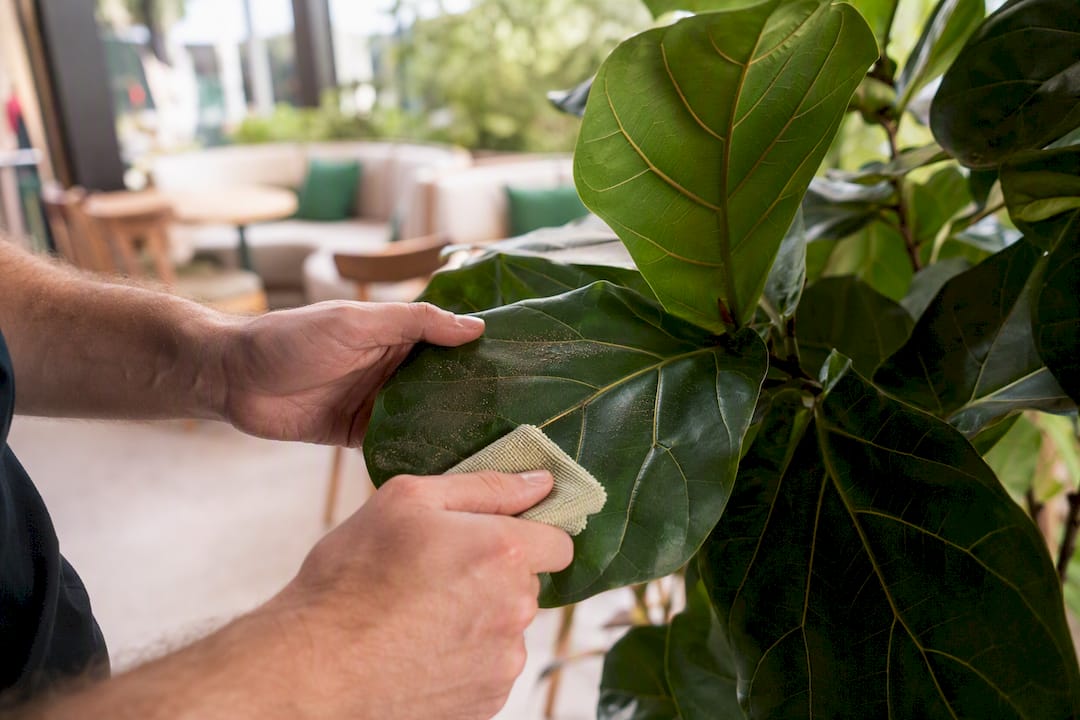
- Weekly: watering checks, pest scans, leaf wiping in high-traffic zones.
- Biweekly to monthly: soil health assessment, pruning, fertilization, and rotation for even light exposure.
- As needed: plant replacement when a specimen declines beyond recovery.
This is precisely what Greenspace+ delivers as one fixed monthly service: design, installation, scheduled maintenance, plant replacement, and a healthy-plant guarantee, with no upfront cost or long-term commitment. Professional design also matters more than most people expect. A trained plantscaper places specimens to maximize surface area and airflow contact, something a DIY office plant purchase rarely achieves by accident.
Pro Tip: If your plants have gone more than two weeks without a leaf wipe, don't assume they're "fine because they're green." A dusty leaf can't do its job.
How Do You Plan and Pilot a Plantscaping Program?
Start small, measure honestly, then scale what works.
- Assess your baseline. Identify pollutant risks (printer rooms, new furniture, high occupancy) and check your ventilation system before adding a single plant.
- Run a four-to-eight-week pilot. Pick one room, set simple metrics (TVOC, PM2.5, CO2, staff survey), choose species and density, install, and monitor.
- Interpret and decide. If results look promising, increase density or upgrade to an engineered biofilter. If not, focus resources on ventilation first.
- Loop in your team. Frame the pilot as part of a wellness or sustainability initiative, not just a decor update, so staff understand what's being tested and why.
What Ten Years of Plant Proposals Taught Me About This Question
Every proposal that oversells "air-purifying plants" as a ventilation replacement eventually disappoints the client. The projects that actually deliver on wellbeing are the ones treating plants as a supplement, layered onto good airflow, with someone accountable for maintenance. That's the pattern across most successful commercial installs: less about picking the "best" species, more about consistent upkeep and realistic framing from day one. Pilot it. Measure it honestly. Then decide.
Get a Working Biofilter, Not Just Decoration
Reading about rhizosphere microbes and induced TVOC reduction is one thing. Installing and maintaining a system that actually performs that way is another, and it's where most DIY plant purchases quietly fail. Greenspace+ removes that gap for a fixed monthly fee covering design, installation, scheduled maintenance, plant replacement, and a healthy-plant guarantee, with no upfront cost and no long-term lock-in.
If you manage an office, restaurant, or retail floor and want plantscaping that's engineered for airflow and light rather than dropped in wherever there's floor space, that's exactly what interior plant design built for commercial spaces is built to solve. Browse the Greenspace client look-book for real installs, or request a pilot proposal for one room and see what a properly designed system looks like before committing to anything larger.
Frequently Asked Questions
What does phytoremediation mean in an office setting? It means using plants as living biofilters, positioned and maintained to reduce some indoor pollutants, support employee wellbeing, and improve the appearance of the space. It's a supplement to good ventilation, not a replacement for it.
How does phytoremediation work indoors? Leaves absorb certain gases and particulates through stomatal pores, transpiration pulls air across the plant, and microbes in the potting mix's root zone break down absorbed VOCs. Surface area and airflow control how strong the effect is.
Is phytoremediation effective in a typical office? It's measurably effective under the right conditions: adequate light, airflow, sufficient plant density, and consistent maintenance. In sealed, high-activity rooms with poor ventilation, the effect is limited no matter how many plants you add.
What plants are used in phytoremediation for commercial interiors? Durable, high-leaf-area species like pothos, snake plant, and peace lily are common choices because they tolerate variable light and irregular care while maintaining active root zones.
How long does a phytoremediation pilot need to run? Plan for four to eight weeks. That's roughly how long it takes for the biological system to acclimate and show an induced reduction response in TVOC and related measurements.
Sources
The claims in this guide draw on peer-reviewed research and field studies rather than marketing copy, and each one covers a different piece of the picture.
Frontiers in Psychology field evidence documents the wellbeing and satisfaction gains reported by employees in green offices versus plant-free ones.
Clean Technologies and Environmental Policy explains the engineering behind botanical biofilters and green walls, and why maintenance and rhizosphere health drive real-world performance.
Evaluation of plant-based indoor air purification in urban environments grounds the ventilation-first argument with direct comparisons between sealed and naturally ventilated rooms.
The potted-plant microcosm office field study supplies the specific TVOC reduction figures and the pilot-duration guidance used throughout this article.
- Frontiers in Psychology (field evidence on green offices)
- Clean Technologies and Environmental Policy (biofilter/green wall mechanisms)
- Potted-plant microcosm office field study (urban garden PDF)