
Yes, indoor plants can support specific LEED credit intents, but only when they're integrated into a documented biophilic or indoor environmental quality strategy that includes the right species, monitored performance, and a maintenance contract behind it. Plants alone earn no points on a scorecard. Paired with measurable objectives and ongoing upkeep, they become legitimate evidence for occupant experience and air quality credits.
TL;DR:
- Indoor plants can support LEED credits only when integrated into a documented biophilic strategy with measurable performance data and ongoing maintenance.
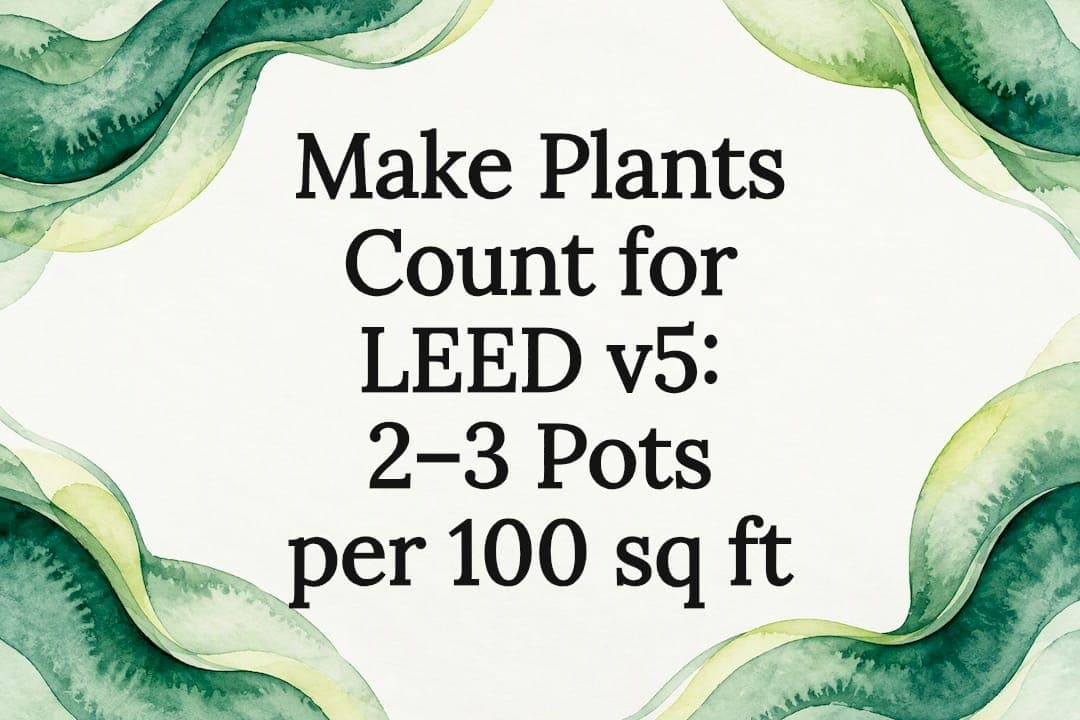
- The most effective species for indoor air quality are pothos, spider plants, and Cordyline, with typically 2 to 3 plants per 100 square feet in occupied spaces.
- Proper lighting, watering, and rotation are essential for plants to deliver measurable benefits, with documentation including baseline and post-installation testing.
- Maintenance contracts must specify regular care, health monitoring, and replacement guarantees to be accepted as credible evidence by reviewers.
- Plants serve as a supplement to, not a replacement for, mechanical ventilation and filtration in achieving indoor air quality improvements.
Table of Contents
- Which LEED credits can indoor plants actually support?
- Which plants actually work, and how many do you need?
- What documentation do LEED reviewers actually want to see?
- What plants can and can't do for indoor air quality
- What project teams get wrong about plants in LEED submittals
- How Greenspace+ keeps your plant strategy LEED-ready
- FAQ
- Sources
Which LEED credits can indoor plants actually support?
Project teams often ask where plants fit on the LEED v5 scorecard, and the honest answer is: nowhere directly, but in several supporting roles. The LEED v5 BD+C rating system structures its Indoor Environmental Quality category around credits like enhanced air quality, occupant experience, and required performance monitoring and testing, and plant strategies can feed evidence into each of these rather than standing as a credit of their own.
The clearest path runs through an integrative or innovation credit, where a documented biophilic design plan, backed by occupant surveys and IAQ test data, builds the case for points tied to occupant wellbeing. A second path runs through enhanced air quality credits, where plant-driven CO2 or particulate reductions supplement mechanical ventilation data rather than replace it. Where habitat or sustainable sites credits reference native or adapted species, reviewers expect a defensible species list tied to regional plant databases, not a generic plant order.
Whichever route a team chooses, reviewers want to see:
- A written performance narrative explaining the intent and the plant strategy behind it.
- Baseline and post-installation monitoring data, not just a design rendering.
- A species list with rationale, including native or adapted options where credits require them.
- Signage or occupant communication where a credit, such as pollinator habitat, calls for public-facing documentation.
A design plan without test data reads as decoration. A design plan with CO2 readings, photo logs, and a signed maintenance contract reads as strong evidence.
Which plants actually work, and how many do you need?
Species selection matters more than most design briefs admit. Four plants come up again and again in field and lab research, and each brings something slightly different to the table.
Epipremnum aureum (Golden Pothos) is the workhorse. A field crossover study placing 30 pothos plants in a 1,765 square foot office recorded mean CO2 at 912 parts per million against 1,343 parts per million in an unplanted control space, along with a parallel drop in fine particulate matter. It tolerates low light and irregular watering, which makes it forgiving in commercial settings where nobody's job is to babysit a planter.
Chlorophytum comosum (Spider plant) performs reliably in the same phytoremediation research and handles office HVAC swings without much drama, making it a sound companion species for density targets.
Syngonium podophyllum and Cordyline fruticosa showed up as standouts in a comparative phytoremediation study published in Scientific Reports, with Cordyline fruticosa reaching removal rates as high as 87.5% for some volatile organic compounds under experimental conditions. Species performance varied by contaminant, so no single plant is the answer for every pollutant profile.
For density, the field study's ratio works out to roughly one pothos per 59 square feet, which translates into a practical planning rule for smaller offices.
- Start with 2 to 3 medium pots per 100 square feet in general office areas.
- Scale up near known pollutant sources: printer stations, kitchenettes, and entries where outdoor air infiltrates.
- Treat living wall or green wall square footage as a separate calculation tied to the wall's own ventilation and lighting design, not the room's floor area.
- Place plants at sightlines from desks and meeting rooms, since visual access to greenery is what occupant experience credits are really measuring.
Lighting and irrigation design can't be an afterthought. Our guide to commercial plant installation workflows walks through how design and lighting decisions happen before a single pot ships.
Pro Tip: Rotate phototropic species like Cordyline a quarter turn every few weeks so growth stays even instead of leaning toward the nearest window.

What documentation do LEED reviewers actually want to see?
Reviewers don't take a designer's word that plants are improving air quality. They want a paper trail, and that trail starts with the maintenance contract, not the planting plan.
A credible maintenance agreement spells out visit frequency, who's responsible for pest management, what counts as declining plant health, and what happens when a plant doesn't recover: a replacement guarantee, stated plainly, not implied. USGBC's living wall and biophilic design guidance makes the point directly: poorly maintained plants can erase whatever benefit the design intended, so maintenance isn't a nice-to-have attached to the credit narrative, it's the thing that keeps the narrative true over time.
Beyond the contract, a defensible submittal typically includes:
- Baseline IAQ readings taken before installation.
- Post-installation testing for CO2, particulate matter, and any targeted VOCs the project flagged as relevant.
- Periodic photo logs showing plant health and placement over time.
- Replacement records tied to the maintenance guarantee.
One field study found offices with 30 pothos plants in a 1,765 square foot space recorded mean PM2.5 at 6.8 µg/m³ compared to 9.5 µg/m³ in an unplanted control, a statistically significant difference documented in a 2025 crossover study. That kind of before-and-after number is exactly what turns a biophilic design plan into usable evidence rather than a mood board.
This is where a turnkey monthly service earns its place in the documentation chain: design, installation, scheduled maintenance, and replacement all run through one accountable contract instead of being split across a designer, a vendor, and whoever waters the ficus on Fridays.
What plants can and can't do for indoor air quality
Plants deliver real, measurable benefits under the right conditions, and it's worth being precise about what those conditions are. The same crossover study behind the CO2 and PM2.5 figures above also found that outcomes depend heavily on light exposure, watering consistency, plant health, and the density of plants relative to room volume. A handful of stressed, underwatered pothos in a dim corner won't reproduce lab results.
Volatile organic compound removal is the trickiest claim to make with confidence. Chamber studies, including the Scientific Reports phytoremediation research, show meaningful VOC reduction under controlled conditions, but field performance tends to be more variable because real rooms have more air exchange, more pollutant sources, and less consistent plant care than a sealed test chamber.
A few operational realities worth building into any plan:
- Plants supplement mechanical ventilation and filtration; they don't replace it, and a submittal that implies otherwise invites scrutiny.
- Declining plant health from poor light or inconsistent watering can undercut the very IAQ narrative the design was built to support.
- Living wall systems integrated into mechanical air handling behave differently from potted plants and need their own engineering documentation rather than borrowing a potted-plant performance narrative.
Treat plants as one input among several, not the whole strategy.
What project teams get wrong about plants in LEED submittals
After years of installing and maintaining plantscapes for commercial clients, the mistake we see most often isn't picking the wrong species. It's picking the right species and then treating maintenance as an afterthought that gets negotiated after the design is already approved.

The projects that hold up under LEED review share a pattern: maintenance gets contracted during design, not after installation, lighting gets specified with the plants' needs in mind rather than the architect's preference alone, and someone commits to photographing and testing the space at intervals instead of once at ribbon-cutting. Seasonal swaps matter too. A Cordyline that thrives through spring installation can struggle by autumn if nobody planned for a rotation.
The gap between a biophilic rendering and a biophilic credit is almost always maintenance discipline, not plant selection.
— Nicole
How Greenspace+ keeps your plant strategy LEED-ready
We offer an all-inclusive plant program built around the needs of LEED documentation: design, installation, scheduled maintenance, and a healthy plant guarantee, all under a fixed monthly fee with no upfront cost and no long-term commitment locking you in.
That structure matters because the biggest risk to a plant-based IEQ narrative isn't the initial design, it's what happens eighteen months in when nobody's tracking plant health or logging photos anymore, highlighting the importance of creating a sustainable waste management strategy for your workplace. We handle that ongoing piece directly:
- Design and installation planned around your lighting and layout, not a generic template.
- Scheduled maintenance visits with pest management and plant health checks built in.
- A replacement guarantee so a struggling plant becomes a swapped plant, not a gap in your documentation.
- Ongoing records your team can pull into a performance narrative without chasing down a maintenance vendor separately.
If you're mapping out a biophilic strategy for an upcoming certification, our indoor plant design team can talk through species, density, and maintenance scope before you finalize the submittal.
FAQ
What is the LEED green building system?
LEED, or Leadership in Energy and Environmental Design, is a certification system developed by the U.S. Green Building Council that rates buildings on categories including energy use, water efficiency, materials, and indoor environmental quality. Projects earn points across these categories and qualify for certification levels based on their total score.
What is indoor environmental quality?
Indoor environmental quality, or IEQ, covers the conditions inside a building that affect occupant health and comfort, including air quality, lighting, acoustics, and thermal comfort. Within LEED, IEQ credits address enhanced air quality, monitoring and testing, and occupant experience, which is where biophilic and plant strategies most often contribute supporting evidence.
What is the LEED framework?
The LEED framework is a point-based rating structure covering categories like sustainable sites, water efficiency, energy, materials, and indoor environmental quality, with credits earned for specific design and performance choices. Teams document their strategies and submit evidence, such as monitoring data or performance narratives, for review before certification is awarded.
What is LEED Platinum certification?
LEED Platinum is the highest of the four certification tiers in the LEED system, awarded to projects that accumulate the most points across all rating categories. Reaching that tier typically requires a combination of strong performance in energy, water, and indoor environmental quality categories, often supported by integrative design strategies and thorough monitoring documentation.
Can indoor plants replace HVAC filtration for air quality credits?
No. Field research shows plants can meaningfully reduce CO2 and particulate levels under the right density and care conditions, but mechanical ventilation and filtration remain the primary systems that LEED air quality credits are built around. Plant strategies work best as a documented supplement, not a substitute.
Sources
- LEED v5 BD+C rating system (USGBC)
- The Impact of Plants on Indoor Air Quality and Health Effects (field crossover study)
- Comparative evaluation of air phytoremediation potential of four ornamental potted plants (Scientific Reports, 2025)