

A commercial spring refresh is a professional, species-specific service visit that restores photosynthesis and brand presentation through leaf-by-leaf cleaning, diagnostic health assessments, tailored watering adjustments, and targeted pruning or repotting. Your immediate next step: schedule a diagnostic spring visit with photo documentation and a written scope of work before peak growing season. Providers like Greenspace Plants deliver this as a structured program, and industry seasonal-care guidance consistently frames spring maintenance as proactive environmental adjustment, not a reactive fix.
Table of Contents
- What does a spring refresh checklist look like for commercial plantscapes?
- How do professionals assess plant health and adjust watering in spring?
- How should you manage light and HVAC changes as winter turns to spring?
- When should you prune, repot, or replace a plant?
- What should your spring-refresh contract actually include?
- How long does a spring refresh take, and what drives the cost?
- What tools and products should your technician bring on-site?
- How should you prepare your site before the technician arrives?
- Key Takeaways
- Why the "just water it more in spring" mindset costs you more than you think
- Useful sources for further reference
- Greenspace Plants handles your spring refresh, start to finish
What does a spring refresh checklist look like for commercial plantscapes?
A well-run spring visit covers far more than watering. Here is what your technician should work through, and what you should require in the scope of work.
- Leaf-by-leaf cleaning: Technicians wipe each leaf with microfiber cloths or soft brushes to remove dust that blocks light absorption and photosynthesis. Compressed air or gentle misting may supplement hand-wiping for dense foliage.
- Plant-by-plant health inspection: Visual check of leaf color, turgor, and stem integrity. Yellowing, wilting, or leggy growth each signal different problems and require different responses.
- Pest scouting: Technicians inspect leaf undersides for spider mites, thrips, and scale. Pests that remained dormant in winter can expand rapidly once HVAC cycles shift and ventilation increases in spring.
- Soil moisture and hydrophobicity check: Surface soil in decorative containers can become hydrophobic, repelling water before it reaches the root ball. Technicians probe moisture at multiple depths, not just the surface.
- Root-bound indicators: Roots circling the container base, cracking the pot, or emerging from drainage holes signal a repotting need.
- Pruning and grooming: Dead, damaged, or overgrown growth is removed, with extra attention to lobby displays, reception desks, and dining patios where visual standards are highest.
- Documentation deliverables: Before/after photos, a written diagnostic report, and a recommended follow-up schedule should be standard outputs of every spring visit.
Pro Tip: Ask your provider for a diagnostic moisture map and a written replacement SLA before signing the scope. If they cannot produce either, that is a signal to keep looking.
How do professionals assess plant health and adjust watering in spring?
Professionals run plant-by-plant diagnostics using moisture probes, root checks, and leaf inspection, then build species-specific watering and fertilizer schedules rather than applying a single routine across the floor. One-size-fits-all watering is the leading cause of plant failure in corporate settings, and spring is when that gap becomes most visible.
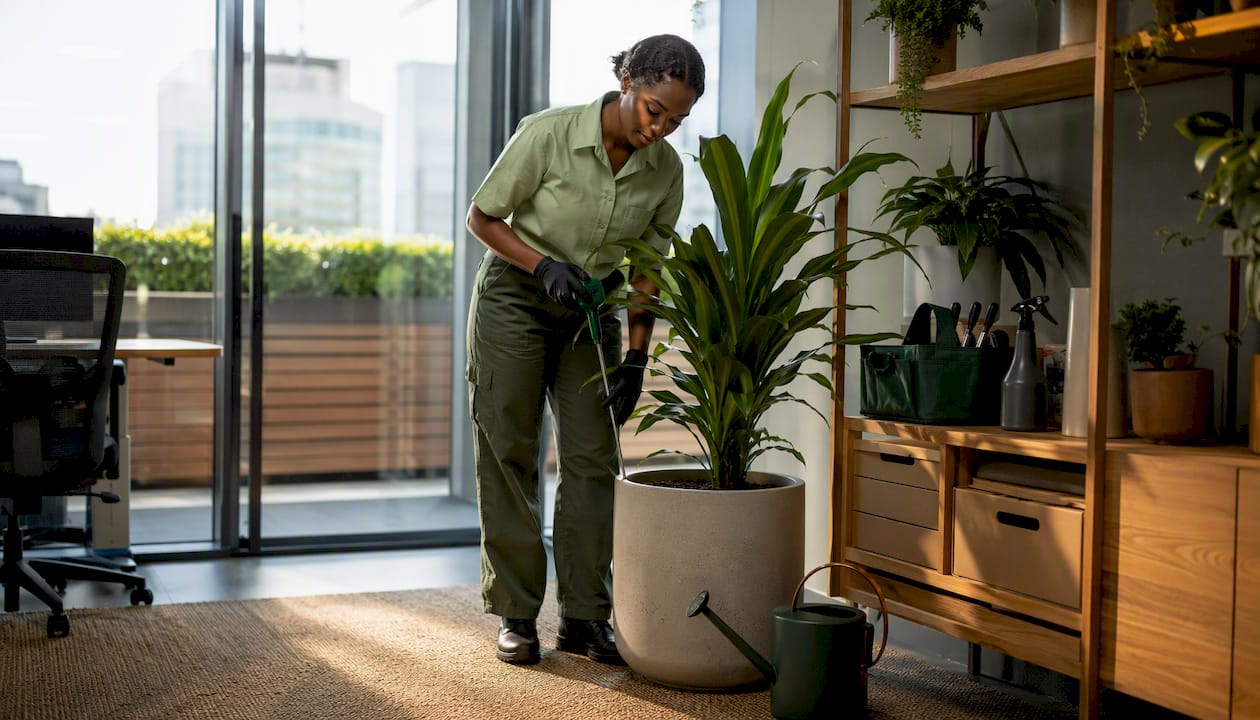
On-site, a technician will probe soil moisture at root depth, not just the surface. They check leaf turgor (a wilted leaf on moist soil points to root rot; a wilted leaf on dry soil is straightforward dehydration). Root checks reveal whether the plant is drawing water effectively or sitting in compacted, hydrophobic media.
Surface hydrophobicity deserves special attention. Decorative containers without drainage often develop a hardened top layer that sheds water rather than absorbing it. Technicians use aeration tools to break this layer and may apply a rewetting agent to restore water penetration to the root ball. Buyers should require this step explicitly in the scope.
Pro Tip: Require your provider to record baseline moisture probe readings and deliver a species-specific watering frequency plan as a written document, not a verbal summary.
How should you manage light and HVAC changes as winter turns to spring?
Spring requires proactive placement and shading adjustments because cleaned windows and changed HVAC cycles cause sudden light and humidity shifts that can stress plants overnight. Monitoring HVAC cycles and daylight shifts is a core part of professional spring visits, not an optional extra.
Environmental changes to monitor include:
- Increased daylight and glare after post-winter window cleaning, which can scorch shade-adapted plants placed near glass
- Cooling cycle activation, which lowers humidity and increases air movement, stressing moisture-sensitive species like ferns and peace lilies
- Heating shutdowns, which can cause temperature swings near exterior walls and HVAC vents
- Phototropic lean, where plants have grown toward winter light sources and now face a different angle of incidence
A practical example: a Boston fern positioned near a north-facing window in January may be sitting in direct afternoon glare by April after the building's exterior glass is cleaned. Moving it two feet back, adding a sheer screen, or rotating it 90 degrees are all low-cost corrections a technician can execute in minutes.
Coordinate any fixture or shading changes with your facilities team before the visit. Shading panels near fire suppression heads or emergency signage can create code conflicts, and sight-line adjustments in lobbies may need sign-off from building management.
When should you prune, repot, or replace a plant?
Prune when growth is cosmetic or interfering with function. Repot when the plant is root-bound or the soil is hydrophobic and unresponsive to aeration. Replace when chronic decline persists despite documented corrective attempts.
These are not judgment calls left to the technician's discretion. They should be written into your contract as objective criteria:
- Prune when dead or damaged foliage exceeds 20% of the canopy, or when growth obstructs signage, walkways, or sightlines in client-facing areas.
- Repot when roots circle the container base, emerge from drainage holes, or when soil aeration fails to restore water penetration after two consecutive visits.
- Replace when a plant shows persistent yellowing, repeated pest reinfestation, or visible structural decline after corrective care is documented in the diagnostic report.
Require your provider to include a photo-based decision log for every repotting or replacement recommendation. That log protects both parties and gives you a clear audit trail.
What should your spring-refresh contract actually include?
A spring-refresh scope should cover diagnostic inspection, leaf cleaning, targeted treatment, full documentation, and a clear replacement SLA. Industry guidance consistently recommends specifying replacement windows and scheduled monitoring to protect high-visibility areas.
Scope items to require:
- Species-by-species diagnostic report with moisture probe readings
- Leaf-by-leaf cleaning with product names and MSDS on file
- Soil aeration and rewetting treatment where hydrophobicity is detected
- Pest scouting with Integrated Pest Management protocol documented
- Before/after photo gallery delivered within 48 hours of the visit
- Written replacement window (7–14 days) for plants that do not respond to corrective care
- Scheduled follow-up visit date confirmed in writing
Trust signals to ask for before signing:
- Technician horticultural training or certification
- Proof of general liability insurance and worker's compensation
- MSDS sheets for all cleaning agents and pest treatments used on-site
- A portfolio or before/after gallery from comparable commercial accounts
Red flags to watch for:
- Vague replacement language ("we will replace as needed") with no defined timeline
- No documentation requirement in the contract
- Undefined chemical usage or no non-toxic product option for public-facing spaces
- No follow-up visit scheduled after the initial refresh
How long does a spring refresh take, and what drives the cost?
A one-time spring refresh for a medium commercial site typically completes in a single visit of 2–8 hours, but total cost varies by scope, plant count, labor skill level, replacement items, and disposal fees. Requesting a line-item estimate upfront is the single most effective way to avoid surprises.
| Cost Factor | What Drives It |
|---|---|
| Labor | Technician count, hourly rate, and visit duration based on plant inventory size |
| Materials | Replacement plants, fresh soil, soil amendments, and repotting supplies |
| Disposal | Green-waste removal fees for replaced plants, old soil, and damaged containers |
| Travel and staging | Distance to site, parking, elevator access, and equipment transport |
| Follow-up visits | Frequency tier (weekly for lobbies, bi-weekly for back-office) and contract length |
High-visibility spaces like reception and client-facing areas often require more frequent attention than back-office zones, which affects both the initial refresh scope and ongoing maintenance pricing. Living walls and moss walls typically require weekly monitoring and carry a separate line item.
Budgeting tip: Request a guaranteed replacement window in writing and confirm that replacement plant costs are included in the quoted scope, not billed separately after the visit.
What tools and products should your technician bring on-site?
Professionals arrive with a compact, purpose-built kit: moisture probes, aeration tools, soft brushes and microfiber cloths for leaf cleaning, hand pruners, soil amendment supplies, and labeled product MSDS sheets available on request. The right equipment signals a trained technician, not a generalist.
- Moisture probes: Record readings at root depth for each plant, not just surface feel.
- Aeration tools: Thin rods or specialized picks to break hydrophobic soil layers without damaging roots.
- Soft brushes and microfiber cloths: For leaf-by-leaf cleaning without scratching waxy or delicate leaf surfaces.
- Hand pruners and snips: Clean, sterilized between plants to prevent cross-contamination of fungal or bacterial issues.
- Soil amendments: Perlite, worm castings, or slow-release fertilizer pellets appropriate to species.
- PPE: Gloves, eye protection, and closed-toe footwear as standard.
This matters most in restaurants, medical offices, and retail environments where guests and staff are in close proximity to treated plants throughout the day.
How should you prepare your site before the technician arrives?
Simple site prep speeds service and protects brand presentation. Clearing work areas, confirming access, and flagging high-visibility zones before the technician arrives can cut visit time and prevent disruptions to your team or guests.
Pre-visit checklist:
- Confirm building access, parking, and elevator availability for equipment transport
- Identify client-facing displays (lobby, reception, dining patio) and mark them as priority zones
- Label any plants with known issues or recent changes in care
- Allocate a staging area for replacement plants, removed soil, and tools
- Notify front-desk staff, dining room managers, or security about the visit window
- Confirm electrical or irrigation shutoffs if the technician will be working near water features or grow lights
- Request the provider's green-waste disposal plan and confirm whether disposal fees are included in the quoted scope
Key Takeaways
A professional commercial spring refresh protects brand presentation and plant health through diagnostic inspection, leaf-by-leaf cleaning, species-specific watering adjustments, and a written replacement SLA.
| Point | Details |
|---|---|
| Book a diagnostic spring visit | Schedule before peak growing season; require photo documentation and a written scope. |
| Require leaf-by-leaf cleaning | Dust blocks photosynthesis; specify this task and the cleaning products in the contract. |
| Insist on species-specific watering | One-size-fits-all routines cause plant failure; require moisture probe records and a written plan. |
| Include a 7–14 day replacement SLA | Protects high-visibility areas from visible decline after corrective care is documented. |
| Greenspace Plants | Delivers full-service spring refreshes with diagnostic reports, photo documentation, and a healthy plant guarantee. |
Why the "just water it more in spring" mindset costs you more than you think
The most common mistake we see in commercial spaces is treating spring as a volume problem. More water, more fertilizer, more light. The plants look a little tired after winter, so the instinct is to push harder. It rarely works, and it often accelerates decline.
What actually turns a plantscape around in spring is precision, not intensity. A fern that looks wilted after a window cleaning is not thirsty. It is stressed by sudden glare. A ZZ plant with yellowing lower leaves after a fertilizer boost is not nutrient-deficient. It is likely overwatered. The diagnostic step, the one most facilities teams skip when they manage plants in-house, is what separates a recovery from a replacement order.
We have walked into lobbies in March where a single 90-minute visit, leaf cleaning, one repot, two plant rotations, and a soil aeration, transformed the space from "something is off" to "this looks intentional." That is not a dramatic intervention. It is just the right sequence, applied at the right time.
The lesson for buyers: the spring refresh is not about doing more. It is about doing the right things in the right order, with documentation that proves it happened.
Useful sources for further reference
These resources informed the guidance in this article and are worth bookmarking for contracting, scheduling, and technical questions.
- Professional Interior Plant Care Services for Commercial Spaces (Growing Roots) — covers plant selection, placement, and what a professional interior plant program includes for property managers and facility teams.
- Seasonal Plant Care Checklist for Business Owners (The Wright Gardner) — explains proactive environmental adjustment for HVAC and daylight shifts as the basis for spring visits.
- A Complete Guide to Office Plant Maintenance Services (Natura) — details diagnostic health assessments and species-specific watering as standard service components.
- Corporate Plant Services: What to Include in Your Contract (Natura) — practical contract language for replacement windows, SLAs, and scheduled follow-up visits.
- Professional Interior Plant Care (Amlings Interior) — covers leaf cleaning, pest scouting, soil aeration, and hydrophobicity treatment in commercial settings.
- How Managed Plant Service Works for Commercial Spaces (Greenspace Plants) — explains SLAs, replacement guarantees, and what to expect from an ongoing maintenance program.
- Seasonal Plants in Buildings: A Facilities Manager's Guide (Greenspace Plants) — guidance on why seasonal programs protect design intent and brand presentation in high-visibility areas.
Greenspace Plants handles your spring refresh, start to finish
If you manage a commercial space and the spring refresh checklist above feels like a full project on top of an already full plate, that is exactly the problem Greenspace Plants was built to solve. Our Greenspace+ program covers design, installation, ongoing plant care and maintenance, and guaranteed plant replacements for a fixed monthly fee, with no upfront costs and no long-term lock-in.
Every spring visit includes the diagnostic inspection, leaf-by-leaf cleaning, species-specific watering adjustments, and photo documentation described in this guide. You get a written scope, before/after photos, and a replacement SLA built into the program, not negotiated separately. Whether you manage a corporate lobby, a restaurant patio, or a multi-tenant property, our indoor plant rental program means your plantscape stays presentation-ready through every seasonal shift. Contact Greenspace Plants to schedule your spring diagnostic visit.