

Plant wellness ROI is the measurable financial return a workplace gets when indoor plants improve productivity, cut absenteeism, and reduce facility-related costs. It's the dollar figure behind what your team already senses intuitively: that a room full of greenery just feels better to work in. Studies on biophilic office design have found productivity gains ranging from single digits up to the mid-teens percentage range, though the exact number depends heavily on your industry, layout, and how well the plants are maintained. Two ideas explain why this happens: Attention Restoration Theory, which holds that natural elements help tired brains recover focus, and Stress Reduction Theory, which links plant exposure to lower physiological stress markers. If you manage an office, restaurant, or retail space, the smartest next move isn't a guess. It's a small pilot, tracked against baseline numbers, using a simple ROI formula (we'll walk through one below). At Greenspace Plants, we've watched enough of these pilots play out to know the pattern: the number that convinces a CFO is rarely the one that convinces an office manager, and you'll want both.
Key Takeaways
Plant wellness ROI works best when a short, measured pilot replaces guesswork with real productivity, absenteeism, and satisfaction data specific to your workplace.
| Point | Details |
|---|---|
| Start with a pilot | Test one department for 8 to 16 weeks before committing to a full rollout. |
| Track the easy wins first | Productivity and sick-day data convert to dollars faster than retention or brand impressions. |
| Placement beats plant count | Position greenery in active work zones and transition areas, not just lobbies. |
| Maintenance protects your ROI | A declining plant erases the benefits you paid for and costs more to replace than maintain. |
| Consider Greenspace+ for low-risk testing | Greenspace Plants offers an all-inclusive subscription with no upfront cost, a healthy plant guarantee, and scheduled maintenance built into the pilot process. |
Table of Contents
- What Is a Plant Wellness ROI Made Of? The Measurable Business Outcomes
- How Do Plants Actually Produce These Results?
- How to Calculate Your Plant Wellness ROI
- What Does the Research Actually Show?
- Where Should You Place Plants for the Biggest Return?
- Rental, Subscription, or Purchase: Which Service Model Protects Your ROI?
- How Do You Run a Pilot to Prove ROI in Your Own Space?
- What Objections Should You Expect, and How Do You Answer Them?
- Should You Start With a Pilot or Go Straight to a Full Program?
- Ready to See What Plants Could Do for Your Workplace?
- Sources
What Is a Plant Wellness ROI Made Of? The Measurable Business Outcomes
Plant wellness ROI isn't one metric. It's a bundle of outcomes that, together, justify the line item on a facilities budget. Some translate to dollars easily. Others matter just as much but resist a clean spreadsheet formula.
- Productivity gains. Cognitive performance and self-reported output improve when workers have visual access to plants, particularly for attention-heavy tasks.
- Reduced absenteeism. Fewer sick days correlate with better indoor environments, though this outcome typically takes longer to show up than productivity does.
- Fewer minor health complaints. Field research has tied indoor plants to lower rates of headaches, fatigue, and eye irritation, with one study reporting reductions in the 20 to 25% range for these complaints.
- Better retention. Employees who report higher satisfaction with their physical workspace tend to stay longer, which lowers the hard cost of turnover and rehiring.
- Stronger client impressions. A well-planted lobby or reception area changes how long visitors linger and how they perceive the business before a meeting even starts.
- Lower perceived noise. Dense foliage placed strategically can soften the sense of a busy, echoing office, which matters in open floor plans.
Statistic callout: A field study across nine organizations found that introducing plants produced clear, fast improvements in complaints about dry air, sense of privacy, and workspace attractiveness, some of the most immediate outcomes tracked in office greening research. Longer-term outcomes like job satisfaction and sustained health improvements took more time to surface, which matters when you're deciding how long to run your own pilot.
Productivity and absenteeism are the two outcomes finance teams tend to trust, because both convert into a dollar figure using numbers you already track: salary, output per employee, and sick-day counts. Retention and client impressions are real, but they're squishier. You'll want to treat them as supporting evidence rather than the backbone of your ROI case.
How Do Plants Actually Produce These Results?
None of this happens by magic. Four distinct pathways explain how a plant on a desk turns into a measurable business outcome.
The psychological pathway is the best documented. Attention Restoration Theory argues that directed attention, the kind used for spreadsheets, emails, and meetings, wears down over the course of a day. Natural elements, even a modest fern near a monitor, give the brain a low-effort visual target that lets that attention recover. Stress Reduction Theory works alongside it: several controlled studies have recorded drops in heart rate and blood pressure after exposure to indoor greenery. One notable experiment found that just 15 minutes spent watering plants produced significant reductions in systolic and diastolic blood pressure and improved self-reported mood, a small task with an outsized physiological effect.

The environmental pathway covers air and acoustics. Certain plants have been shown to reduce volatile organic compound concentrations by 50 to 70% under specific experimental conditions, though real offices with normal airflow and fewer plants per square foot won't see numbers that dramatic. Humidity modulation and micro-noise dampening from foliage add a smaller, cumulative benefit. The operational pathway is more indirect: a workspace people find attractive is one they're more willing to stay in, both during the workday and over the span of their employment.
Placement determines how much of this potential you actually capture. A designer analysis of biophilic office layouts found that plants positioned near where people do focused, cognitively demanding work, and in transition zones like hallways or near coffee stations, produce stronger effects than the same number of plants clustered only in a lobbyclean%20version%20FINAL%20with%20tables%20and%20figures%20included.pdf).
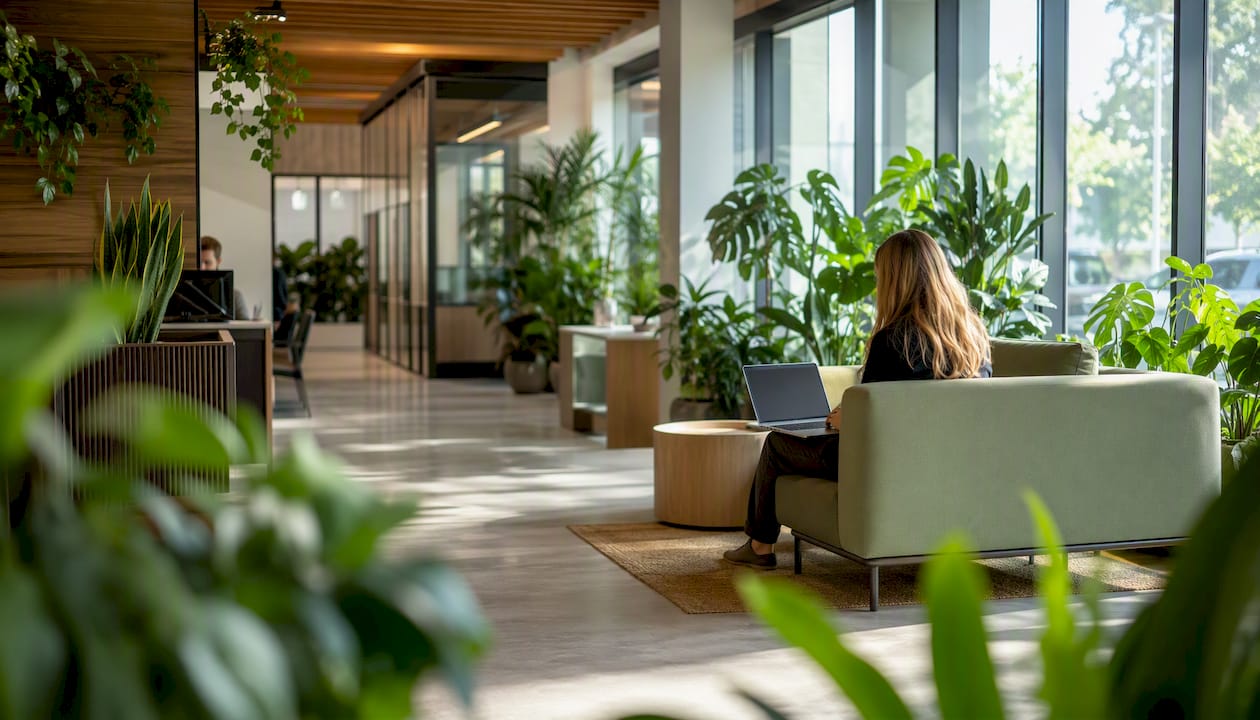
Pro Tip: Don't chase a plant count. Fifteen plants scattered near desks and walkways will outperform forty plants stacked in a single decorative corner. Density near people beats density on a floor plan.
How to Calculate Your Plant Wellness ROI
The formula itself is simple:
ROI = (Annual Net Benefit − Annual Cost) ÷ Annual Cost
The complexity lives in the inputs, not the math. Here's what feeds each side of that equation.
Benefit-side inputs:
- Productivity gain percentage (conservative estimates start around 1 to 3%; some studies report figures up to the mid-teens under favorable conditions).
- Average fully loaded salary or revenue generated per affected employee.
- Number of employees exposed to the plant intervention.
- Reduction in sick days, converted to dollars using average daily salary cost.
- Estimated value of turnover avoided, if retention improvement is part of your case.
Cost-side inputs:
- One-time costs: design, planters, and installation.
- Recurring costs: maintenance visits, plant replacement, and any subscription fee.
Step-by-step process:
- Pull your current baseline: average salary, headcount, and last year's sick-day total for the affected area.
- Choose a conservative, likely, and aggressive productivity uplift scenario, rather than betting the whole case on one number.
- Multiply the uplift percentage by total payroll cost for the affected group to get a dollar productivity gain.
- Add estimated savings from reduced sick days and, if relevant, avoided turnover cost.
- Subtract your annual plant program cost (installation amortized plus maintenance) to get net benefit.
- Divide net benefit by annual cost to get your ROI percentage, and divide annual cost by monthly net benefit to estimate payback period.
Worked example (change these numbers for your site): Say you have 40 employees at an average fully loaded cost of $70,000 each, for a total payroll base of $2,800,000. Add $4,000 in estimated sick-day savings. That's $60,000 in annual benefit.
The most sensitive input by far is the productivity percentage you choose, since it's multiplied against your entire payroll base. A small, honest pilot is how you replace that guess with a real number for your own site. Run your low scenario first when presenting to finance. If the payback still looks good at the conservative end, the case sells itself.
What Does the Research Actually Show?
The evidence for stress reduction and mood improvement is strong and consistent across dozens of studies. The evidence for long-term absenteeism and sustained productivity gains is thinner, and that gap matters when you're setting expectations internally.
A systematic review synthesizing 124 studies across hospital, eldercare, and confined environments found consistent reductions in stress and improved mood from biophilic interventions, while flagging real implementation constraints: infection control protocols, limited space, and inconsistent maintenance all reduce the benefit in practice. Separately, a broad evidence summary on nature exposure and cognitive outcomes found that short-term lab results don't always replicate cleanly in longer field studies, largely because offices are messier environments than controlled experiments.
| Outcome | Evidence Strength | What the Research Shows |
|---|---|---|
| Stress and mood improvement | Strong | Consistent across dozens of controlled and field studies, including EEG and blood pressure data |
| Short-term productivity and attention | Moderate to strong | Reasonably consistent in office field studies, though effect size varies by task and layout |
| Workspace satisfaction and attractiveness | Strong, fast-appearing | Improvements show up within weeks in field interventions |
| Long-term absenteeism | Promising but inconclusive | Fewer long-duration studies; effects likely real but harder to isolate from other factors |
| Air quality (VOC removal) | Context-dependent | Lab conditions show large reductions; typical office density won't replicate those numbers |
What this means for a business decision is straightforward: the psychological and near-term satisfaction benefits are well-supported enough to act on now. The longer-term financial outcomes, absenteeism and retention specifically, deserve a pilot with your own tracked data rather than a leap of faith based on someone else's office.
Where Should You Place Plants for the Biggest Return?
Placement decides whether your plant investment produces measurable results or just decorates an annual report photo. Four zones matter most.
- Active work zones. Desks, cubicle perimeters, and shared workstations are where attention restoration has the most to offer, since this is where cognitive fatigue accumulates fastest.
- Break and meeting areas. Plants here support the recovery half of the attention cycle, giving people a genuine mental reset between focused tasks.
- Lobbies and reception. This is where client impressions form in the first ninety seconds of a visit, and it's the zone most tied to brand perception rather than internal productivity.
- Privacy and acoustic zones. Taller, denser plants near open desks or between workstations soften sightlines and dampen the sense of being overheard.
For species, commercial spaces generally do best with durable, low-light-tolerant plants that survive inconsistent watering schedules: pothos, snake plants, and ZZ plants show up repeatedly in office plantscaping because they hold up under real-world neglect better than showier options. You can browse low-maintenance office plant options for specifics suited to different light conditions.
Pro Tip: A dying plant does more damage to your ROI than an absent one. A brown, drooping fern in a reception area signals neglect to every visitor who walks past it. If your maintenance schedule can't keep pace with your plant count, scale back the plants before you let quality slip.
Rental, Subscription, or Purchase: Which Service Model Protects Your ROI?
The way you buy and maintain plants changes your risk exposure just as much as the plants themselves do. Four models dominate the market, and each carries a different cost and risk profile.
| Model | Upfront Cost | Ongoing Cost Predictability | Maintenance Risk | Replacement Guarantee | Best Fit |
|---|---|---|---|---|---|
| All-inclusive subscription | None to low | High, fixed monthly fee | Low, professionally managed | Usually included | Busy offices without in-house plant expertise |
| One-time purchase, internal care | High | Low, unpredictable replacement costs | High, depends on staff attention | Rarely included | Teams with a dedicated, knowledgeable staffer |
| Third-party rental with maintenance | Low to moderate | Moderate | Low to moderate | Sometimes included | Businesses wanting flexibility without ownership |
| Hybrid (purchase plus paid maintenance add-on) | Moderate to high | Moderate | Moderate | Depends on contract | Businesses that already own plants and want to reduce risk |
Maintenance quality is the hidden variable that determines whether any of the ROI math above actually materializes. A dying plant doesn't just look bad. It erases the psychological and air-quality benefits you paid for, and then costs more to replace than it would have cost to maintain properly in the first place.
Before signing any plant service contract, compare these terms directly:
- Replacement policy: is a dead or declining plant swapped at no extra cost, or billed separately?
- Visit frequency: weekly, biweekly, or monthly, and does that match your foot traffic and light conditions?
- Health guarantee: is there a written commitment to plant condition, not just a delivery promise?
- Reporting: do you get any documentation on plant condition over time, useful for tracking your own ROI data?
Greenspace Plants runs its Greenspace+ program as the all-inclusive model in that table, fixed monthly fee, no upfront cost, with design, installation, maintenance, and replacements bundled together. For office managers already stretched across a dozen other responsibilities, that predictability is often the deciding factor over raw price.
How Do You Run a Pilot to Prove ROI in Your Own Space?
A pilot is how you replace industry averages with numbers specific to your building, your staff, and your workflow. Here's a realistic timeline.
- Weeks 0 to 1: Baseline. Record current sick-day rates, a productivity proxy (output per employee, project completion rates, or software-tracked metrics), and a short employee survey on mood and perceived air quality.
- Week 1: Install. Bring in plants at the density and placement recommended for your space, focused on active work zones first.
- Weeks 2 to 4: Short-term check. Re-survey employees on perceived air quality, comfort, and satisfaction. Expect fast movement here, since these proximal outcomes shift quickest.
- Weeks 8 to 16: Full KPI measurement. Compare productivity proxy, sick-day rate, and survey results against baseline. This window is long enough to smooth out short-term noise from unrelated factors like seasonal illness or project deadlines.
Your measurement checklist should include:
- A consistent productivity proxy tracked the same way before and after.
- Sick-day logs pulled from HR records, not self-reported estimates.
- An employee mood and perceived air quality survey, repeated at the same intervals.
- Visitor or client impression notes if lobby or client-facing areas are part of the pilot.
- Maintenance logs documenting plant condition, since a struggling plant will skew every other metric downward.
Where possible, run the pilot in one department or floor and use an untouched area as an informal control. Short pilots are noisy. A single unusually busy week can swing sick-day numbers more than the plants ever will, so treat the 8 to 16 week window as a minimum, not a formality.
What Objections Should You Expect, and How Do You Answer Them?
Every ROI pitch to a skeptical stakeholder runs into the same handful of pushbacks. Here's how to handle each one honestly.
- "There's not enough long-term evidence." Fair. Long-duration field studies are fewer than short-term lab studies. Answer this by piloting and measuring your own site rather than relying entirely on published averages.
- "Plants won't actually clean our air." VOC reduction figures from lab studies used far more plants per square foot than any real office installs. Set expectations around comfort and perceived air quality rather than measurable air purification.
- "Someone on staff has allergies." Choose low-pollen, low-fragrance species and avoid flowering plants in shared spaces. This is a solvable design constraint, not a reason to skip the program.
- "Plants attract pests." Professional maintenance schedules include pest monitoring as standard practice, which is one of the strongest arguments for a managed service over unmanaged office plants.
- "Maintenance will fall on someone who doesn't have time for it." This is the most common reason plant programs fail. A replacement guarantee and scheduled maintenance visits, written into the contract, remove this risk entirely.
If your organization already runs a WELL Building Standard or similar healthy-building initiative, a plant program slots in as a low-cost, fast-to-implement piece of that broader strategy rather than a standalone experiment. Coordinating it with existing air quality efforts, like those covered in general office air quality strategy guidance, tends to produce a stronger combined result than either approach alone.
Should You Start With a Pilot or Go Straight to a Full Program?
If you've read this far, the evidence-based move is a short, measured pilot using the ROI template above, not a company-wide rollout based on someone else's case study. Pick one department, run it for 8 to 16 weeks, and let your own baseline numbers decide whether to expand.
Greenspace+ is built for exactly this kind of low-risk starting point. It's an all-inclusive monthly service covering design, installation, maintenance, and plant replacements with no upfront cost and no long-term lock-in, which means the financial risk of a pilot stays low while you gather real data. If a plant declines or dies during your measurement window, it gets replaced as part of the guarantee, so your pilot results reflect the program's actual effect rather than a maintenance failure. Scheduled visits also generate the kind of condition reporting you'll want when presenting pilot results internally.
An editorial perspective on measuring plant wellness ROI
Most plant ROI conversations skip straight to the productivity percentage and ignore the variable that actually determines whether that percentage shows up at all: maintenance consistency. A plant program measured during its first healthy month will always look better than the same program measured six months in in offices that skip maintenance visits or delay replacements. The honest lesson from years of watching these programs run is that placement and upkeep matter more than the initial design plan ever does.
Here's an anonymized pattern that shows up often enough to be worth sharing. A mid-sized office had installed plants primarily in its reception area, assuming visual impact mattered most. Employee surveys six weeks later showed almost no change in reported stress or focus, because the plants never touched the zones where people actually did their work. After shifting a portion of the plant density to desk perimeters and a shared break room, follow-up surveys at twelve weeks showed a meaningful jump in self-reported focus and satisfaction with the workspace, tracking closely with what field research on placement would predict. The fix wasn't more plants. It was moving the ones they already had.
That kind of pilot data is exactly why maintenance visit frequency gets revisited and adjusted over time rather than locked in at a single default. When condition reports show a plant struggling in a particular zone, whether from low light or heavy foot traffic, that information should change the placement plan, not just trigger a replacement.
Ready to See What Plants Could Do for Your Workplace?
If you've been comparing plant programs against other facilities upgrades, ergonomic furniture, HVAC improvements, better lighting, the honest advantage Greenspace Plants offers is removing the maintenance risk entirely before you've committed a dollar. Greenspace+ has no upfront cost and no long-term contract, so a pilot costs you almost nothing to test against the ROI numbers you just calculated.
Every installation comes with a healthy plant guarantee, meaning a declining or dead plant gets replaced as part of the service rather than billed as a surprise cost. That protects the exact pilot data you'd be presenting to a skeptical stakeholder three months from now. Whether you're outfitting a reception area, dense desk zones, or an outdoor patio space, the same design and maintenance team handles installation, plant health, and replacements under one predictable fee. Browse the Greenspace look-book for examples across offices, restaurants, and retail, then request a tailored ROI estimate for your specific square footage and headcount to see what a pilot could realistically cost and return at your site.
Sources
What is a plant wellness ROI in simple terms? It's the financial return your business gets from plants through improved productivity, fewer sick days, better retention, and stronger client impressions, measured against the cost of buying and maintaining them.
How long does it take to see measurable ROI from office plants? Proximal outcomes like perceived air quality and workspace satisfaction often shift within 2 to 4 weeks, while productivity and absenteeism effects generally need 8 to 16 weeks of tracking for a reliable read.
Do indoor plants really improve air quality in a normal office? Lab studies show large VOC reductions, but those tests used far more plants per square foot than typical offices install, so expect improved perceived air quality more reliably than measurable purification.
Is a subscription plant service worth it compared to buying plants outright? For most offices, yes, because maintenance failure is the single biggest reason plant ROI never materializes, and a subscription like Greenspace+ shifts that risk to a professional team with a replacement guarantee.
What's the fastest way to estimate my own plant wellness ROI? Use the formula in this guide with your actual payroll and sick-day numbers, run the conservative scenario first, and validate it with a short department-level pilot before scaling up.